

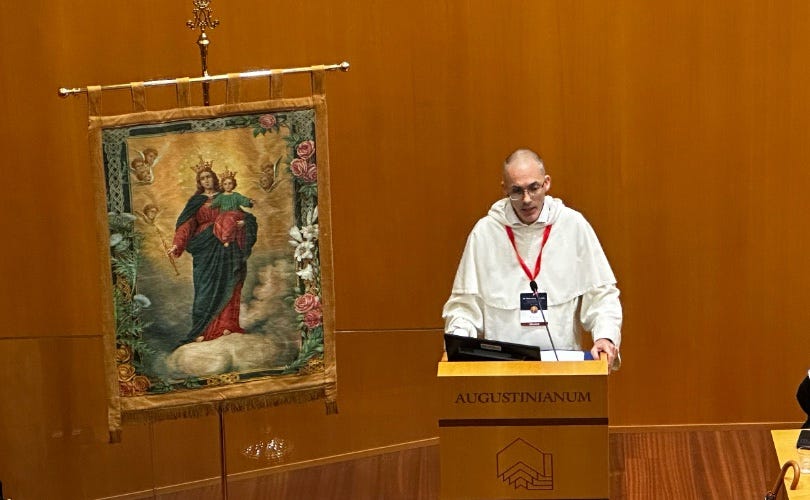
VATICAN CITY (PerMariam) — Editor’s note: Below is the full text of the address delivered by Father Thomas Crean OP, at the international Mariology conference held next to the Vatican on October 7 and 8.
Full updates from the conference can be found on Per Mariam here, with links to some of the talks published in full.

Father Thomas’ speech is found below, with grateful thanks to Father for allowing its publication.
In this talk, I shall begin by briefly looking at the origins of the Marian title ‘Destroyer of all heresies’ in the Latin liturgical tradition. I shall then look, briefly again, at some patristic passages that have a certain affinity with this liturgical tradition and which may possibly have influenced it. But the main part of my talk will be a theological meditation on this Marian title, in which I shall seek to understand both its suitability and its precise meaning.
1. Liturgical Origins
The assertion that the Blessed Virgin Mary has by herself destroyed all heresies throughout the world is one that has been made by the Catholic liturgy for over a thousand years. We find it present already in the oldest extant Latin office book. This is the antiphoner of Compiegne, or called the antiphoner of Charles the Bald; it was copied about the year 870. This assertion belongs not simply to one or other liturgical use, but rather to the common patrimony of the Roman rite. It is found in the office-books compiled by Humbert of Romans for the Dominican Order in the middle of the 13th century. The antiphon for terce in the office of our Lady on Saturday in these books runs as follows: “Gaude maria virgo cunctas haereses sola interemisti in universo mundo” [‘Rejoice, O Virgin Mary, thou alone hast destroyed all heresies in all the world.’] The tract of the Mass for our Lady on Saturdays during Septuagesima uses much the same words. This assertion was maintained in the breviary and missal of the Dominican Order, as in the breviaries and missals of the other uses of the Roman rite, until the liturgical reform of the 1960’s, when this antiphon and this tract were suppressed.
I should respectfully claim that the removal from all modern missals and breviaries of the assertion that our Lady has by herself destroyed all heresies is much to be regretted. Needless to say, however, the tranquil presence of this assertion through the whole Roman rite for more than a thousand years is ample reason for us to continue to repeat it. Cardinal Joseph Ratzinger, in an interview that he gave to the late Vittorio Messori, admitted that as a young theologian he had experienced problems both with the statement that our Lady has destroyed all heresies, and with the adage that forms the title of our colloquium, de Maria numquam satis. Later experience, as he ingenuously confessed, had worked within him a change of heart. He told Messori: “Now, in this confused period where truly every type of heretical aberration seems to be pressing upon the doors of the authentic faith – now I understand that it was not a matter of pious exaggerations, but of truths that today are more valid than ever.”
2. Patristic Roots
Although our phrase appears first in a liturgical context, it has roots in the writings of the Fathers of the Church. Speaking at the Council of Ephesus in the year 431, St Cyril of Alexandria declared that the title Theotokos, ‘Mother of God or God-bearer’, which the faithful had long been accustomed to give to our Lady, implied the true doctrine of the incarnation against Nestorius. In what has been described as the most famous Marian sermon of antiquity, St Cyril acclaimed Mary as ‘sceptre of orthodoxy or of right doctrine’, to skeeptron tees orthodoxias. “We salute thee, O Mary Mother of God”, said Cyril in the presence of the other bishops, “venerable treasure of the entire world, inextinguishable lamp, crown of virginity, sceptre of orthodoxy, imperishable temple, container of him who cannot be contained.”2
Another possible influence on the formation of our liturgical phrase is a letter of Pope Leo the Great to Flavian, archbishop of Constantinople. Having mentioned three of the principal points of Christian faith, namely belief in God the Father almighty, in Jesus Christ His only Son, and in the birth of Christ from the Holy Spirit and the Virgin Mary, St Leo concludes: “By these three assertions, the schemes of almost all heretics are destroyed.”3 This letter was famously read at the Council of Chalcedon in 451, provoking the cry: “Peter has spoken through Leo!”
A third patristic author who might be mentioned in this connexion is St Epiphanius. The 17th century Jesuit author Cristóbal de Vega, in his Theologia Mariana, refers us to Epiphanius’ Panarion or ‘medicine-chest’. In his description of the heresy of the so-called Antidicomarianites, ‘those who speak against Mary’, the bishop of Salamis quotes the phrase of the Apocalypse, Behold, the lion of the tribe of Judah … has conquered, and he adds that if the Lord is called a lion, “then I should call the mother who bore him a lioness”.4 Vega appeals to this passage as part of his own explanation of the title ‘destroyer of heresies’: “Like a lioness”, he writes, “she bore that undefeated Lion of the tribe of Judah, the vanquisher of heretical wickedness.”5
As a final patristic reference, we may mention the well-known Akathist hymn in honour of the Blessed Virgin, sung especially during Lent by Eastern Christians. Traditionally dated to the year 626 but perhaps written earlier, this Akathist greets our Lady, among numerous other titles, as “thou who hast quenched the furnace of error”. To quote from the translation of the hymn made in 1934 by the English Dominican Fr Vincent McNabb:
“Hail! Mother of the unsetting Star./ Hail! Splendour of the Mystic Day./ Hail! thou who hast quenched the fire of error./ Hail! thou who enlightenest the initiates of the Triune.” 6
3. Theological Meditation
I. Suitability of the title
Having very briefly sketched this patristic background for the liturgical assertion that Mary has brought to nothing all heresies, I’d like for the rest of my talk to attempt a theological meditation on this theme. First of all, I shall say why it seems fitting that Mary should have such a role within the Christian economy; secondly, I’ll try to consider more precisely what this title means.
a. Mother of the Word
Our Lady’s unique office as Mother of God makes it fitting that she should have a unique role in the overthrow of heresy. She is the mother of the Word incarnate. But heresy is a rejection of the word of God. Therefore already by virtue of her maternity of the Word, Mary is opposed to heresy in her very being. One of the litanies used in the Order of Preachers since the Middle Ages boldly invokes her as Sancta Maria generans aeternum lumen, “Holy Mary, generating the eternal light”. Christ, as He Himself says in St John’s gospel, has come as light into the world. But heresy is the attempt to quench this light in the participated form in which it exists within the human mind as the virtue of theological faith. Mary, therefore, as the Mother of God the Son who is the eternal light, must necessarily be in enmity with the darkness of religious error.
b. Socia Christi
Yet our Lady’s office is to be not only mother of our Lord but also His associate. She calls herself His handmaid, δούλη. Since the Middle Ages, she has often been spoken of as Christ’s socia, or companion. This title is found, for example, in the 13th century work called Mariale, formerly attributed to St Albert the Great. Mary therefore shares in her Son’s work, in the manner befitting a pure creature. But in the first epistle of St John we read that the Son of God appeared, that he might destroy the works of the devil, and one of the principal works of the devil is the lie. Heresy is the most pernicious kind of lie, since it is directed against divine truth. The devil, after all, was the first heresiarch. You will not die, he told Eve concerning the forbidden fruit. Notice that in this conversation with our first mother, he did not explicitly deny all the truths that she had learned from God. It was sufficient for him to persuade her to disbelieve one such revealed truth, namely the truth that she would harm herself by eating of the forbidden tree. As St Thomas Aquinas explains, the heretic by disbelieving a single truth revealed by God thereby loses supernatural faith in all the articles of the creed, since he has rejected the formal object of this virtue, the veracity of God who speaks. Our Lady, then, as handmaid and socia of the Son of God will be united with Him as He destroys this terrible work of the devil which is heresy.
c. Faith of Mary
Commenting on the verse of Isaiah chapter 63, I have trodden the winepress alone, and of the Gentiles there is not a man with me, St Thomas observes that the prophet here deliberately uses the word for a male human being, vir, “on account of the blessed Virgin, in whom faith never failed”. This observation of the angelic doctor corresponds to the Hebrew text, which in this verse uses the word ’ish, a male human being. There was no man with our Lord in His great act of redemption, in the sense in which there was with Him a woman, an ’ishah. The fathers of the 2nd Vatican Council agree with St Thomas: “The consent which she gave in faith at the Annunciation”, says Lumen Gentium, “[…] she sustained without wavering beneath the cross.”
On account, then, of this heroic faith, on account of her general participation in the work of her Son, and on account of her maternity of the Word, it was fitting that Mary should become the destroyer of all heresies throughout the world.
II. The meaning of the title
But how exactly does she accomplish this task? What is the proper meaning of this liturgical phrase? Like a diamond that gleams from various sides, the title ‘destroyer of all heresies’ has more than one sense. Allow me to mention three.
a. Mediatrix of all graces
First, and most generally, Mary has obtained and does obtain for us the graces that we ourselves need to combat heresy. As mediatrix of all graces, she has merited them for us in general by her charity on earth and she impetrates them for us individually by her prayer in heaven. Here we can think both of the graces that we need to resist the allure of some false doctrine that may appeal to our own pride or concupiscence, and also of the graces that we need to combat heresies that threaten the faith of others. Cristóbal de Vega in his explanation of the title ‘Destroyer of all heresies’ writes: “She assists the doctors and fathers strenuously and bravely rising up against heresies, giving help for the fight, as is clear in St Dominic battling the Albigensians.” But since it is not doctors and fathers alone, but all Catholics endowed with the sacrament of confirmation who must engage in such battles according to their competence and possibilities, she has a universal role in helping the Church on earth to resist false doctrine.
St Louis de Montfort, himself a Dominican tertiary, has expressed this idea with admirable clarity in his work True Devotion to the Mary. In paragraph 167, he writes as follows:
As it is Mary alone, says the Church (and the Holy Ghost, who guides the Church), who alone makes all heresies come to naught - Sola cunctas haereses interemisti in universo mundo - we may be sure that, however critics may grumble, no faithful client of Mary will ever fall into heresy or illusion, at least formal. He may very well err materially, take falsehood for truth, and the evil spirit for the good; and yet he will do even this with more difficulty than others. But sooner or later he will acknowledge his material fault and error; and when he knows it, he will not be in any way self-opinionated in believing and maintaining what he had once thought true.
That is, so to speak, a general office of the Blessed Virgin. But does she not also sometimes intervene in the Church’s doctrinal combats in a more direct, and even visible way? This brings me to the second of the three meanings which I see in this phrase, of our Lady as teacher within the Church.
b. Teacher in the Church
St Gregory of Caesarea, called Thaumaturgos or wonder-worker, was born around the year 213. His life was written by his namesake, Gregory of Nyssa. Nyssa records that on one occasion, while still a young man and shortly before his ordination to the priesthood, St Gregory of Caesarea was pondering at night-time over certain truths of the faith that were already being depraved by the heretics of his time, in particular the relations between the three divine Persons. Suddenly, he beheld in a vision the apostle St John and the mother of the Lord discussing the very subject which occupied his troubled thoughts. Astonished, he heard Mary requesting the evangelist to explain to the perplexed ordinand the truth that he was seeking, whereupon John recited a short creed, one not previously heard upon earth, beginning: “There is one God, the Father of the living Word, who is His subsistent wisdom and power and eternal image”. The whole of this profession of faith, which still exists, furnished Christians with a defence in advance against the Arianism that would break upon the Church, especially in the East, during the next century.
St John Henry Newman was deeply moved by Gregory of Nyssa’s narration of these events. He refers to them more than once in his works. Writing to his former co-religionist, the Anglican Edward Pusey, who had expressed an apparent distaste for the title ‘destroyer of all heresies’, Newman observes that in Gregory of Nyssa’s description, “our Lady is represented as rescuing a holy soul from intellectual error”.
I shall give a second example of what I mean by Mary intervening in a direct way in the Church’s doctrinal combats. Seventeen centuries after St Gregory the Wonderworker, there took place the events of Fatima. As we all know, our Lady taught the three shepherd children a new prayer and asked them to recite it at the end of each decade of the rosary. “O my Jesus, forgive us our sins; save us from the fires of hell; lead all souls into heaven, especially those in most need of thy mercy.” Perhaps I am wrong, but I have often thought that if belief in the existence of hell persisted among Catholics in the second half of the 20th century and to our own day, despite the doctrine being so rarely preached, this is due more than anything else to the recitation of that little prayer by countless faithful in parish churches across the world.
c. Divine antidote for each heresy
Yet even by such considerations as these we have not yet exhausted the significance contained in Mary’s title of ‘destroyer of all heresies’. From eternity, God sees all the heresies that are to trouble the Church down the centuries from the time of Simon Magus until the coming of antichrist. There must be heresies, observes St Paul, that they who are approved may be made manifest among you, and St Thomas notes that there never has been any age wholly free from them. Nevertheless, there will be a finite number of heresies in the history of the Church, though a number known to God alone. May we not therefore suppose that in His eternal idea of the Blessed Virgin, God willed in advance that each one of these heresies should find a direct refutation in some attribute or characteristic action of Mary? Thus, the Christian, by believing as he ought to believe about her, would inevitably and as it were instinctively reject each new error in the faith as it arose.
It seems to me that this is a hypothesis we can explore in an inductive way. So, please bear with me as, for the remainder of my talk, I briefly consider chronologically the main heresies that have arisen with the Church, and how the Blessed Trinity seems to have designed our Lady as not only a general but as even a specific antidote for each one.
i. Apostolic age
The first heresy, then, that we encounter in the history of the Church is simony: the belief that spiritual goods can be adequately paid for by temporal means. Mary’s divine maternity is already a rebuke to this false doctrine. No one, I think, could be mad enough to suppose that the payment of a sum of money would be sufficient to bring about the incarnation! She herself sings of the gratuity of God’s gift of His Son to the world: He hath regarded the humility of his handmaid… the rich he hath sent empty away.
St Paul records a second heresy that broke out during his life-time. In 1 Corinthians 15, we learn that some of those in the Church of Corinth were saying, in the middle of the 50s of the first century, that there is no resurrection of the dead. Writing to St Timothy, he notes that some have erred from the truth, saying, that the resurrection is past already. Presumably the heresy in question was one that spiritualised the resurrection of believers, saying that it consisted merely in the deliverance of the soul from sin, or perhaps, from matter. Against this error, the assumption of Mary into heaven, which must have taken place very close to the time when St Paul was writing to the Corinthians provides the perfect remedy. If she, the first of believers, has been taken into glory as to her body as well as to her soul, why should we not hope for a like resurrection?
Still within the apostolic age, we seem to find mention by St John of a third heresy. Every spirit which confesses that Jesus Christ is come in the flesh, is of God, he writes. By implication, certain false teachers, later known as gnostics, were already denying the reality of the incarnation and making our Lord’s human nature illusory. It is obvious that the veneration of the Mother of the Lord is a sure defence against this error.
ii. Patristic age
If we turn from the New Testament to the patristic period, we encounter the Trinitarian and Christological debates that dominated the first ecumenical councils. Here too, we can find that our Lady has a unique role in aiding the Church’s struggle against heresy. Catholics were protected against Arius’s claim that the Son of God was simply the most exalted of creatures for as long as they remembered that that position was, so to speak, already occupied. It is the Mother and not the Son who is the greatest of the works of God’s hands. As Newman would write to Pusey about the state of Christendom in their own time, the 19th century: “If we look through Europe, we shall find, on the whole, that just those nations and countries have lost their faith in the divinity of Christ, who have given up devotion to His Mother, and that those on the other hand, who had been foremost in her honour, have retained their orthodoxy.”
As for the other main Christological heresy, that of Nestorius, it is well-known how decisive was title Theotokos in breaking that error. While the doctrine of the incarnation could, abstractly speaking, be sufficiently defined simply by the use of terms such as ‘person’, ‘nature’, and ‘existence’, Nestorianism could not in practice have been expunged had the Council of Ephesus shrunk from defining the Theotokos. To be preserved in the truth, God’s people need a confession of faith that is not only theoretically incompatible with errors, but one that also confronts errors directly, in the form in which they actually exist in the world. For wars are fought not by ideas but by persons, and our Lady is victorious over heresies, not merely in the abstract, but in reality.
At the time that Nestorianism troubled the East, Pelagianism was disturbing the West. For Pelagius, man must achieve holiness by his own efforts, unaided by grace; and he can do so, for he is not fallen. Here too we find our Lady to be a providential protection against error. We believe in her Immaculate Conception; Mary was endowed with holiness, from the first moment of her existence; but not, therefore, through her own merits. At the same this grace has been defined by the Church as singularis, unique. The rest of us, contrary to Pelagius, are conceived in sin.
The last of the ecumenical councils of the patristic period was Nicaea II, called to deal with the iconoclasts. Here too, we can identify a unique role of the Blessed Virgin. It is not only that the Church was accustomed to venerate icons of our Lady, as well as of Christ and of the saints. There is also the fact that the legitimacy of iconodulia under the new covenant is itself a consequence of the incarnation. “I will not cease venerating matter”, wrote St John Damascene, “since matter has wrought my salvation.” While the faithful remember that the Son is made from the very matter of His mother – factus ex muliere, as St Paul says - they will not fear to venerate also the material things that represent Him. How fitting that Damascene, the great defender of the icons, should have benefitted, according to hagiographical and iconographical tradition, from a very material miracle worked through the intervention of Mary: the restoration of his severed hand.
iii. Mediaeval period
In the mediaeval period, I see three principal, new heresies: the denial of the Filioque, the denial of the real presence of our Lord in the Eucharist, and the denial of a visible hierarchy. The first of these, Photianism, or the denial of the eternal procession of the Holy Spirit from the Son, emerges in the ninth century, even if we find hints of it earlier among the Nestorians. Among his other arguments in defence of the Filioque, St Thomas Aquinas affirms that without this eternal procession, the Church would not truly be Christ’s own. “Christ Himself, the Son of God,” he writes, “consecrates and seals the Church to Himself by the Holy Spirit as by His own character and seal.”7 May we not likewise say that the eternal procession is also necessary for us to understand how Mary, prototype of the Church, is also truly His own? Christ Himself, we may say, consecrates and seals Mary to Himself by the Holy Spirit as by His own character and seal.
Next comes the denial of the real presence, and Berengarius’s purely symbolic account of the Eucharist in the 11th century. Pope St Gregory VII, in the profession of faith drawn up by the Synod of Rome in 1079 against this error, refers to the Blessed Virgin in defining the reality of our Lord’s presence in the sacrament: “After consecration, it is the true body of Christ that was born of the Virgin, and that, offered for the salvation of the world, hung upon the Cross.” The synod turns to Mary to emphasise the truth of Christ’s presence. Between the miracles of incarnation and transubstantiation there is so deep an analogy, as evoked by the custom of reciting the prologue to St John’s gospel at the end of the Roman Mass, that whoever believes whole-heartedly in the former will be as it were naturally inclined to believe in the latter too.
As for the recurring denials that troubled the end of the Middle Ages, of the very existence of a visible hierarchy in the Church, endowed with power from Christ independently of the merits of its occupants, we may perhaps refer to Mary’s spirit of obedience in submitting to the legal observances of the Old Testament, even when she was not strictly subject to them. Writing of Mary’s presenting herself before the priest on the fortieth day after Christ’s birth, St Thomas observes: “She wished to fulfil the observance of purification, not because she needed it, but on account of the precept of the Law”. Immaculate though she is, she submits herself to the priesthood of the Old Law. It is obvious that anyone who has meditated on her example will not be tempted to say, with the anarchist heresies, that authority and subjection within God’s people are determined by greater and lesser merits.
iv. Reformation period
We may turn now to the period since the end of the Middle Ages. What are the dominant heresies that the Master of the Household has permitted to grow among His wheat during these last centuries?
While the Reformation was in part a recrudescence of mediaeval errors, it was also surely the entrance within Christendom of some new spirit. How are we to characterise this spirit? It seems to me that the ‘specific difference’ of Protestantism, that which gives to it such unity as it possesses as well as a kind of tragic grandeur, is the attempt to deny true human causality in man’s relations with God. I say ‘the attempt’ to deny human causality, rather than the denial of it simpliciter, since it is clear that reality will constantly be forcing itself upon the Protestant theoretician, making it impossible for him to go all the way to the end in his denial. Thus, Luther himself had to allow to the human act of so-called fiducial faith a role in man’s justification.
Nevertheless, to this basic tendency, of denying human causality in man’s relations to God, we may, I think, trace classic Protestantism’s apparently disparate errors: justification without love (man does not have to detest his sins and turn to God with charity in order to be made right), double predestination (men are doomed to beatitude or woe independently of their own initiative), and sola scriptura (the whole of God’s word is to be found in texts that lie outside of us).
Here too, I should argue that our Lady is the antidote to a grave error. No one, after Jesus Himself, ever humbled himself more than Mary humbles herself before God. Yet no one shows more wonderfully than her how a pure creature does indeed co-operate with God. Ecce ancilla Domini … et Verbum caro factum est. Mary gave both her will and her substance to the Son of God. Some of the earliest versions of the Apostles’ Creed make this co-operation particularly striking by using the same preposition of both our Lady and of the Holy Ghost. The Son of God, they say, was born ex Spiritu Sancto et ex Maria Virgine. Again, one who meditates on this truth will be as it were immunised in advance against the Reformation spirit.
v. Modern times
We are approaching now more closely to our own times. What are the heresies that have troubled God’s people since Protestantism began to lose its spiritual momentum? Once again, I see three principal errors: rationalism, materialism, and modernism.
Rationalism denies that the Christian religion contains mysteries in the proper sense. In the famous phrase of Immanuel Kant, it seeks to confine “religion within the limits of reason alone”. Entering within the Church, rationalism sought to establish Catholic dogmas as necessary consequences of what reason can know about ‘spirit’ and ‘nature’. In this way, of course, faith loses its proper dignity, which is to be an assent, based simply on the truthfulness of God, to whatever God has revealed, and not to be the acceptance of the conclusions of a philosophical system.
Now, the rationalist theologian might think, albeit mistakenly, that he could prove by pure reason such dogmas as the Trinity, the Incarnation, the Fall, and the Redemption. He might even succeed in convincing his disciples that he had done so. But he could hardly suppose that he could demonstrate by a priori proofs that God had come into the world by a woman, indeed, by a mother. To quote St John Henry Newman once more:
If you would bring out distinctly and beyond mistake and evasion, the simple idea of the Catholic Church that God is man, could you do it better than by laying down in St. John’s words that “God became man”?; and again could you express this more emphatically and unequivocally than by declaring that He was born a man, or that He had a Mother? The world allows that God is man; the admission costs it little, for God is everywhere, and (as it may say) is everything; but it shrinks from confessing that God is the Son of Mary. It shrinks, for it is at once confronted with a severe fact, which violates and shatters its own unbelieving view of things; the revealed doctrine forthwith takes its true shape, and receives an historical reality; and the Almighty is introduced into His own world at a certain time and in a definite way.8
In other words the divine maternity, as it overthrew Nestorianism in the fifth century, must overthrow rationalism in the nineteenth. This is what Newman’s contemporary, the English Catholic poet Coventry Patmore, doubtless had in mind when he called Mary “our only Saviour from an abstract Christ”.9
So much for rationalism. Materialism, however, has wrought more havoc within mankind and therefore within the Church. We may say that the imaginations of men in the 19th and early 20th century were haunted by the fear that all reality could be explained as matter in motion, governed by inexorable laws. If I am not mistaken, we can find the echo of such fears even in the ‘dark night’ of Therese of Lisieux. Taking pity on weak human minds, our Lord placed His mother, like a sign in the heavens, to be a remedy against this confusion too. For the period of materialism was also the period of the multiplication of Marian apparitions: of La Salette, Lourdes, and Fatima. But if Mary can pass from heaven to earth and back again, as simply as we may walk into a room, why should we fear that our scientific instruments show us all that exists? And who will feel imprisoned by the inexorable laws of nature, who hears or reads about the miracle of the Sun?
In particular, as Pope St Pius X pointed out in his encyclical letter of 1904, Ad diem illum laetissimum, the Blessed Virgin overthrows the materialists’ account of human origins. The pope notes that “the enemies of religion” tend to begin their attack on Christianity by denying the perfection of our first parents when they came from the hand of God, and hence by denying, like Pelagius though for very different reasons, the fall and original sin:
All this rejected [writes the pope], it is easy to understand that no place is left for Christ, for the Church, for grace or for anything that is above and beyond nature; in one word the whole edifice of faith is entirely undermined. But let the nations believe and confess that the Virgin Mary has been from the first moment of her conception preserved from all stain; and it is straightway necessary that they should admit both original sin and the rehabilitation of the human race by Jesus Christ.
He adds that by this doctrine of the Immaculate Conception, “rationalism and materialism are torn up by the roots and destroyed.”
I should add that our custom of calling Mary ‘the new Eve’ also helps Catholics to continue to believe in the reality of our two first parents, while belief in her virginity helps to preserve belief in their special creation. Thus, echoing a common patristic theme, St Thomas Aquinas writes in his commentary on the Epistle to the Romans, that as Adam was formed from the earth without intercourse, so was the body of Christ from the Virgin.10
The mention of St Pius X brings us to our final heresy: modernism. While this error, like Protestantism, has much in common with errors that came before, it seems also, like Protestantism, to have introduced a new spirit within what remained of Christendom. How shall we characterise this spirit? It is, I think, the rejection of the very idea of faith itself as the acceptance of propositions communicated to us by God. Whereas the Catholic accepts that faith is, in the words of the anti-modernist oath, “a real assent of the intellect to truth received by hearing from an external source, [an assent] by which we believe to be true that which has been said, attested to and revealed by a personal God”, the modernist, says Pius X, makes faith into, “a blind sense of religion, bursting up from the hidden places of the subconscious”: what today we might call “an experience of transcendence”. On this view, dogmas are only an attempt, worthy perhaps but inevitably flawed, to record such experiences and to evoke them again in ourselves and in other people.
It is not hard to see why in his encyclical letter Pascendi, the same pope referred to modernism as a synthesis of all heresies. Even if the dogmas remain externally intact, the modernist voids them of all definite content. It is as if all the bottles in St Epiphanius’s medicine chest had been secretly filled with unknown liquids, while retaining the same labels as before.
How is our Lady a remedy for this heresy? She is the archetype of all who receive divine revelation from without. When she first appears in the gospel, it is as one who hears the word of God from an external source, that is, from St Gabriel, and who responds to it in faith. She believes all the propositions communicated to her by God through His angelic messenger, and therefore, as St Elizabeth says, she is blessed.
It is not surprising, finally, that the pope who first spoke of this synthesis of all heresies should also be the pope who, to my knowledge, first invoked our Lady in a letter written to all the bishops as destroyer of all heresies. At the end of Pascendi, he prays thus for his brethren in the episcopate: “May Jesus Christ, the author and finisher of our faith, be with you by His power; and may the Immaculate Virgin, the destroyer of all heresies, cunctarum haeresum interemptrix, be with you by her prayers and aid”.
Quoted in Manfred Hauke, Introduction to Mariology (CUA, 2021), 4-5.
PG 77:992
Letter 28, PL 54:757.
Panarion 78.12.5
Theologia Mariana 1122.https://books.google.co.uk/books?id=mz3ygRnoyjUC&pg=PA467&redir_esc=y#v=onepage&q&f=false
https://isidore.co/CalibreLibrary/McNabb,%20Vincent,%20O.P_/Akathist_%20An%20Ancient%20Hymn%20to%20Our%20Lady%20(10289)/
Contra errores Graecorum, 2.32.
‘The Glories of Mary for the Sake of Her Son’, discourse 17 in Discourses to Mixed Congregations.
The Child’s Purchase’, in Songs of the Unknown Eros.
Commentary on the Epistle to the Romans, cap. 5, lect. 4.

So grateful for an excellent presentation, Fr Crean. Coventry Patmore’s reference to Our Lady as “our only Saviour from an abstract Christ” is applicable as well today, only at present she is the antidote to an “abstract Church.” Despite the suggestion that one can be faithful to an “eternal Church” of sorts, her concrete motherhood weds us to the visible hierarchy, for which we pray and to whom we owe concrete allegiance.