


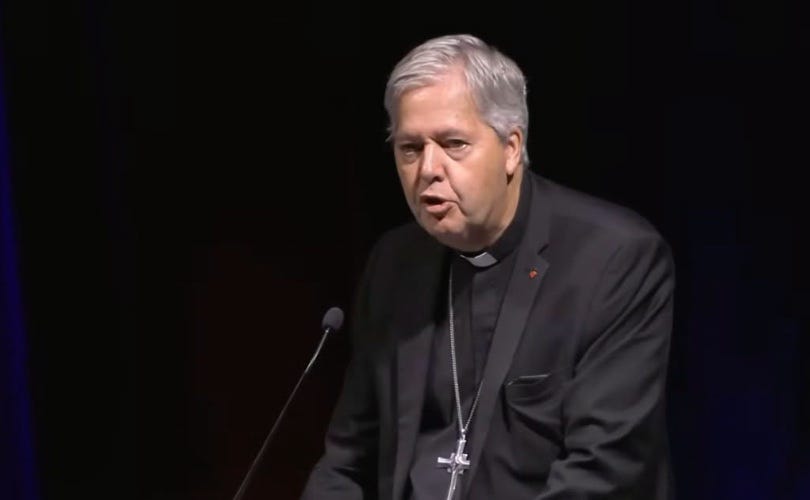
Editor’s note: The following is a guest commentary by Bishop Robert Mutsaerts, the auxiliary bishop of the Diocese of ‘s-Hertogenbosch. He warns there is a move in the Church to change doctrine, not by clear methods, but by ignoring it over long periods of time and allowing it to evaporate through the practice of the opposite of such teaching.
(PerMariam) — Over the course of two thousand years, the Catholic Church has endured just about everything that can happen to an institution: bad popes, corrupt bishops, heresies, schisms, revolutions, persecutions, decadent monasteries, dissolute clergy, and theologians so determined to be original that, in the end, they were the only ones who still understood what they meant.
And yet the Church is still here. Not because Catholics have always been sensible. That would be a rather daring historical hypothesis. The Church survived because, time and again, one remarkable phenomenon occurred: once the smoke had cleared, the quarrels subsided, and the intellectual acrobatics exhausted themselves, Catholic orthodoxy proved to have extraordinary staying power. Arius disappeared; Nicaea remained. The Cathars disappeared; the Creed remained. Jansenism, Modernism, and dozens of other fashions arrived proclaiming themselves the future and ended up as footnotes. Catholicism has a fairly simple litmus test: continuity. Hence the importance of Tradition, of the faith handed down to us.
That does not mean that nothing may ever change. The liturgy has developed, canon law has changed, ecclesiastical disciplines have been modified, and theological formulations have been refined. An oak tree looks different after five hundred years than it did when it was an acorn. But when a tulip suddenly grows out of that acorn, “development” is no longer the right word.
And that is precisely the problem at the heart of the present crisis in the Church. There is no spectacular storming of the Vatican. First, the doctrine remains unchanged. The modern ecclesiastical formula runs more or less as follows: “Of course the teaching does not change, but our pastoral approach must change.” That sounds reassuring—until pastoral practice spends years communicating precisely the opposite of the teaching that supposedly remained unchanged.
Take Germany. The German Synodal Way has not merely discussed administrative reforms or better oversight of episcopal authority. Its official agenda included sexuality, homosexuality, the role of women in ecclesiastical offices, and the structure of authority within the Church. In 2023, the Synodal Way even adopted a resolution calling for official blessing ceremonies for, among others, same-sex couples and divorced-and-remarried couples, complete with liturgical forms to be developed for the purpose.
Rome itself recognized the problem. In 2022, the Holy See explicitly stated that the German Synodal Way had no authority to impose new forms of governance or new directions in matters of doctrine and morals, since doing so could constitute a “wound to ecclesial communion” and a threat to the unity of the Church. That is quite a statement. When Rome has to publicly warn a process led by bishops that it may not introduce a new morality, we are clearly talking about more than a few unfortunate excesses.
And yet the process continues. In April 2025, representatives of the German Bishops’ Conference and the ZdK issued guidelines explicitly encouraging blessings for divorced-and-remarried people, couples of every sexual orientation, and other couples not married in the Church. And once again, the argument is not “the old teaching was wrong,” but rather, “We accompany people.” Not: “Morality has changed.” Rather: “This is pastoral closeness.” Anyone who objects quickly finds himself assigned the curious role of Pharisee. The reformer possesses love; the orthodox Catholic apparently possesses nothing but the rulebook. Rhetorically, it is remarkably effective.
The same problem became visible with Fiducia supplicans. That 2023 document formally and explicitly upholds Catholic teaching on marriage. It even states that same-sex unions must not be confused with marriage and that the blessings in question must not take on a liturgical form resembling a wedding. At the same time, however, it permits same-sex couples to receive spontaneous blessings. One would have to be extraordinarily naive to imagine that symbolic actions communicate no message.
One day after the document was published, the American Jesuit James Martin blessed a civilly married same-sex couple in New York, with the press present. Formally, one can say: no marriage was celebrated. Materially, half the world saw two men living as a married couple receiving a blessing together from a Catholic priest.
And once again that curious distinction appears: “What you see is not what we mean.” In the long run, that is a difficult pastoral strategy. The sacramental language of the Church is, after all, built precisely upon visible signs. Having spent centuries teaching that gestures have meaning, we can hardly turn around and claim that an ecclesiastical blessing can only be properly understood by consulting the footnotes of a Roman document.
Then there is Bishop Johan Bonny of Antwerp. In March 2026, he stated that he intends to ordain married men to the priesthood in Antwerp in 2028—after an extremely short period of preparation; the priesthood genuinely requires several more years than that. He even framed the matter as though, in his view, the question were no longer whether it would happen, but when. Candidates are already being prepared, even though actual ordination would still require permission from Rome.

And that is precisely what makes the case so illustrative of a new style of Church governance. First one creates the expectation. Then one organizes the practice. Finally, one asks Rome to regularize the reality that has meanwhile been created. The question is no longer, What does the Church permit? but rather, What can we start doing now so that it will later become difficult for the Church to reverse it? That is not synodality. That is theology by fait accompli.
And this brings us to Pope Francis. His pontificate fostered a culture in which ambiguity was strikingly often interpreted in a progressive direction. The formula was more or less always the same: the teaching remains intact, but the concrete case is complicated; norms continue to exist, but discernment is necessary; doctrine is clear, but pastoral application may vary.
In itself, there is nothing un-Catholic about that. Thomas Aquinas also understood that prudentia must be applied to concrete circumstances. But when virtually every exception moves in the same direction, it becomes legitimate to ask whether we are still dealing with exceptions at all.

There is reason for concern. Why? Read Church history. Ecclesiastical revolutions rarely begin with the announcement: “Starting Monday, we are abolishing two thousand years of Catholic tradition.” They proceed differently.
First it is said that a teaching has been “misunderstood.” Then that the terminology is “hurtful.” Next, that nobody wants to change the teaching, but that “pastoral space” is needed. Local experiments then emerge. The experiments become practice. Practice creates expectations. Expectations become “lived reality.” And finally, those who continue to defend the original teaching are asked why they cling so rigidly to a formulation that has supposedly become outdated.
That is the Quiet Revolution. Not the denial of dogma, but its evaporation. Not: “This is no longer true,” but: “We need to speak about this in a more nuanced way nowadays.” Not: “The Sixth Commandment no longer applies,” but: “We must avoid burdening people with rules.” Not: “The priesthood is changing,” but: “The needs of the local community require new forms.” In this way, a teaching can remain formally present in the Catechism for decades while becoming increasingly irrelevant in pastoral practice.
Sometimes the Church must find new words in order to proclaim the same truth intelligibly. But precisely for that reason, the decisive question is not: Is something changing? The question is: Can what is changing still be recognized as an organic development of what came before, or does it constitute a rupture with it? That is why continuity is not a hobby for nostalgics. It is a Catholic criterion. The Catholic question is never merely: “Is this kind?”, “Is this inclusive?”, “Does this work pastorally?” The decisive question remains: Is this the same faith we received? The faith of Paul, of Augustine, of Thomas Aquinas, of Trent, of Newman, of John Paul II, and of Benedict XVI.

Perhaps the greatest irony of the present situation is that progressive reforms have now been marketed for sixty years as necessary in order to make the Church more attractive to modern man. Meanwhile, churches in strongly secularized countries continue to empty. Perhaps modern man is less impressed than we thought by a Church that tells him what he already read in yesterday’s newspaper. Why should anyone get up early on a Sunday morning merely to hear in a church building the same morality he was given free of charge on a Saturday-night talk show? When, after a while, there is no one left in the pews, one may congratulate oneself for having reached the prophetic vanguard. But there is another possibility: one may simply have taken a wrong turn.
The Church possesses only one genuinely revolutionary product: the Gospel. And unfortunately for the marketing department, that product cannot be adapted to suit the market. Christianity did not begin because twelve apostles decided that they needed to align themselves more closely with the Roman Zeitgeist. They proclaimed something their contemporaries sometimes found beautiful, sometimes insane, and sometimes offensive. For doing so, they were not invited to take a seat at the synodal discussion table. They were killed.
+Rob Mutsaerts
