


Editor’s note: The following is a guest commentary by Monsignor Martin Grichting, an esteemed professor of canon law, the emeritus Vicar General of the Diocese of Chur and a former consulter for the Congregation for the Clergy in the Vatican.
Mgr. Grichting writes regarding Amoris Laetitia, ahead of the high profile meeting due to be held in the Vatican next week to mark the 10th anniversary of the text. (A preview of the meeting by this correspondent can be read at the Catholic Herald)
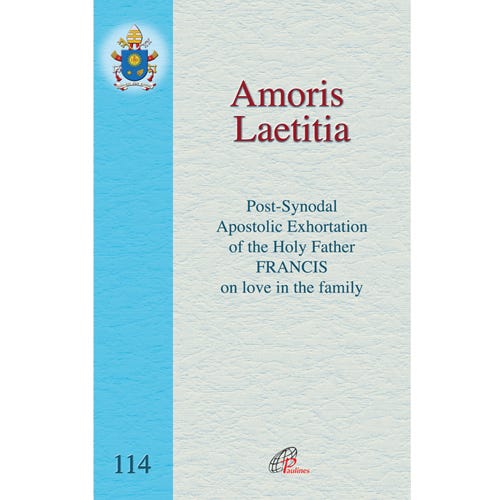
(Per Mariam) — The Apostolic Exhortation Amoris Laetitia (AL) is a masterstroke. It consists in maintaining the Church’s teaching in theory, whilst abolishing it in practice. For it is now incumbent upon priests and other ‘accompanists’ to make ‘pastoral discernments’ in their own name concerning people living in adultery. If there are good reasons, may such people then receive the sacraments of the Eucharist and Penance without changing anything about their behaviour, which breaks the bond of marriage.
The Word of God and the Church’s teaching are pulverised by ‘pastoral discernment’ into a thousand incomparable individual cases. And anyone whose way of life runs counter to the Church’s teaching will find an understanding ‘companion’ and ‘discerner’ who recognises justifiable reasons which, in a specific case, make it possible to do what one is not allowed to do. The floodgates are wide open to arbitrariness. Since the publication of AL, the Church no longer knows what is happening. Nor does it wish to know any more.
Historical precedent
This AL ploy is not being employed for the first time. It was the Jesuits who, as far back as the 17th century, employed the trick of the ‘justified individual case’. The only difference from today is that those Jesuits were not popes.
In his “Lettres Provinciales” (“The Provincial Letters”, 1656/1657), Blaise Pascal (1623–1662) exposes the Jesuits’ approach. He does so through a dialogue with a fictional model Jesuit. “One cannot be too minute in particularising cases,” Pascal quotes his interlocutor as saying (Letter 8). The linchpin of the Jesuit ruse is the concept of ‘probability’. This does not mean probability in the modern sense, but rather an opinion that can be justified on sound grounds. “It is the foundation, the very A, B, C, of our whole moral philosophy,” as Pascal’s Jesuit observes (5th Letter).
According to the Jesuit Escobar, probability is to be understood as follows: “An opinion is called probable when it is founded upon reasons of some consideration. Hence it may sometimes happen that a single very grave doctor may render an opinion probable. For a man particularly given to study would not adhere to an opinion unless he was drawn to it by a good and sufficient reason.”
Even back then, Pascal sensed that this circular line of reasoning lay at the root of all confusion and arbitrariness, and retorted: “Who can assure me, considering the freedom your doctors claim to examine everything by reason, that what appears safe to one may seem so to all the rest? The diversity of judgements is so great”. A war of words ensues. The Jesuit admits that casuists often hold differing views: “No doubt they are often of different sentiments, but what signifies that? Each renders his own opinion probable and safe.” And that is a good thing. Pascal retorts: “But, father, a person must be sadly embarrassed in choosing between them!” To this, the Jesuit replies: “Not at all, he has only to follow the opinion which suits him best.” Pascal objects: “What if the other is more probable and safer?” The Jesuit, however, quotes an author from his order: “A person may do what he considers allowable according to a probable opinion, though the contrary may be the safer one. The opinion of a single grave doctor is all that is requisite.”
The doctrine of probability also binds the confessor. Pascal’s model Jesuit explains it as follows: “We have bound them to absolve their penitents who act according to probable opinions, under the pain of mortal sin, to secure their compliance. ‘When the penitent,’ says Father Bauny, ‘follows a probable opinion, the confessor is bound to absolve him, though his opinion should differ from that of his penitent.’”
One can already read in Pascal’s work where the trick of probabilism ends. He quotes a Jesuit author who maintains “that persons of every description, and even priests, may receive the body of Jesus Christ on the very day they have polluted themselves with odious crimes; that, so far from such communions implying irreverence, persons who partake of them in this manner act a commendable part; that confessors ought not to keep them back from the ordinance, but, on the contrary, ought to advise those who have recently committed such crimes to communicate immediately; because, although the Church has forbidden it, this prohibition is annulled by the universal practice in all places of the earth.” And Pascal remarks: “See what it is, fathers, to have Jesuits in all places of the earth! Behold the universal practice which you have introduced, and which you are anxious everywhere to maintain!” (16th Letter).
The reality that has in fact been created thus ultimately transforms the theoretical superstructure and triumphs over it. In the “Communist Manifesto” of 1848, Karl Marx and his comrades put it this way: “Does it require deep intuition to comprehend that man’s ideas, views, and conception, in one word, man’s consciousness, changes with every change in the conditions of his material existence, in his social relations and in his social life?” Against the backdrop of the 17th-century Jesuits, Marx appears to be an imitator.
The issue of adultery, which AL addresses, is also discussed by Pascal. He has his Jesuit interlocutor quote the aforementioned Father Étienne Bauny. The latter is said to have permitted those who were caught up in circumstances likely to lead to sin to remain in that situation, “when they cannot avoid them without becoming the common talk of the world, or subjecting themselves to inconvenience.
A priest, he remarks in another work, may and ought to absolve a woman who is guilty of living with a paramour, if she cannot put him away honourably, or has some reason for keeping him, provided she promises to act more virtuously for the future.” For the following applies: “One may seek an occasion of sin, directly and expressly- primo et per se- to promote the temporal or spiritual good of himself or his neighbour.” Pascal remarks on this: “Well, father, you have certainly succeeded in relaxing the obligation of avoiding the occasions of sin to a very comfortable extent, by dispensing with the duty as soon as it becomes inconvenient.” (Letter 10).
The significance of Pascal’s “Provincial Letters” lies not least in the fact that he demonstrates that the ‘probability and individual case’ argument can be applied to all manner of topics: murder is no longer murder if it is not committed for money; the obligation to support the poor out of one’s material abundance does not arise in practice, because the rich are, after all, legitimately entitled to maintain their own standard of living first, and so in fact nothing remains for others. Whether the issue concerns killing and revenge, duelling, theft and property, usury, lying, oaths, as well as deception and simoniacal or unauthorised dealings in ecclesiastical matters: in theory, the norm remains entirely intact. But through ever more subtle casuistic distinctions and conceptual differentiations, ‘plausible’ opinions are used in practice to permit behaviour that materially contradicts what the norm requires (Letter 6 and following). Pascal sums up where this leads by quoting a critic of the aforementioned P. Bauny. The latter is said to have remarked about this Jesuit: “Ecce qui tollit peccata mundi!” (”Behold the man that taketh away the sins of the world!”) (4th Letter).
Effects of Amoris Laetitia today
The probability and case-by-case method can still be applied universally today. Given that it is once again being promoted by a Pope, this is all the more true. If one can deconstruct the indissolubility of marriage, one can deconstruct anything on the basis of probable, justifiable grounds.
AL is therefore a boomerang that will come back to strike the Church’s Magisterium. For one can put forward justifiable counter-arguments against anything and everything. Even the positions on climate change, just war, the death penalty, migration and AI – so dear to the last two popes – are then merely probable opinions, against which there are contrary probable opinions that, on a case-by-case basis, one can just as legitimately prefer to the papal ones.

In this vein, Pascal quotes the Jesuit Diana: “The pope, I grant, has said it as the head of the Church; but his decision does not extend beyond the sphere of the probability of his own opinion.” And Pascal’s Jesuit interlocutor adds: “Now you perceive this is not doing any harm to the opinions of the popes; such a thing would never be tolerated at Rome, where Diana is in high repute. For he does not say that what the popes have decided is not probable; but leaving their opinion within the sphere of probability, he merely says that the contrary is also probable.” (6th Letter).
It is not only the Ten Commandments that can be deconstructed, but also ecclesiastical discipline. A statement issued by the Swiss Bishops’ Conference in November 2025 represents a further development of the AL method in this regard. In it, the Conference refrains from demanding consistency from lay church workers. Referring to AL, it states, with regard to laypeople living in extramarital, adulterous or same-sex partnerships: “Rather, we present an assessment that takes current life realities seriously and invites spiritual discernment. A person’s life situation is unique, and one can only act justly in accordance with the Gospel if one takes this into account in its entirety. Two people may do the same thing, yet it is not the same thing.” Pascal would have remarked on this: “They conceal their carnal and worldly policy under the garb of divine and Christian prudence.” (5th Letter).
Every professor of theology at a German state university also puts forward probable opinions when he contradicts the Church’s magisterium, be it regarding the doctrine of God, ecclesiology or ecclesiastical discipline. As long as he also regards the Church’s opposing position as a probable opinion, he has nothing to fear. The same applies to the state bishops on their synodal path.
The AL method as ‘probabilism 2.0’ and the non-transparent ‘discernment’ of individual cases behind closed doors by means of probable opinions – this is the foundation of a suicidal Magisterium that is deconstructing itself. This process will stop at nothing.
The de facto destruction of the Church’s doctrine of the faith will increasingly undermine, in the hearts of the faithful, their trust in the divine assistance of the Church’s Magisterium and, with it, their faith in God. This can only be averted by correcting AL through the Magisterium in accordance with the Church’s perennial teaching. The Church’s unity depends on this.
In the 17th century, the Church was aware of the danger that threatened it. Thus, in 1665 and 1666, the Holy Office (now the Dicastery for the Doctrine of the Faith) condemned 45 propositions put forward by casuists (Denzinger-Hünermann [DH], 17th edition, Freiburg/Basel/Vienna 2017, nos. 2021–2065). A further 65 propositions followed in 1669 (DH 2101‒2165). These contain points that are also relevant in relation to AL.
DH 2061 is particularly pertinent: “A man living with a concubine is not to be obliged to dismiss her if she is exceedingly useful for his comfort or pleasure – commonly called ‘regalo’ – when, without her, he would find life too burdensome, other food would cause him great distaste, and another maid would be too difficult to find.” The sleight of hand – condemned by the Church – is already being employed here, just as it repeatedly surfaces in the AL debate and in the discussion on the remarriage of divorcees: in reality, she is a concubine. But by means of a shift in terminology, she is turned into a housekeeper. And the poor man would have to eat worse food if he were to send his ‘cook’ away. Among today’s (papal) AL casuists, it is no longer the less palatable food that is put forward as a reason for keeping a concubine, but rather, for example, children, for whom one must, after all, have some concern.
AL also contradicts the Church’s condemnations on the following points. DH 2160: “A penitent who is habitually accustomed to sin against the law of God, of nature, or of the Church may be granted absolution even when there appears to be no hope of amendment; nor must absolution be denied or deferred, provided that he declares verbally that he is sorry and promises to amend”. DH 2161: “A person who is in a proximate occasion of sin may sometimes be absolved even though he can avoid that occasion but is unwilling to do so; indeed, even if he directly and deliberately seeks it or places himself in it.” DH 2162: “One is not obliged to avoid a proximate occasion of sin when there is some useful or honorable reason for not avoiding it.” DH 2163: “It is permissible directly to seek a proximate occasion of sin for the sake of some spiritual or temporal good, whether our own or our neighbor’s.”
By virtue of his magisterial authority and the primacy of his jurisdiction, it falls to Pope Leo XIV to protect the Church today from pernicious teachings. In his encyclical Magnifica humanitas, he has demonstrated that he also takes seriously authors who do not belong to the classical canon of Catholic teachers of the faith (J. R. R. Tolkien, Hannah Arendt, Viktor Frankl).
Leo XIV should therefore heed Heinrich Heine’s words regarding AL. For fools often speak the truth. In “Die romantische Schule” (1833), the German writer remarked on Pascal’s opponents: “Never has the human mind devised greater schemes than those by which the old Jesuits sought to preserve Catholicism. But they did not succeed, because they were enthusiastic only for the preservation of Catholicism and not for Catholicism itself. (…). Yet in vain did their confessors grant the kindest absolutions, and their casuists pander to every vice and crime. (…). Barrault was right when he once said: The Jesuits could not raise the earth to heaven, and they dragged heaven down to earth. All their deeds and labours were fruitless. No life can blossom from a lie, and God cannot be saved by the devil.”