


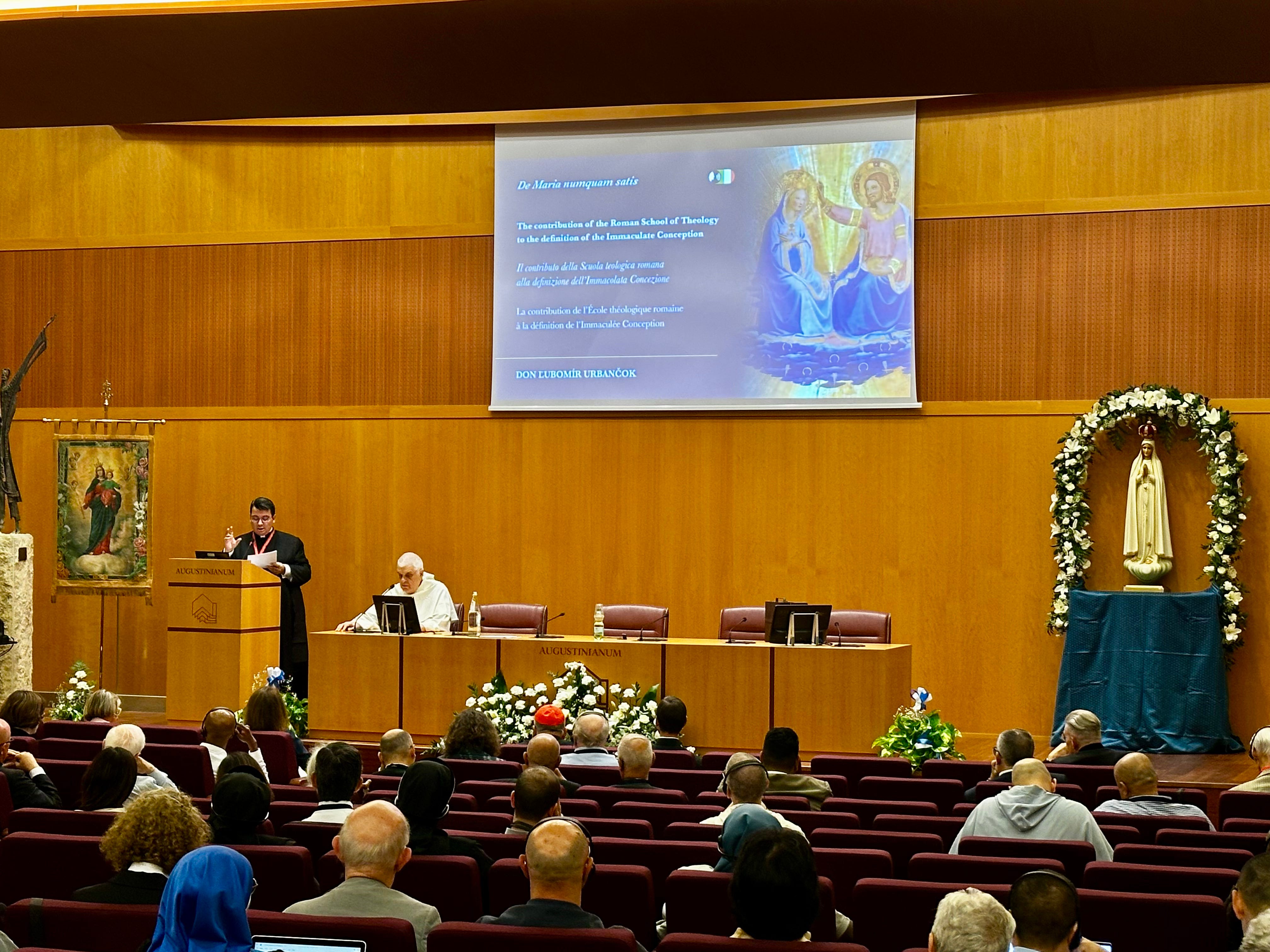
VATICAN CITY (PerMariam) — Editor’s note: the following is the full text of the address delivered by Father Ľubomír Urbančok at the Augustinianum in Rome, October 7, 2026. It was given at the “De Maria numquam satis” conference, on which full, live updates can be found here. It is published here upon Fr. Urbančok’s permission.
The contribution of the Roman theological school to the dogmatic definition of the Immaculate Conception of the Blessed Virgin Mary.
By Father Ľubomír Urbančok
“What a life of self-denial they lead as regards the enjoyments of this world! They have no pleasure in life. On a cold evening I go to Father Repetti, one of the confessors, in order to keep myself awake—or rather, perhaps, to keep myself from growing dull. I find him in an inhospitable room; neither door nor window closes properly; there is, of course, no fire; a wretched bed, a few modest pictures upon the walls, several books upon a shelf. Yet the room is perfectly clean, and he is reading. What can he look forward to in this life? Nothing. Nothing sustains him except the thought of the world to come.”
These words of Saint John Henry Newman, Doctor of the Church, evoke a chapter of ecclesiastical history that has today been almost forgotten, as well as the fervour of that army of God — the religious order founded by Saint Ignatius of Loyola for the service of the Church and the Kingdom of God. The Roman College in particular exercised a profound influence upon nineteenth-century theology, upon the preparation of the dogma of the Immaculate Conception, and ultimately upon both the course and the doctrinal theses of the First Vatican Council. Its influence was exerted above all through the hundreds of European bishops who received their intellectual and ecclesiastical formation within its walls.
Following his conversion to the Catholic faith, Newman encountered in Rome the restored Society of Jesus and the Roman College once again entrusted to its care. These events are also presented in an engaging and historically informed manner in Father Joseph Carola’s historical novel Dragons, which was presented to the public only a few days ago.
The beginning of the nineteenth century was marked by a decline in theology, particularly in speculative theology, whose roots reached back into the eighteenth century. Rationalist philosophy, Jansenism, and the abandonment of the older scholastic tradition all contributed to this decline. No less significant was the suppression of the Society of Jesus in 1773, since its members had numbered among the foremost defenders of the true faith against unbelief and Jansenism.
Pius VII restored the Society of Jesus in 1814, and in 1824 Leo XII returned the direction of the Roman College to the Society. The restored Order thus re-entered the service of the Church at a time when the challenge was no longer merely that of overcoming theological decline. The Church was compelled to confront fideism, rationalism, and naturalism, while at the same time facing the mounting pressure of the revolutionary movement that would ultimately lead to the dissolution of the Papal States.
In these struggles, the Jesuits became a particular target of the revolutionaries. During my archival research, I encountered records indicating that in Ferrara they were virtually the only ecclesiastical force that constituted a serious obstacle to the revolutionary movement. Consequently, in February 1831, the revolutionaries, in cooperation with the Freemasons, succeeded in having them expelled from the city. At that time the local Jesuit community was headed by Father Giovanni Perrone, one of the first and undoubtedly the most important theologians of the restored Roman College.
The Roman School thus took shape amid turbulent circumstances: first came the exile from Ferrara, followed by the Revolution of 1848, which drove Pius IX to Gaeta and the Jesuits to England. Nevertheless, its theologians exercised a remarkable influence upon the life and doctrine of the Church. Perrone, Carlo Passaglia, and Clemens Schrader made major contributions to the preparation of the dogmatic definition of the Immaculate Conception. Later, the Roman School would likewise exert a decisive influence upon the First Vatican Council.
Giovanni Perrone was born on 11 March 1794 in Chieri, Piedmont, and died in Rome on 28 August 1876. After completing his theological studies in Turin, he entered the restored Society of Jesus and was subsequently entrusted with the chair of dogmatic theology. Between 1835 and 1842 he published the nine-volume Praelectiones theologicae, which became the foundation of the theological curriculum at the Roman College. During the nineteenth century the work appeared in eighty-one editions—thirty-four editions of the complete work and forty-seven editions of the two-volume compendium—and circulated throughout the world. Newman would later remark that the Praelectiones remained a lifelong point of reference in his theological work.
One section of the Praelectiones is devoted to Tradition. There the Fathers of the Church appear both as witnesses and as teachers. As witnesses, they transmit the apostolic Tradition: “The testimony of the Fathers not only expresses the apostolic Tradition but embodies it.” From these principles Perrone would later develop his answer to the question why the Fathers of the earliest centuries remain silent concerning the Immaculate Conception.
Through the Praelectiones, the influence of the Roman College extended throughout the continent. Approximately three hundred future bishops passed through the College during the nineteenth century. Perrone’s student Heinrich Denzinger incorporated his objections to the fideist Louis Bautain into the Enchiridion symbolorum (1854). A contemporary French edition described Perrone as “the prince of contemporary theologians.” From 1854 Perrone served as a consultor to the Congregation of the Index, and one year later he also became involved in the preparation of the Syllabus of Errors.
“Non sumus episcopi, sed facimus episcopos—We are not bishops, but we make bishops,” Perrone once remarked, referring to the great number of his students who were consecrated to the episcopate. He enjoyed a close relationship with Popes Gregory XVI and Pius IX, with whom he served as a consultor to the Congregation for Bishops. Leo XIII was among Perrone’s most distinguished students. Perrone made a major contribution to the papal Magisterium. Pius IX wished to reward him by creating him a cardinal. The Jesuit Superior General, however, prevented the honour, wishing to preserve the scholar’s tranquillity so that, instead of the purple, he might retain his quiet study and the faithful companionship of his books.
A special place in Perrone’s work—and consequently in the present lecture—is occupied by his treatise De immaculato B. V. Mariae conceptu, published in 1847.
Another protagonist of the Roman School who played a major part in the definition of the dogma was Carlo Passaglia. Walter Kasper, in his habilitation thesis on the Roman School, describes him as its most brilliant theologian. Together with Matthias Joseph Scheeben, Passaglia ranks among the most important theologians of the period. He was born in Lucca on 2 May 1812 and entered the Society of Jesus at the age of fifteen.
In collaboration with Clemens Schrader, he published the three-volume De immaculato Deiparae semper Virginis conceptu in 1854–1855. Pius IX regarded it as a fundamental contribution to the preparation of the dogma and called Passaglia the Advocatus Immaculatae. The work reveals the depth of the knowledge of Scripture and the Fathers cultivated at the Roman College.
Their collaboration was interrupted in 1857 when Schrader was transferred to Vienna in connection with the events surrounding the Roman convent of Sant’Ambrogio. Passaglia took this development hard. He relinquished his teaching duties and left the Society of Jesus in 1859. Increasingly serious conflicts with ecclesiastical authority followed, eventually culminating in his suspension a divinis. In his writings he advocated the unification of Italy and urged the Pope to renounce temporal sovereignty. The man who had once defended the Immaculate Virgin as the Advocatus Immaculatae returned to full communion with the Church four days before his death. His return seems almost to confirm the ancient maxim: Servus Mariae numquam peribit—the servant of Mary shall never perish.
At the beginning of the nineteenth century, the popes promoted devotion to the Immaculate Conception principally by approving religious communities and granting liturgical privileges. In 1806 Pius VII permitted the Franciscans in the Kingdom of Naples to employ the expression in conceptione immaculata in the Preface. In 1816 the first petition for a solemn definition came from Spain. In 1824 Leo XII assured theologians bound by oath to follow Saint Thomas that, in defending the Immaculate Conception, they were not violating that oath.
The apparition at the Rue du Bac constitutes an extraordinary chapter. In November 1830, while Saint Catherine Labouré was at prayer in Paris, the Blessed Virgin Mary appeared to her. She stood upon a globe, with rays streaming from her hands. Around her appeared the invocation: “O Mary, conceived without sin, pray for us who have recourse to thee.”
Under Gregory XVI, individual expressions of support developed into a powerful movement in favour of a definition. Permissions to employ Marian formulations in the liturgy and the litanies multiplied, so that this conviction entered ever more clearly into the public prayer of the Church. In 1840 ten French archbishops and forty-one bishops petitioned for a definition. They emphasised that the doctrine was professed by almost the entire Church dispersed throughout the world—quam fere tota dispersa credit Ecclesia (Pareri IX, 16). Between 1843 and 1845 approximately forty further petitions reached Rome, principally from Sardinia and the Kingdom of the Two Sicilies, but also from the missions (Roskovány IV, 67–104).
In 1843 Cardinal Lambruschini, Gregory XVI’s Secretary of State, published the treatise Sull’immacolato concepimento di Maria. Dissertazione polemica. There he assembled the arguments in favour of the privilege: its fittingness and the testimony of Scripture, the popes, the Fathers, and theologians. Above all, however, he stressed the universal consensus of the faithful as a guarantee of the certainty of the doctrine and as preparation for its definition. He also pointed to the spread of the Miraculous Medal and to the conversion of Alphonse Ratisbonne. The treatise was translated into several languages and enjoyed considerable influence.
Pius IX, elected on 16 June 1846, was deeply devoted to the Immaculate Virgin. He gladly confirmed the decision of the bishops of the Provincial Council of Baltimore, who in May of that year had unanimously proclaimed the Blessed Virgin Mary conceived without sin as Patroness of the United States (Pareri VI, 597).
Father Perrone’s De immaculato B. V. Mariae conceptu, published in the autumn of 1847, was one of the principal catalysts for the definition of the dogma. Pius IX received it with great enthusiasm, and the consultors of the theological commissions repeatedly referred to it in the subsequent discussions (cf. Le Bachelet, DTC).
In the first, historical-critical part of the work, Perrone surveyed the history of the controversy and evaluated the arguments advanced by both sides. He concluded that neither Scripture, the Fathers of the Church, the liturgy, nor the decisions of the Church contained anything genuinely contrary to the privilege. The controversy became particularly acute in the twelfth century, and the position of Saint Bernard of Clairvaux constitutes a central issue to which Perrone repeatedly returns. In the patristic period, no one called into question the purity of the Blessed Virgin. Perrone, moreover, finds a biblical argument in Genesis 3:15 and sees in the manner in which this verse was received during the first centuries evidence that the doctrine was rooted in the faith of the Church. The Fathers of the Church, however, are not the sole witnesses to the past. There also exists the sensus antiquae Ecclesiae, the sense of the ancient Church.
In the second, theological part, Perrone elaborated the theological conditions required for a dogmatic definition. According to Perrone, the Immaculate Conception had been directly revealed, although at first only in a veiled and obscure manner. Tradition progressively unfolded and clarified this truth until it attained precise formulation. What occurred, therefore, was not the emergence of a new truth, but a fuller understanding of what had already been contained in Revelation (Pareri VI, 535).
Perrone thereby rejected the position of the Jesuit Cardinal Sforza Pallavicino, who had once submitted to Pope Alexander VII the opinion that the privilege could not be defined as a revealed truth. Perrone’s treatise strengthened Cardinal Lambruschini’s argumentation and made an important contribution to the preparation of the dogmatic definition.
In his treatise, Father Perrone does not confine himself to the positivistic assertion that, on the basis of an accumulation of quotations and arguments, one may maintain that the Blessed Virgin was conceived immaculate. He poses a much more fundamental question, one capable of assisting the search for an answer in later periods, including our own. He asks what doctrinal criteria and conditions permit the Church to receive a particular teaching, and even to define it, as a divinely revealed truth binding upon the consciences of all the faithful. It is not sufficient to demonstrate that a doctrine is pious, fitting, or theologically probable. It must be established that it belongs to divine Revelation and that the Church can authoritatively propose it as such (pp. 99–100). How, then, can the definability of a doctrine that has not yet received an explicit dogmatic formulation be demonstrated? What conditions are required for the establishment of an article of faith (p. 99)?
Perrone therefore distinguishes two necessary conditions: an intrinsic (intrinseca) and an extrinsic (extrinseca) condition. The intrinsic condition is that the truth be contained in divine Revelation. The extrinsic condition is its authoritative proposition by the Church. The reason for which we believe remains the authority of God who reveals. The Church, however, certifies with certainty to the faithful that a particular doctrine has been revealed by God. Scripture and Tradition are therefore the remote rule of faith (regula fidei remota), whereas the Church’s authoritative proposition is its proximate rule (regula fidei proxima). The Church cannot create a new revealed truth; she can, however, definitively recognise and proclaim a truth which she had not previously proposed explicitly for belief. The fact that the Church in the past expresse non proposuerit a particular truth does not mean that it was not contained in the Word of God (verbum Dei) (pp. 99–100).
At this point the question of dogmatic development arises. Before continuing with Father Perrone’s argument, allow me a brief digression. One result of my doctoral research has been a more precise determination of the relationship between Perrone and John Henry Newman. The literature sometimes advances the thesis that Perrone’s understanding of development was influenced by Newman. Both the chronology and an analysis of Perrone’s works, especially his treatise on the Immaculate Conception, however, suggest otherwise. Perrone appears to have been engaging with the question of doctrinal development already in the 1830s through his study of Johann Adam Möhler, whose work he repeatedly employs. As early as 1837 he reviewed Möhler’s Symbolik, considerably before Newman developed his own theory. Moreover, when Perrone first met Newman in February 1847, his De immaculato was already in press. Perrone therefore did not derive his conception of development from Newman; he had already worked it out before their meeting. He should not be regarded as a passive recipient of Newman’s theory, but as an independent protagonist in the Catholic theology of doctrinal development.
Perrone emphasises that a truth need not be contained in Revelation solely in an explicit, clear, and fully formulated manner. It may also be present implicitly: concealed within the meaning of revealed concepts, contained within revealed principles, or joined to other truths of faith by an intrinsic and necessary bond. The history of dogma shows that the Church has progressively articulated with greater precision what she had already received. This occurred, for example, in the distinction between the two natures and the two wills in Christ and in the formulation of Eucharistic doctrine. A later formulation, therefore, does not in itself imply a later origin of the truth. A dogmatic definition renders explicit what had previously been present implicitly within the depositum fidei (pp. 101–102).
Perrone expresses this growth through the distinction between in se and quoad nos: the revealed content does not change in itself; what grows is our knowledge of that content. The Church does not receive new revelations by which she supplements what Christ and the Apostles handed down. Rather, truths that were initially contained in the Word of God implicitly and, as it were, under a veil were progressively unfolded and clarified (evoluta atque explicata) and ultimately proposed as truths to be explicitly believed (expresse credenda). It is in precisely this sense that the Fathers speak of a fidei progressio: a deeper understanding and more exact articulation of the same revealed content (pp. 102–104). According to Perrone, divine Providence left many revealed truths implicit so that the faithful might recognise the necessity of the Church’s living and infallible Magisterium. For the Church is the guardian and infallible interpreter of both Scripture and Tradition (p. 105).
How, however, can it be demonstrated that a later formulation genuinely expresses the apostolic faith? It is precisely here that Perrone introduces his crucial distinction: Tradition itself must not be confused with the means by which Tradition is known. The writings of the Fathers are witnesses to Tradition, but they do not exhaust it. Tradition is also known through liturgical books, feasts, the enduring practice of the Church, historical monuments, and the common conviction of pastors and faithful. Foremost among these means stands the continuous and living Magisterium of the Church (p. 107; cf. pp. 120, 174).
It follows that the silence of certain Fathers does not prove that a doctrine was absent from apostolic Tradition. What has not survived in explicit written testimony may nevertheless have been transmitted through preaching, worship, and the life of the Church (pp. 107–110). Nor does the contrary opinion of an individual eminent theologian automatically constitute evidence against Tradition. Perrone distinguishes between an author speaking as a witness to the received faith of the Church and an author proposing his own theological judgement. In the latter case, even a great teacher may err (pp. 110, 120). With regard to the earlier scholastics, moreover, Perrone observes that they had only limited access to patristic sources, especially Greek sources, and that their historical knowledge was inadequate (pp. 136–137).
He likewise attributes considerable evidentiary value to the common conviction of pastors and faithful. His point of departure is that the whole Church, guided by the Holy Spirit, cannot universally embrace error in matters of faith (pp. 110–111, 121). In treating the Immaculate Conception, he therefore begins also from the contemporary faith of the Church and, retrospectively, investigates its continuity with earlier faith, liturgy, and patristic testimony. The contemporary conviction concerning the Immaculate Virgin is understood as the further development of a seed that had been present in the Church from the beginning (pp. 119–124).
The liturgy likewise forms part of Perrone’s argument. If the Church consistently approves a cult whose object is a particular truth, her practice possesses doctrinal significance (p. 174). For a dogmatic definition, however, what remains decisive is certainty that the doctrine belongs to the Revelation handed down to the Church (p. 144).
Perrone thus demonstrates how a truth can be dogmatically defined when it has been present in Revelation from the beginning even though its precise articulation matured only gradually. Its apostolic origin is discerned through the whole life of the Church: her teaching, worship, historical testimonies, and the common faith of pastors and faithful (pp. 107–111, 119–124). A dogmatic definition then authoritatively articulates what the Church already possessed in the Revelation she had received and had progressively come to recognise (pp. 102–105). The question of the Immaculate Conception thereby becomes at the same time a question concerning the nature of Tradition and the manner in which the Church attains certainty regarding the revealed content of her faith.
Perrone thereby provided the theological foundation for the further preparation of the definition. On 1 June 1848 the Pope convoked a theological commission to assess the possibility of a dogmatic definition. Perrone was at that time in England and joined the work of the commission after returning from the exile imposed upon him by the danger to his life amid the ongoing revolution that was leading towards the collapse of the Papal States. Although the Pope sought to keep Father Perrone close to himself, valuing both his presence and his theological counsel, concern for the safety of Perrone and the other Jesuits ultimately made their departure unavoidable.
A further important step towards the proclamation of the dogma was taken by Pius IX himself during his exile at Gaeta. In the encyclical Ubi primum of 2 February 1849, he addressed the bishops throughout the world, asking them to report on the devotion of their clergy and faithful to the Immaculate Virgin and whether they desired the Apostolic See to render a definitive judgement on the question.
The great majority of responses to the papal encyclical were affirmative. In March 1851, therefore, the preparation of the papal bull began. The first schema, entitled Deus omnipotens, was drafted by Giovanni Perrone. The principles and conclusions of his 1847 treatise thus found direct application in the preparation of the dogmatic definition. As in the treatise, Perrone interpreted Genesis 3:15 in the schema of the bull in the light of Tradition (Sardi II, 23).
For Perrone, the continuity of Tradition does not exclude progressive growth in the understanding of the faith. Such maturation is attested by the Fathers of the Church, the spread of devotion to the Immaculate Virgin, papal pronouncements, and the consensus of the entire Church. Taken together, these show that the doctrine constitutes a conviction deeply rooted in the faith of the Christian people—the communis sensus fidelium—and preserved through the various manifestations of living Tradition until the time of the dogmatic definition (Sardi II, 30–35).
A further important argument is the concordant teaching of the bishops as pastors of the Church. By virtue of the assistance promised by Christ, the Church is preserved from error in matters of faith.
Perrone’s schema nevertheless provoked objections. Tizzani questioned the sufficiency of the biblical and patristic evidence; other consultors, although supportive of the definition, requested a more precise formulation of the assertion that the Immaculate Conception had always been the teaching of the Church. Mariano Spada proposed adding the qualification “although not always explicitly.” The discussion thus opened a fundamental question: how is the permanent presence of a truth within apostolic Tradition to be distinguished from the gradual maturation of its explicit understanding and formulation? (Kasper, pp. 370–372; Sardi II, 38–45).
The second schema, attributed to Carlo Passaglia, bears the title Quemadmodum Ecclesia. Dom Prosper Guéranger also appears to have played a significant role in its preparation, although his contribution cannot be examined here in greater detail. Eight preparatory schemata preceded the final text of Ineffabilis Deus. Passaglia played an important role in this process; nevertheless, at the direction of Pius IX, the final redaction placed the living faith of the Church in the foreground, thereby drawing upon both Perrone’s fundamental ideas and the conception of Tradition expressed in Passaglia’s second schema.
Passaglia’s authorship of the second schema is inferred principally from its style and from the fact that it constitutes a concise synthesis of his theory of Tradition as found in his treatise De Ecclesia and in his theses of 1852. One distinctive feature of this draft bull also lies in its fulfilment of Pius IX’s desire to combine the bull with a condemnation of various modern errors—a desire that would find its historical fulfilment ten years after the proclamation of the dogma with the publication of the Syllabus of Errors. The Pope’s intention also expressed the conviction that the dogma of the Immaculate Conception constituted a response to the errors of the age, particularly to erroneous understandings of original sin and even to its outright denial.
According to this schema, the Church received from Christ the entire treasury of truth, which she has preserved from the beginning. Under the guidance of the Holy Spirit, she explicitly articulates and proposes this treasury to the faithful according to the circumstances of successive ages.
Faith in the Immaculate Conception is likewise rooted in this treasury, above all in the mystery of the Incarnation. From the beginning, the Church celebrated Mary’s election and privileges: her dignity as Mother of God and her place as the New Eve. In their light, the fittingness of her Immaculate Conception becomes manifest. The celebration of this privilege is thus, ultimately, a celebration of the Incarnation of Christ.
Although the schema does not expressly employ the word Tradition, its understanding of Tradition is evident from the text. The foundation of the transmission of the faith is the personal presence of Christ and the Holy Spirit in the Church. The Church thus preserves within herself all the truths entrusted to her by Christ, while the Holy Spirit recalls to her the deposit of faith she has received (cf. Kasper, p. 375).
Nor did the second schema become the text directly adopted for the bull. On 10 May 1852 Pius IX established a special commission of twenty theologians under the presidency of Cardinal Fornari. Its deliberations therefore concentrated upon the criteria by which a doctrine may be recognised as revealed and dogmatically defined. The results are preserved in the Breve esposizione degli Atti della Commissione speciale. Passaglia’s autograph manuscripts make it possible to see that he was not merely the redactor of this document but also its intellectual originator (Kasper, pp. 376–380).
In the manuscript analysed in detail by Walter Kasper, Passaglia distinguishes two kinds of criteria for dogmatic definition: negative and positive.
The negative criteria concern what is not required for the definition of a truth of faith, although it is often mistakenly regarded as indispensable. It is not necessary that the doctrine have been unanimously maintained by everyone in the past, nor that no authoritative theologian ever have opposed it. Nor is it required that the doctrine be attested in Scripture, or that there exist an uninterrupted chain of patristic testimonies extending back to the Apostles. To impose such requirements would be to presuppose that all revealed truths were clearly formulated and recorded from the beginning and that all such records have survived. Tradition therefore cannot be identified with an unbroken and internally uniform collection of ancient texts.
The positive criteria, by contrast, indicate the grounds upon which a doctrine may be recognised as revealed and dogmatically defined. These include, first of all, solemn testimonies in its favour. Secondly, the doctrine may be contained in one or more revealed principles. Finally, there may exist a necessary connection between it and dogmas already professed by the Church, such that its denial would immediately entail the denial of an article of faith. To these criteria are added the concordant declaration of the contemporary episcopate and the practice of the Church. On this final point, however, the consultors had not yet reached agreement, and they therefore devoted a subsequent session to the question whether, and under what conditions, ecclesial practice could sufficiently attest that a doctrine is revealed (Kasper, pp. 380–381).
Passaglia understands the arguments as a whole that must be evaluated in the light of the Church’s proclamation. He is not seeking a strict logical deduction from revealed principles, but rather a constellation of mutually reinforcing testimonies and interconnections among the truths of faith.
For Passaglia too, a further criterion of Tradition is the concordant proclamation of the Church, which need not have possessed the same degree of clarity and explicitness in every historical period. If, however, the Church arrives at a concordant profession of a particular doctrine, this consensus, according to Passaglia, is brought about by the Holy Spirit and therefore cannot contradict the preceding Tradition. It is manifested in solemn doctrinal decisions, in the common teaching of the bishops, and in ecclesial practice.
In November 1854 this common profession of faith received a striking historical expression. On 20, 21, 23, and 24 November, the bishops assembled in Rome met in the Consistorial Hall of the Vatican to examine the draft bull. The sessions were presided over by Cardinals Brunelli, Santucci, and Caterini; theological questions were clarified by Perrone, Passaglia, and Schrader. The Pope himself did not participate in these discussions. During the final redaction of the bull, the cardinals requested that the text primarily define the truth of faith rather than engage in academic controversies. Yet, according to a contemporary account, as the Angelus came to an end at the conclusion of the final session on 24 November, all those present suddenly cried out, as though inspired from above: Petre, doce nos, confirma fratres tuos!—“Peter, teach us; strengthen your brethren!” Having carefully examined the proposed definition, they thus turned together to Peter’s successor and entrusted themselves to his infallible teaching authority. At the secret consistory of 1 December, Pius IX, in the allocution Inter graves, reviewed the entire course of the deliberations and then addressed the cardinals with the question: Placetne igitur Vobis, ut dogmaticum de Immaculata Beatissimae Virginis Mariae Conceptione proferamus decretum? A unanimous Placet followed. The Pope then announced that the solemn proclamation of the dogma would take place on 8 December 1854.
On 2 December 1854 Pius IX entrusted the final redaction to a group of cardinals, who met on 4 December and decided to reverse the structure of the bull. The Pope then reserved the matter to himself and instructed Cardinal Pacifici first to present the faith and living Tradition of the Church—the factum Ecclesiae—and only thereafter the testimony of the Fathers. The definitive bull thus took as its point of departure the Church herself, who under the guidance of the Holy Spirit preserves the deposit of Revelation entrusted to her. Her faith in the Immaculate Conception was attested by papal acts, the liturgy, and the consensus of theologians, religious institutes, and bishops.
This restructuring, however, was not carried through with complete consistency: the testimony of the contemporary episcopate remained placed after the arguments from Scripture and Tradition. This may be explained by the haste of the final revisions, after which the Pope permitted no further discussion. In this respect, the bull Munificentissimus Deus of 1950, by which Pius XII defined the dogma of the Assumption of the Blessed Virgin Mary, proceeded more consistently and appears to have drawn upon the structure of Ineffabilis Deus.
According to Kasper, Pius IX’s instruction to return to the “method intended from the beginning” may be understood as a return to the fundamental ideas of Perrone and Passaglia, although this interpretation remains hypothetical. In comparison with the second schema, however, the definitive bull also introduced an important shift. Whereas the schema emphasised the doctrine of the Church and the activity of the Holy Spirit within her, the bull placed greater emphasis upon the Church’s teaching authority, a concept close to Perrone’s thought. The distinction between the witnesses and means by which Tradition is transmitted, on the one hand, and the Magisterium which authoritatively recognises and interprets it, on the other, thus came more clearly to the fore. This distinction between the function of witness—the ministerium testis—and the teaching office became important for the subsequent development of the theology of Tradition.
Perrone and Passaglia likewise distinguish between interpreting Scripture by exegetical methods alone and reading Scripture in the light of the faith and Tradition of the Church. The bull leaves open the question to what extent the Marian significance of Genesis 3:15 can be demonstrated by exegesis alone; in the light of Tradition, however, it recognises this interpretation as a true interpretation of Scripture. Its procedure thus moves from the present faith of the Church, through the testimony of the Fathers, to the biblical foundation of that faith. This procedure has been described as the “regressive method” (Kasper, p. 401).
On the basis of what has been said, it may be concluded that the influence of the Roman College professors Perrone and Passaglia upon the dogmatic definition was decisive. The truth of the Immaculate Conception is a divinely revealed truth contained in the Word of God. The primary source of this knowledge is neither Scripture nor Tradition, but the factum Ecclesiae, the living and present proclamation of the Church. In this respect the doctrine is consonant with the teaching of the Council of Trent that the Gospel in the Church is “the source of every saving truth and of all discipline of morals” (DH 1501).
The bull presents the Immaculate Conception as a truth contained both in Scripture and in Tradition, rather than as a doctrine attested by Tradition alone. Their relationship is not conceived as though each supplied content lacking in the other, but rather in terms of their conjoint operation: Tradition elucidates the meaning of Scripture and enables the Church to recognise within it this revealed truth.
The preparation of the dogmatic definition reached its culmination on 8 December 1854 in Saint Peter’s Basilica. After the chanting of the Gospel, Cardinal Macchi, in the name of the bishops and faithful, petitioned Pius IX solemnly to proclaim the Immaculate Conception of the Blessed Virgin Mary. The Pope first called upon those present to invoke the Holy Spirit and, after the singing of the Veni Creator, pronounced the dogmatic definition: the Blessed Virgin Mary, from the first instant of her conception, by a singular grace and privilege of Almighty God, in view of the merits of Jesus Christ, Saviour of the human race, was preserved immune from every stain of original sin. He declared this doctrine to be a truth revealed by God and therefore to be firmly and constantly believed by all the faithful. According to contemporary accounts, the bishops responded “Amen,” while joyful acclamations in honour of the Immaculate Virgin resounded throughout the basilica. Pius IX himself was so deeply moved that tears ran down his face and his voice trembled as he read the definition. The bells of Rome and the cannon of Castel Sant’Angelo announced the solemn event, and at the conclusion of the Mass the Te Deum was sung. The bull Ineffabilis Deus, dated that same day, brought to completion a long process of prayer, theological inquiry, and discernment of the Church’s faith, in which the theologians of the Roman School had played a major role. The proclamation of the dogma was at the same time a testimony to the supernatural order of grace in an age when rationalism and materialism were calling both its existence and its significance into question.
The contribution of the Roman School to the definition of the Immaculate Conception remains relevant to contemporary theological discourse. It bequeaths to us a precisely formulated question and criteria for addressing it: how can one discern that a particular doctrine belongs to divine Revelation, and under what conditions may it be authoritatively proposed as a truth of faith? These criteria can also guide the contemporary discussion concerning Mary’s participation in the work of Redemption and the title Co-redemptrix. The present debate often remains confined to the accumulation or rejection of individual pieces of evidence: on the one hand, lists of papal uses of the title; on the other, appeals to its absence from the Fathers. The analysis offered by the Roman School provides a deeper and more systematic key. It does not examine isolated texts alone, but the entire constellation of testimonies in the light of the living faith of the Church.
The first task is to determine precisely what is being asserted by this title. One must distinguish the doctrine itself concerning Mary’s participation in Christ’s redemptive work, the suitability of the term by which this participation is designated, and the possibility of its dogmatic definition. These questions are interconnected, but each requires a distinct answer. The truth of a doctrine does not of itself establish the suitability of every term used to designate it; conversely, an objection to a particular designation does not necessarily entail rejection of the doctrine that the designation is intended to express.
The first step, therefore, is to examine the precise content of the claim concerning Mary’s participation in Redemption and how that content is rooted in Revelation. The fundamental criterion must remain the uniqueness and complete sufficiency of Christ’s redemptive work. Mary’s participation can be understood only as a participation bestowed by grace, dependent and subordinate, deriving all its efficacy from Christ himself. Theological inquiry must then determine wherein this participation consists and what Scripture and Tradition genuinely attest concerning it.
The next step is to evaluate the various testimonies in their mutual relation: biblical texts, patristic interpretations, the liturgy, the teaching of popes and bishops, and the enduring conviction of the faithful. The distinction between Tradition itself and its historical testimonies protects us here from the premature conclusion that a doctrine cannot be apostolic merely because its later designation is absent from the earliest Fathers. As we have seen in the case of the Immaculate Conception, it is not necessary that a doctrine have been clearly formulated from the outset in precisely the manner in which we understand it today. What must be demonstrated, however, is continuity of doctrinal content. Neither widespread devotion nor the repeated use of a particular title can, by themselves, substitute for demonstrating its relationship to the revealed deposit of faith.
As the case of the Immaculate Conception has shown, the argument that something is remote from the language of Scripture or the Fathers is insufficient: the later origin of a term does not in itself establish the later origin of its content, and the need for theological clarification does not of itself determine the truth of that content. The history of dogma demonstrates that a more precise articulation of the faith has often required new terminology and a rigorous clarification of its meaning (Perrone, De immaculato, pp. 101–104).
A pastoral objection to a particular title does not, therefore, exhaust the theological question. It remains necessary to examine what content earlier ecclesial tradition attributed to it, how the popes employed it, and in what manner it expressed Mary’s dependent and subordinate participation in the one Redemption accomplished by Christ.
The method of the Roman School therefore enables us to formulate a subtle but fundamental question: alongside warnings concerning the possible risks associated with a particular title, would it not also be appropriate to clarify more fully its possible orthodox content and its continuity with previous teaching?
In the definition of that 8 December 1854, a centuries-long journey of prayer, faith, and theological inquiry reached its culmination. Today this inheritance is entrusted to us. Mary received the Word, treasured it in her heart, and remained faithful to it even at the foot of the Cross. May she teach us likewise to preserve the faith we have received and to hand it on.
Conscious of this responsibility, we turn our gaze towards the Chair of Peter and add our own voice to that ancient supplication:
Petre, doce nos, confirma fratres tuos!