

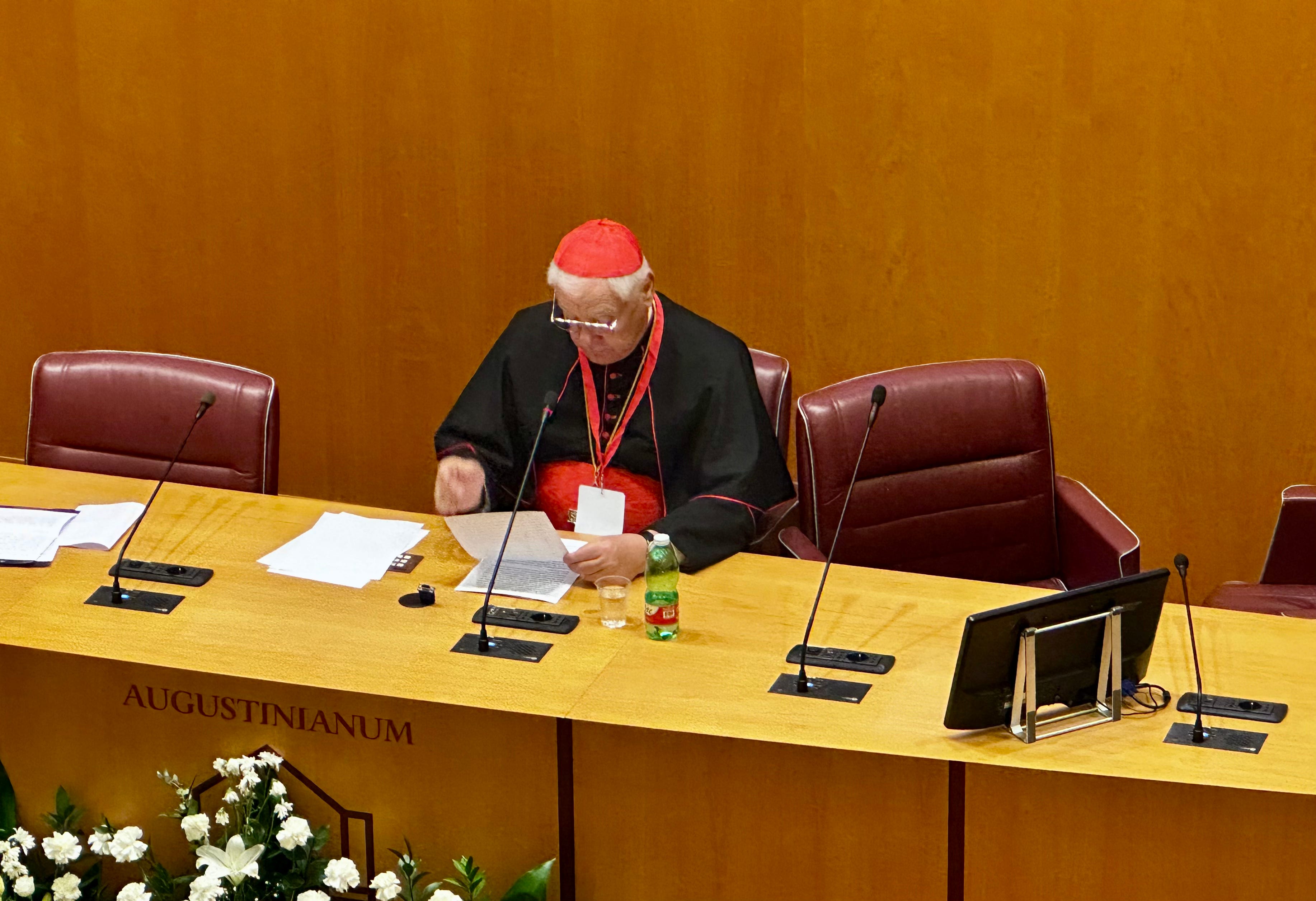
VATICAN CITY (PerMariam) — Editor’s note: Below is the full text of the address delivered by Gerhard Cardinal Müller at the international Mariology conference held next to the Vatican on October 7 and 8. Full updates from the conference can be found on Per Mariam here.

Cardinal Müller makes a firm defence of Mary as Co-Redemptrix, while also defending the appropriate nature of invoking her under that title. The full address is found below
The Blessed Virgin Mary’s Cooperation in the Redemption
1. The fundamental difference between the Catholic and Protestant conceptions of divine grace and human cooperation
One of the greatest theologians of the 19th century and a leading figure of the Catholic school of Tübingen was Johann Adam Möhler (1796–1838). In his magnum opus, *Symbolik* (1832), he attributed the numerous doctrinal differences between Catholics and Protestants to Christian anthropology. Reference is made to the doctrine of the natural and supernatural image of God, to original sin—which either totally corrupts human nature or merely wounds it—and to the justification of the sinner through the grace of Christ, the Redeemer (Symbolik, Introduction 18). The unity of Western Christianity has been shattered over the question of the subjective justification of the sinner and his relationship to the objective work of redemption by Jesus Christ.
The big question is: Did Adam’s sin not cause, in addition to the loss of supernatural grace for the entire human race, the total corruption of human nature, created in the image and likeness of God?
Catholics and Protestants agree in answering “yes” to the first part of the question. In Adam, we lost supernatural grace, which made us inwardly like God in spirit and will, and we can regain it only through the grace of Christ, the world’s one and only Savior.
To the second part of the question, Protestants respond, according to their confessional texts, that nothing good or pleasing to God remains in human nature. In his totally corrupt nature, the sinner would not even be capable of observing the commandments of the natural moral law (Rom 2:15) nor of recognizing God’s existence—at least by reason—nor of thanking and loving Him (Rom 1:20). Because of Adam’s sin, our will is said to be entirely evil and to hate God. And according to Protestant doctrine, not even redemptive grace is capable of restoring, healing, and elevating the natural image of God in the creature, even though—on the basis of Christ’s divine-human unity—a nuptial union between nature and grace is realized in man. According to Protestant teachings, I am justified by faith only through trusting in Christ. Christ does not—so to speak—pull me out of the lions’ den, where sin, the devil, and death threaten me with death, but simply drives away, time and again, the lions that attack me. As long as I live on earth, I am in constant struggle against my nature, which is opposed to God, and I obtain certainty only by constantly trusting, in an act of faith, exclusively in Christ, so that He may keep me away from sin, the devil, and death (simul iustus et peccator).
The Catholic, on the other hand, believes that the grace of redemption and justification not only brings about supernatural deification but also restores human nature—with its spiritual and moral faculties—to its original goodness, making it possible to love God above all things and to love one’s neighbor as oneself. The inclination toward sin—which is opposed to God and to the good—that is, concupiscence, is no longer a sin in itself, but merely the residual weakness of a nature that has been fully and completely healed. The justified person does not sin at all, especially when doing good (DH 1481). The baptized person sins only, as the Catholic faith affirms, when he or she freely consents to temptation. In fact, temptation is by no means a sin in the person justified and regenerated in Christ. The inclination toward sin has been left to us so that we may fight it with the help of grace and so that, through prayer, fasting, spiritual exercises, and works of charity, we may grow in love for God and neighbor, build up the Kingdom of God, and thus, through our merits in doing good in accordance with God’s universal saving will, be rewarded with eternal life.
And it is precisely at this point that the truth of the Catholic faith is established and its distinctive character is revealed—a truth we must recognize, defend, and proclaim. There is no relationship of rivalry between God and man. Irenaeus of Lyons already affirmed this against the Gnostics of his time and of all times: God neither gains nor loses anything when He allows personal creatures to share in His infinite Being, His Spirit, and His inexhaustible goodness. God’s grace does not become greater the less we think of man. His Majesty does not crush us into the dust. On the contrary: the Son, in consubstantiality with the Father, takes on our lowliness and becomes like us humans even unto death on the cross, in order to exalt us in his person to the glory of God the Father. His perfection is manifested in the fact that he creates us without us and redeems us from original sin and personal sins by pure grace.
2. The Catholic Concept of Cooperation with Grace
God does not exclude us from the work of redemption, but includes us, allowing us to participate in and cooperate with the work of redemption and the perfection of humanity in the communion of the Father, the Son, and the Holy Spirit. Human cooperation with God thus constitutes the highest dignity that God can communicate to humanity, since the nature created and blessed by God is realized in the spiritual acts of knowing God and is perfected in moral action through free will. Thomas Aquinas summarizes this concept. He distinguishes between the level at which God, by His very nature, acts alone, and the way in which, on the level of creation, He bestows upon man the grace of cooperation, so that human beings too may be co-causes of the redemption and justification of sinners, serving as secondary causes and means of the first cause. As the passage from 1 Corinthians 3:9 states: “We are God’s fellow workers.” The Doctor Angelicus states: “This does not stem from a lack of divine power, but from the fact that God makes use of intermediate causes to preserve the beauty of order in things and also to communicate to creatures the dignity of causality—ut etiam creaturis dignitatem causalitatis communicet.” (S.th. I q. 23 a. 8 ad 2).
We must understand that the creature’s cooperation in God’s plan of salvation is the pinnacle of our human dignity. And this is where the fundamental difference between the Catholic faith and Protestantism lies. St. Thomas writes: “Neque hoc est propter defectum divinae virtutis: sed quia utitur causis mediis, ut ordinis pulchritudo servetur in rebus, et ut etiam creaturis dignitatem causalitatis communicet.” (Summa Theologica, I, q. 23, a. 8, ad 3). — This is not due to a lack of divine power, but to the fact that He makes use of intermediate causes so that the beauty of order may be preserved in things and so that He may also confer upon creatures the dignity of causality.
3. Mariology as the criterion of Catholic orthodoxy
Precisely for this reason, Mariology is the culmination of Catholic anthropology and the criterion of Catholic orthodoxy, since the entire redemption depends on God having communicated to Mary the dignitas causalitatis in the fulfillment of His universal salvific will. The act of the Incarnation is the exclusive work of God, for the eternal Son of the Father assumed human nature from Mary and sustains it within his divine person. In fact, the human nature of the Mother of the God-Man is not a philosophical abstraction, nor a mere instrument of biological procreation, nor even a passive tool, but rather the spiritual nature of a free person. And for this reason, her “Fiat” is not merely the obedient execution of a superior’s order, as occurs in a military context. Rather, God reveals the greatness of his grace in a love that does not overwhelm, but brings about salvation by submitting to the free consent—the “consensus”—of the creature. God made the fulfillment of his saving will in the Incarnation, the Cross, and the Resurrection of his Son contingent upon the free consent of a single woman, thus entrusting the salvation of all humanity to her virginal and maternal heart. If she had refused her “Fiat,” we would all have remained lost for eternity. But God did not take a gamble; rather, He chose Mary from all eternity to become the Mother of His Son. And for this reason, from the very first moment of her conception, she was preserved even from original sin in view of the redemption of the world through her Son. For this reason, her free “yes” was not an arbitrary choice between two equivalent possibilities, but the fulfillment of her most pure love, which unites her in a spousal covenant with the Holy Spirit, precisely as a bride.
Upon the angel’s announcement that she would become the mother of the Son of God—who would be conceived in her womb, carried there, and born of her—she responded in the strength of the grace she had already received and her freedom from Adam’s sin: “Behold, I am the handmaid of the Lord; let it be done to me according to your word” (Lk 1:38). Mary declares her willingness, in the freedom wrought by grace, to place herself at the service of God’s universal saving will and thus to cooperate in its historical fulfillment, all the way to the cross and the resurrection of Christ. And it is the Holy Spirit himself, who brought about the Incarnation of the Word in her body and will, and who, in his eschatological outpouring upon Jesus’ disciples, makes Mary the Virgin who receives every grace and the Mother of believers.
For this reason, Mary is in a unique way intrinsically and essentially linked to Christ’s salvific work.
Through her preservation from original sin in view of the merits of the Mediator between God and humankind—who, from her womb and through her free “yes,” took on our human nature—Mary represents in her person, and in an archetypal way for all redeemed humanity, the new unity of grace and nature. And grace does not remain alien to nature, but deifies it and reveals to us the goodness and glory of the New Man in Christ. Christ, in his human nature born of Mary—which is, however, hypostatically united to his divinity and thus makes Mary the Mother of God—is the Redeemer and the Mediator between God and humankind.
And for this reason, in this sense, Mary too, through her constitutive cooperation in the Incarnation, is indissolubly and intimately bound to the work of redemption. If Mary, with her “Fiat mihi secundum verbum tuum,” cooperated in a constitutive way in the Incarnation, this also includes—on behalf of all humanity—her cooperation in redemption through the cross of her Son, at whose side she stood and where her soul was pierced by a sword. In fact, the body that hung on the cross—and in which Christ offered himself to the Father for the salvation of the world—is the very same body that was born of her for the salvation of the world.
4. The Eve-Mary Typology
Messianic salvation begins with Christ and with Mary’s faith and willingness to allow the Incarnation of God to take place in her womb. This naturally leads us to contrast, in the wake of Paul’s Adam-Christ typology, Eve’s disobedience (= voluntary lack of faith) with Mary’s obedience and faith (Lk 1:38; Gen 3; Rom 5:19). Eve, through her disobedience and lack of faith, became the cause of death, while Mary became the cause of life. Mary is truly the “mother of the living” (Jn 3:20), for just as death came through both sexes, so life had to come through Christ, the man, and through Mary, the woman. Mary stands at the beginning of the history of faith of the new humanity—that is, of the Church of the New Covenant, reborn in faith. Through her faith, she is, as a virgin, the type of the Church that receives salvation from God and, at the same time, the typological embodiment of the Church’s essence, which—through its preaching and salvific ministry—continually brings forth, by virtue of faith and baptism, new members of the Body of Christ, which is the Church. From the perspective of a doctrine of redemption developed in the light of the Incarnation, Mary appears as Christ’s partner and helper (socia Cristi) and is consequently, in relation to the Church and to humanity, the one who intercedes for them and helps them (adiuvatrix).
Mary’s cooperation does not, however, refer to her supporting the work of Christ, the progenitor of the new humanity. Rather, she stands on the side of the Church, which receives salvation, and cooperates—through the grace bestowed upon her and her own example—so that the Church and its individual members may allow themselves to be united, in faith and love, to Christ their Head, in accordance with the relationship that exists between the bridegroom and the bride, in which the personal relationship of Christ to the Church and of the Church to Christ is expressed (cf. Eph 5:23).
The theological category of Eve’s disobedience—typically contrasted with Mary’s obedience and faith, as already attested by Justin Martyr and Tertullian—finds a compelling expression in Irenaeus of Lyons: “The Lord came visibly into his own; he was borne by his own creation, which is borne by him; through his obedience on the wood, he accomplished the recapitulation of the disobedience that had been committed through the wood, and the seduction, of which Eve—a virgin subject to her husband—had been a wretched victim, was dispelled by the truth that was magnificently announced by the angel to Mary, a virgin already under her husband’s authority. For just as the former was seduced by the angel’s word so as to flee from God by transgressing His word, so the latter received the good news through the angel’s word, so as to bring forth God by obeying His word; and just as the former allowed herself to be seduced so as to disobey God, so this one allowed herself to be persuaded to obey God, so that the Virgin Mary might become the advocate of the virgin Eve; and just as the human race was bound to death through a virgin, so it was freed through a virgin, for the disobedience of one virgin was counterbalanced by the obedience of another. Thus, the sin of the first man was atoned for by the righteous conduct of the Firstborn, and the cunning of the serpent was overcome by the simplicity of the dove, and the bonds that bound us to death were broken...”
It therefore remains true that “Mary, through her obedience, became the cause of salvation for herself and for the whole human race.” By virtue of the historical fact of her obedience to the word of God—who took flesh from her for the salvation of all people—Mary is also the model and standard of the human being perfectly united to God. She is the one full of grace, the believer par excellence, and therefore the fully redeemed one.
5. The Development of Mariological Dogma
Here we also see that the two fundamental terms “grace and faith,” interrelated like two focal points, are the starting point of the history of Mariological dogmas. The future statements of faith concerning Mary, which gradually crystallized in the Church’s consciousness of faith, therefore do not merely reflect an isolated interest in the person of Mary. Rather, throughout the history of the faith, the contours of the Christian image of humanity have become visible in the mirror of the fundamental Mariological statements.
Therefore, when Mary is called “Co-Redemptrix” in Catholic piety and theology, this is neither a misleading attribution nor an enthusiastic exaggeration, but a truth objectively contained in revelation.
This title should not be silenced because of its rejection by Protestants, who, based on their doctrine of justification, conceive of redemption without man’s free participation and thus diminish its significance; rather, it requires an explanation within the overall context of the divine-human work of redemption carried out by Christ, the Son of God, and Mary.
Christological titles are also applied to us by analogy. Christ is the consubstantial Son of God, but we too are, by the grace of adoption, children of God. The designation as children in no way calls into question the uniqueness of Christ’s divine sonship within the Holy Trinity and in the Incarnation, but rather expresses its universal effect. Thomas Aquinas cites another example: the soteriological title of Christ as the sole mediator between God and humankind (1 Tim 2:5) belongs to him alone. But priests (bishops and presbyters) can also be defined as mediators between God and humankind, since they are servants of the High Priest and Mediator of the New Covenant, and, as vicars of Christ, administer the sacraments of salvation to humankind. They, however, do not exercise the ministry of priest and mediator in a “primary and perfect” way, but only in a “servile and preparatory” manner (Summa Theologica, III, q. 26, a. 1). And every baptized person is called and obliged to cooperate, in the spirit of Mary, so that all people may share in Christ’s redemption.
Anyone familiar with the principles of Catholic theology, therefore, can find no cause for scandal in the analogical use of Christological and soteriological titles. Even in ecumenical dialogue, this is not a matter of false irenicism that compromises the purity of Catholic doctrine, but rather a deeper understanding of the original meaning and its correct conceptual and linguistic formulation. Even with regard to the hierarchy of truths, as discussed in the Second Vatican Council’s decree on ecumenism, this is not a mechanical division between important and less important doctrines, but rather their analogy in relation to the foundation of the Christian faith—namely, God’s will that all people be saved and come to the knowledge of the truth through the one mediator between God and humanity, the man Christ Jesus, Son of Mary, who through the Incarnation and her “Fiat” became the Mother of God.
The principle “numquam satis de Maria” has nothing to do with Mariological maximalism, which one would have to balance diplomatically and pedagogically with Mariological minimalism. The principle simply expresses the fundamental truth of the Catholic faith against Gnosticism. According to the Catholic faith, a person becomes greater in thought and action the more he allows himself to be sustained by grace and led to the heights of God. In Mary, Mother of the Son of God, of the Church of Christ, and of all believers, we recognize in a typological and exemplary way what holds true for everyone: “gloria Dei est vivens homo, vita autem hominis visio Dei” (Irenaeus of Lyon, Adv. haer. IV, 20, 7).
6. The Truth Revealed in the Title “Mary Co-Redemptrix”
Nor does the objection hold that the title appeared only in the late Middle Ages. In fact, the fact that a truth of faith is contained in Revelation must not be confused with its conceptual formulation. From the very beginning, Christianity has believed in the Incarnation of the Son of God, whereas it was only much later that the Magisterium expressed this mystery using the formula of the unity of the divine and human natures in the person of the Son of God—the hypostatic union. Thus, even in Mary’s perpetual virginity and her divine motherhood—clearly attested to by the Bible—their absolute origin lies in God’s election of her, their conception free from the stain of original sin, and their fulfillment in the Assumption of her body and soul into heaven.
Just as all the mysteries of the Christian faith are intimately connected in theanalogia fidei and interpret one another, so too the dogmatic doctrine on Mary is not a subjective collection of disparate elements, but the expression of its origin in the single mystery of God’s self-revelation in Christ, his Son, as the truth and life of every person who, together with the Mother of the faithful, says: “Behold, I am the handmaid of the Lord.” The Angelic Doctor asks in his *Expositio in Salutationem Angelicum* (Exposition on the Angelic Salutation), the Hail Mary: “Since Mary is blessed among women,” and answers: “Mary brought the blessing and opened the gate of heaven; and therefore the name Mary, which translates as ‘Star of the Sea,’ suits her well; for just as sailors are guided to port by the Star of the Sea, so Christians are guided to glory by Mary.”