

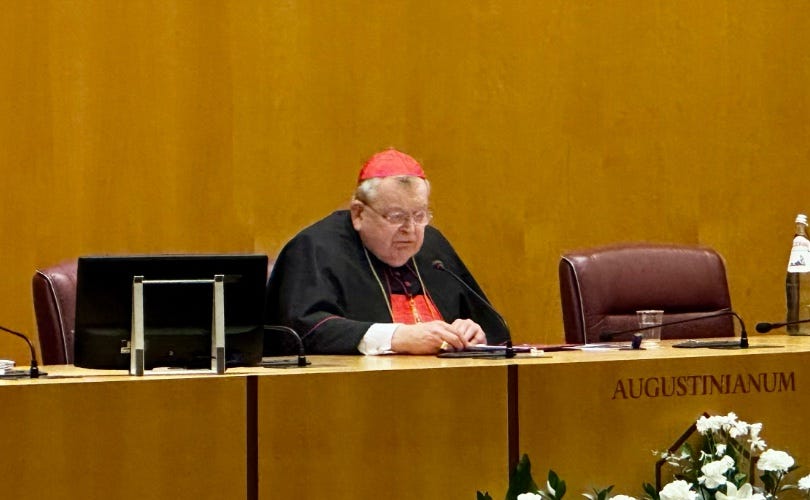
VATICAN CITY (PerMariam) — Editor’s note: the following is the full text of the address delivered by Cdl. Raymond Burke at the Augustinianum in Rome, October 7, 2026. It was the keynote speech at the “De Maria numquam satis” conference, on which live updates can be found here. Delivered in English, the text can be read in Italian also here.
Introduction
It is a source of profound joy for me to deliver the opening address at this important International Conference on the theme “The Most Blessed Virgin Mary in Dogma and Devotion: Theological and Historical Contributions.” Together with you, I express my deep gratitude to those who organized the conference and to those who made it possible. To begin the conference, I would like to offer a reflection on the theme: “Our Lady of Guadalupe and the Kingdom of Christ the King: The Mission of the Co-Redemptrix and the Co-Redeemers.”
Right at the beginning of her first apparition to Saint Juan Diego, Our Lady of Guadalupe identified herself with these words: “Know, my little and most beloved son, that I am the most perfect and ever-Virgin Holy Mary, the Mother of the most true and only God, of Him who is the author of life, the Creator of mankind, of Him in whom all things subsist, the Lord of heaven, and the Master of the earth” (1).
Her apparitions to Saint Juan Diego, from December 9 to 12, 1531, can be described as the manifestation of Christ, her Divine Son, as King of Heaven and Earth, the One who restores the right order and peace, through whom and for whom God created the world and, above all, humankind—male and female.
In her miraculously created and preserved image, Our Lady of Guadalupe is the “woman clothed with the sun, with the moon under her feet and a crown of twelve stars on her head” (2) whom Saint John, the Apostle and Evangelist, saw in his vision of Our Lord’s definitive victory over sin and death. Our Lady of Guadalupe is pregnant with the “male child” (3) who is truly the King of Heaven and Earth, the One who conquers Satan and his hosts, so that, despite their fierce and wicked rebellion, they may never prevail over the Church or over the souls of those who live in Christ. (4) The vocation and mission of every Christian therefore consist, according to the words of St. Paul in his Letter to the Ephesians, in “bringing all things—those in heaven and those on earth—back to Christ, the one Head”. (5) Our Lord Jesus Christ, God the Son made flesh, is the one and only Redeemer; but God the Father, in sending His only-begotten Son in human flesh to redeem the world, willed the collaboration of humanity in the work of redemption, beginning with the Blessed Virgin Mary.
The Blessed Virgin Mary, Mother of God, participated in a wholly unique way in the Mystery of faith, in the Mystery of the redemptive Incarnation, and is rightly called Co-Redemptrix.
In the same way, to the extent that we unite our hearts, together with her Immaculate Heart, to the Most Sacred Heart of Jesus, we participate in Christ’s salvific mission. And we can rightly be called co-redeemers. In the words of Saint John, Apostle and Evangelist, we are called to be “co-workers for the truth” in Christ. (6) Our Lord Himself clarifies the intimacy of our relationship with Him when He declares: “If anyone wishes to come after Me, let him deny himself, take up his cross daily, and follow Me.” (7)
In addressing this International Conference on the Blessed Virgin Mary in Dogma and Devotion, I wish to present the unique participation in the mission of Christ the King—the mission of the Redemptive Incarnation—that belongs to the Virgin Mother of God as Co-Redemptrix, and our participation in that same mission as co-redeemers.The apparitions of the Virgin Mother of God on the hill of Tepeyac, in what is now Mexico City, help us, in a special way, to understand her mission and our corresponding one. In fact, the children of Our Lady of Mexico—the guadalupanos and guadalupanas—have always understood their mission in the world as service to Christ the King under the maternal care of His Mother, whom He gave us as our Mother as He died on the cross for our eternal salvation. (8)
Blessed Miguel Pro wrote two short prayers on the wall of the prison where he was held before being martyred on November 23, 1927, by a firing squad during the bloody persecution of the Church in Mexico: “¡Viva Cristo Rey! Long live the Virgin of Guadalupe!” (Long live Christ the King! Long live the Virgin of Guadalupe!). (9) Saint José Sánchez del Río, too, while being cruelly tortured and killed by a firing squad on February 10, 1928, repeatedly exclaimed: “Long live Christ the King! Long live Saint Mary of Guadalupe!” (Long live Christ the King! Long live Saint Mary of Guadalupe!). (10)
Just as the Virgin Mother of God, at the wedding at Cana, led the servants to her divine Son to remedy their great distress, telling them, “Do whatever he tells you”, (11) so she accompanied these heroes of the faith as they offered their lives in fulfillment of God’s will. In the same way, she draws our hearts to her Immaculate Heart, leading us to give them totally to the Sacred Heart of Jesus, even to the point of shedding our blood together with Him for the glory of God and the salvation of souls.
The Doctrine of Co-Redemption
The Virgin Mary’s collaboration in Christ’s work of redemption has two aspects that, over time, theologians have elucidated by distinguishing between objective and subjective redemption. Monsignor Arthur B. Calkins, author of numerous in-depth writings on the title of “Co-Redemptrix,” explains this distinction:
“Traditionally, theologians have distinguished between Mary’s unique collaboration in redemption, which took place in actu primo, and the application of the graces of redemption to individual persons, which takes place in actu secundo. Redemption in actu primo, or ‘objective redemption’—that is, the ascending phase of redemption—can be defined as the acquisition of universal salvation through the sacrifice willed by God to reconcile the world to Himself. Redemption in actu secundo, also called ‘subjective redemption,’ or the descending phase of redemption, or even the mediation of grace, can be defined as the application of the fruits of redemption to individual persons through the mediation willed by God. It has consistently been held that the Blessed Virgin Mary participates in both of these phases of the work of redemption, whereas all other Christians can participate in the application of the graces of redemption to specific persons and situations. Therefore, we can all be co-redeemers in actu secundo. (12)
Holiness of life, in fact, is participation in the salvific work of Christ, who alone is our salvation. St. Paul affirms the truth of our participation in Christ’s redemptive work in his Letter to the Colossians. Speaking of his own sufferings, he understands that they must be united to the Passion and Death of Christ: “Now I rejoice in my sufferings for your sake, and in my flesh I am filling up what is lacking in Christ’s afflictions for the sake of his body, that is, the Church. Of this I have become a minister, according to the commission God has given me for you, to fulfill the word of God—the mystery hidden for ages and generations but now revealed to his saints”. (13)
It is not that anything is lacking in Christ’s sufferings for our eternal salvation, but his life within us—the life of grace—must reach maturity in us, especially through the union of our sufferings with his Passion and Death.
In recent decades, a debate has taken place within the Church regarding the Blessed Virgin Mary’s active collaboration in the work of Redemption. The question is: in what sense is the Blessed Virgin Mary the New Eve, the companion of Jesus, the New Adam (cf. Rom 5:12–21; 1 Cor 15:22, 45)? For over five hundred years, the term “Co-Redemptrix” has been used to express the idea that Mary, while not equal to Jesus—but rather a creature totally dependent on Him, secondary and subordinate to Him—nevertheless united herself with Him and joined Him in offering Him to the Father for our salvation on Calvary.
The appropriateness of this title was the subject of heated debate during the drafting of the eighth chapter of Lumen Gentium, which contains the Second Vatican Council’s fundamental teaching on the Blessed Virgin Mary. In the end, the Council clearly taught Mary’s active collaboration in the work of Redemption in nos. 56–58 and 60–62 of the Dogmatic Constitution on the Church, Lumen Gentium, but did not use the term “Co-Redemptrix” for fear that it might be misunderstood by non-Catholics.
Our Lady’s mediation of grace derives from her role as Co-Redemptrix. The term “Mediatrix” was used only once in no. 62 of Lumen Gentium, with the appropriate clarification that “this, however, must be understood in such a way that nothing is detracted from or added to the dignity and efficacy of Christ, the one Mediator”. (14) She is a Mediator together with her divine Son, the Mediator, as had been taught in very clear terms by the popes of the nineteenth and twentieth centuries, as well as by the post-conciliar popes. Part of the difficulty lies in the meaning that the term “Co-Redemptrix” can take on when translated into certain modern languages. The English term “Co-Redemptrix” can refer to a joint actor, but it can also mean someone who collaborates in a work that is primarily and essentially that of another. Monsignor Arthur Burton Calkins addresses the potential confusion regarding the meaning of “Co-Redemptrix,” clearly stating that “[i]n the Latin language, from which the term ‘Co-Redemptrix’ derives, the meaning is nevertheless always that Mary’s cooperation or collaboration in redemption is secondary, subordinate, and dependent on that of Christ—and yet, despite all this, something that God ‘freely chose to accept… as a non-essential, yet wonderfully welcome part of that one great price’ paid by His Son for the redemption of the world”. (15)
In his General Audience on October 25, 1995, Pope Saint John Paul II described how, throughout history, the Church has expressed ever more clearly the truth regarding the participation of the Blessed Virgin Mary, Mother of God, in Christ’s work of redemption:
“1. By stating that ‘the Virgin Mary is recognized and honored as the true Mother of God, Mother of the Redeemer’ (Lumen Gentium, 53), the Council draws attention to the connection between Mary’s motherhood and redemption. After becoming aware of Mary’s maternal role—venerated in the doctrine and worship of the early centuries as the virginal Mother of Jesus Christ and therefore Mother of God—the Church’s piety and theological reflection in the Middle Ages delved deeper into her collaboration in the Savior’s work.
This delay can be explained by the fact that the efforts of the Church Fathers and the early ecumenical councils, centered as they were on the mystery of Christ’s identity, necessarily left other aspects of the dogma in the shadows. It was only gradually that revealed truth could be articulated in all its richness. Over the centuries, Mariology would always be guided by Christology. Mary’s very divine motherhood was proclaimed at the Council of Ephesus primarily to affirm the personal unity of Christ. The same is true of the deepening understanding of Mary’s presence in the history of salvation.
2. At the end of the second century, Saint Irenaeus, a disciple of Polycarp, already highlighted Mary’s contribution to the work of salvation. He understood the significance of Mary’s consent at the moment of the Annunciation, recognizing in the obedience and faith of the Virgin of Nazareth toward the angel’s message the perfect antithesis to Eve’s disobedience and unbelief, with a beneficial effect on the destiny of humanity.
In fact, just as Eve brought about death, so Mary, through her “yes,” became the “cause of salvation” for herself and for all humanity (cf. Haer Adv. 3. 22, 4; SC 211, 441). However, this assertion was not systematically or consistently developed by the other Church Fathers.This doctrine, however, was systematically elaborated for the first time at the end of the tenth century in the “Life of Mary” by a Byzantine monk, John the Geometer. Here, Mary is united to Christ in the entire work of redemption, participating—according to the divine plan—in the Cross and suffering for our salvation. She remained united to her Son “in every action, attitude, and will” (Life of Mary, Bol. 196, f. 122v.)
Mary’s association with Jesus’ salvific work takes place through her motherly love—a love animated by grace, which grants her a superior strength: the one most free from passion proves to be the most compassionate (cf. Life of Mary, Bol. 196, f. 123 v.).3. In the West, St. Bernard, who died in 1153, addressing Mary, comments on the presentation of Jesus in the temple as follows: “Offer your Son, most holy Virgin, and present to the Lord the fruit of your womb. For our reconciliation with all, offer the holy sacrifice, pleasing to God” (Sermo 3 in Purif., 2, PL 183, 370).
A disciple and friend of St. Bernard, Arnold of Chartres, highlights in particular Mary’s offering in the sacrifice of Calvary. He distinguishes on the Cross “two altars: one in Mary’s heart, the other in Christ’s body. “Christ offered up his flesh; Mary, her soul.” Mary offers herself spiritually in profound communion with Christ and intercedes for the salvation of the world: “What the Mother asks, the Son approves; the Father grants” (De septem verbis Domini in cruce, 3: PL 189, 1694).From this time onward, other authors expounded the doctrine of Mary’s special cooperation in the redemptive sacrifice”. (16)
As Saint Pope John Paul II explains, the use of the term “Co-Redemptrix” adds nothing new to the Church’s teaching, but rather coherently develops the expression of what the Church has always taught.In recent years, there has been a strong movement in favor of recognizing Mary’s role as Co-Redemptrix, Mediatrix, and Advocate through a solemn papal definition. On the occasion of the Mariological and Marian Congresses held in Częstochowa, Poland, in August 1996, a commission was convened for a brief period to advise the Holy See on this matter. One of its recommendations was that further studies were necessary. (17) Such studies continue to be conducted by numerous competent theologians.Our Lady’s role as Co-Redemptrix and Mediatrix of all graces derives from her nature as our spiritual mother, to whom we consecrate ourselves in order to belong ever more fully to Jesus.
Two of the greatest modern masters of Marian consecration, St. Louis-Marie Grignion de Montfort (1673–1716) and St. Maximilian Maria Kolbe (1894–1941), base their teaching on consecration to Mary explicitly on the mediation of the graces of Redemption that Mary exercises on our behalf. Living in union with Mary is a fundamental key to growing in knowledge and love of Jesus. She never draws us to herself for her own sake, but always to bring us ever closer to Jesus. This is how St. Louis-Marie Grignion de Montfort prayed: Totus tuus ego sum et omnia mea tua sunt. Accipio te in mea omnia. Præbe mihi cor tuum, Maria—“I belong entirely to you, and all that I have is yours; I receive you as my all. O Mary, give me your heart.” (18) His prayer inspired the motto on St. John Paul II’s papal coat of arms.
Mary, Co-Redemptrix, in Sacred Scripture
The truth of the Blessed Virgin Mary’s unique participation in the work of Redemption is foreshadowed in the first promise of salvation made by the Lord at the time of our first parents’ sin. Addressing the serpent that had succeeded in tempting Eve, Our Lord declared: “I will put enmity between you and the woman, between your offspring and hers; she will crush your head, and you will strike her heel”. (19)
The Protoevangelium, the first Gospel, as it is rightly called, highlights that the work of salvation will involve a woman whose offspring will crush the head of the serpent, of Satan, and of his hosts. In other words, a woman will cooperate in the work of salvation in a singular—indeed, unique—way. Our Lord renewed the promise of salvation through the words of the prophet Isaiah to King Ahaz: “Therefore the Lord himself will give you a sign. Behold, the virgin shall conceive and bear a son, and shall call his name Immanuel”. (20)
Commenting on the texts of the Protoevangelium and the prophet Isaiah, the Second Vatican Council declared:
“The books of the Old and New Testaments and the venerable tradition show ever more clearly the role of the Savior’s mother in the economy of salvation and, so to speak, present her to our contemplation. The books of the Old Testament describe the history of salvation, in which the coming of Christ into the world is gradually being prepared. These early documents, as they are read in the Church and understood in the light of the subsequent and full revelation, gradually bring into ever clearer focus the figure of a woman: the Mother of the Redeemer. In this light, she is already prophetically foreshadowed in the promise made to our first parents, who had fallen into sin, concerning the victory over the serpent (cf. Gen 3:15) .
Likewise, it is she, the Virgin, who will conceive and give birth to a Son, whose name will be Emmanuel (cf. Is 7:14; Mt 1:22–23). She stands out among the humble and the poor of the Lord who trustingly await and receive salvation from him. And finally, with her—the daughter of Zion par excellence—after the long wait for the promise, the fullness of time is realized and the new “economy” is established, when the Son of God assumed human nature from her to free humanity from sin through the mysteries of his flesh. (21)
The liberation of humanity from sin is accomplished by God, the Son incarnate through the Virgin Mary by the power of the Holy Spirit. The Virgin Mary cooperates in a wholly singular—indeed, unique—way in the work of Redemption, according to God’s plan.
We find the full expression of the Virgin Mary’s identity in the work of the redemptive Incarnation. Father Ignace de la Potterie illustrates the mediation of the Virgin Mother of God in the work of Redemption by analyzing the Prologue of the Gospel according to Saint John and the account of the Annunciation in the Gospel according to Saint Luke. (22)
Mary’s Heart was, according to God’s eternal plan, conceived without the stain of original sin, so that her womb might be the worthy tabernacle in which God the Son would come to dwell and from which He would be born into the family of Mary and Joseph, her true spouse and the virginal father of Jesus. Her Immaculate Heart remains forever ready to lead people, with maternal love, to the Heart of her Divine Son with that instruction she first gave at the wedding at Cana: “Whatever he tells you, do it”. (23)
In his Letter to the Galatians, Saint Paul expresses the truth of Mary’s unique cooperation in the Mystery of the redemptive Incarnation in relation to our own call to be “co-workers [with Christ] in the truth” (24): “But when the fullness of time had come, God sent his Son, born of a woman, born under the Law, to redeem those who were under the Law, so that we might receive adoption as sons. And that you are sons is proven by the fact that God sent the Spirit of his Son into our hearts, who cries out, ‘Abba! Father!’”. (25)
It is through the mediation of the Virgin Mary—her co-redemptive mission in the redemptive Incarnation of her Son—that we are heirs to eternal life, called to the high dignity of following Christ on the way of the Cross. (26)
Our Lady of Guadalupe, Co-Redemptrix
The apparitions and message of the Blessed Virgin Mary on the hill of Tepeyac, in present-day Mexico City, from December 9 to 12, 1531, are a powerful expression of her singular—indeed, unique—participation in the redemptive Incarnation, in actu primo — that is, in the work by which God the Son, incarnate, accomplished our salvation through His Passion, Death, Resurrection, and Ascension — and in actu secundo — that is, in the realization of His salvific work in the souls of many, in every time and place, who come to life in Him through Baptism and live in Him in the Church, His mystical Body.
It can be said, in fact, that all the apparitions of the Virgin Mother of God are a manifestation of her unique relationship with God the Son, her Divine Son, through whom she became Co-Redemptrix, as well as an expression of her mission as Co-Redemptrix in every time and place until the end of time. Every Marian apparition is the work of Christ, assisted—as she has been since the moment of her virginal conception—by his Mother.
Mary declares her identity as Co-Redemptrix in actu primo from the very first moment of her apparitions to Saint Juan Diego. On December 9, 1531, Saint Juan Diego was on his way to Tlatelolco to receive catechetical instruction from the Franciscan friars when, on the hill of Tepeyac, he had an otherworldly, heavenly experience: from the singing of the birds to the glorious apparition of Our Lady, amid stones and plants transformed so as to resemble precious jewels.
The account of the apparition contained in the Nican Mopohua — written by Juan Diego’s good and learned friend, Antonio Valeriano, based on Juan Diego’s firsthand account — indicates that Juan Diego recognized the Virgin Mary as the Mother of God. The Virgin Mary addressed Juan Diego in an extremely affectionate and maternal manner, asking him where he was going, and he replied: “My most beloved Lady and Queen, I wish to go to your little house in México Tlatilolco to receive the religious instruction given to us there by our priests, who are the living image of Our Lord”. (27)
The Virgin Mary then declared: “Know, my beloved little son, that I am the perfect and ever-Virgin Holy Mary, the Mother of the most true and only God, of Him who is the author of life, the Creator of mankind, of Him in whom all things subsist, the Lord of heaven, the Master of the earth”. (28) These words wonderfully express the mystery of Our Lady’s perpetual Virginity and divine Motherhood, through which she participates, in a wholly singular, indeed unique, way, in the redemptive work of her divine Son. Our Lady identifies herself both as the ever-Virgin and as the Mother of God the Son. She declares her participation in the work of Redemption in actu primo.
In other words, she makes clear that our relationship with God the Father, who has redeemed us through the Incarnation of God the Son, places us in a filial relationship with her, the Mother of God the Son made flesh. We are adopted sons and daughters of God in his only-begotten Son, our Lord Jesus Christ, and therefore we share his Mother with him, just as he said to Saint John, Apostle and Evangelist, as he was dying on the cross. (29)
Saint John, the Apostle and Evangelist, represented the Apostles and the entire flock that Christ had entrusted to the pastoral care of the Apostles—to his own pastoral care. Our relationship with Our Lady originates precisely in the very act of our Redemption through Christ’s death on the Cross.Our Lady, after identifying herself as Co-Redemptrix in actu primo before Saint Juan Diego, then expresses her mission as Co-Redemptrix in actu secundo.
Thus she clarifies the reason for her apparition:
“I ardently desire that my little sacred house be built in this place, that a temple be erected for me, in which I wish to reveal Him, make Him manifest, and give Him to the people through my love, my compassion, my help, and my protection; for, in truth, I am your merciful Mother: yours, of all who dwell on this earth, and of all those who love me, invoke me, seek me, and place all their trust in me. Here I will hear your weeping and your lamentations. I will take to heart and heal all your many sorrows, your miseries, and your pains to provide a remedy for them. And so that what my merciful love desires may be fulfilled, go to the bishop’s palace in Mexico City and tell him that I am sending you to reveal to him what I desire—namely, that he provide me with a home here, erecting a temple for me at the foot of this hill. You will tell him everything you have seen and marveled at, and everything you have heard. Be assured that I will be very grateful to you and will reward you; for this I will enrich you and glorify you. Your efforts and the service you render to me by going to plead my cause will be worthily rewarded. Now that you have heard my word, my beloved little son, go and carry out this mission!.” (30)
Our Lady’s words reveal her unique and irreplaceable role in the work of our salvation, according to God’s plan.In the second act, the Blessed Virgin Mary continues to be the privileged instrument of divine grace in the Church, just as she was the first tabernacle in which God the Son came to dwell, when He united our human nature to His divine nature in her womb through the work of the Holy Spirit.
On the hill of Tepeyac, she appeared to Saint Juan Diego to reveal the love and mercy of God toward all people, to reveal the inviolable dignity of human life—created in the image and likeness of God and saved from sin and death through the redemptive Incarnation of God the Son. In the words she addressed to Saint Juan Diego—when he feared for the life of his uncle Juan Bernardino and postponed the his appointment with Our Lady so that he could bring a priest to hear his uncle’s confession before he died, Our Lady expressed her constant presence among us in the Church as the Virgin Mother of God—who is also the Mother of divine grace, our Mother—drawing us ever more intimately into communion with her divine Son.
She said to Saint Juan Diego:
“Listen, my son, take this to heart. Do not be afraid or distressed. Let not your heart be troubled, and do not worry about this or any other illness. Am I not here, I who am your Mother? Are you not under my protection? Am I not the source of your joy? Are you not in the fold of my mantle, in the embrace of my arms? What more do you want? Nothing should distress or trouble you. Do not worry about your uncle’s illness, for he will not die for now. Know with certainty, rather, that he is already perfectly healed”. (31)
Our Lady’s words are not mere figures of speech. On the contrary, they reflect her ongoing mission in the Church—a unique mission in which she asked Saint Juan Diego to participate.The miraculous imprint of her image on the tilma, St. Juan Diego’s cloak, is a marvelous sign of her participation in the work of Redemption, accomplished by her divine Son. In confirming his mission to the bishop through the sign of the miraculous blooming of roses in the middle of winter, on a rocky hill where only grass and thorny bushes grew, God gave further confirmation that He has not granted in any other apparition of Our Lady.
Let us listen once more to the account of St. Juan Diego’s presentation of the sign of the roses to Bishop Juan de Zumárraga:
“Then he opened his white ayate, in which the gathered flowers were placed, and as soon as they scattered onto the ground, the beloved Image of the most perfect Virgin Mary, Mother of God, in the form and figure in which we see her today, just as she is preserved in her beloved home, in the temple erected at the foot of Tepeyac and which we invoke under the title of Guadalupe. Upon seeing this, the bishop and all those present fell to their knees, deeply astonished and filled with awe. Then they rose to get a better look at her, and their faces were filled with sadness and grief. They gazed upon her not out of curiosity, but with sincere hearts... The bishop, with tears in his eyes and a heavy heart, prayed to her and asked her forgiveness for not having been quick to accept her message and carry out her will. Remaining on his feet, he approached Juan Diego, removed the tilma from his neck—on which the Image of the Heavenly Lady had been imprinted—and immediately went to place it in his chapel. Juan Diego spent another day at the bishop’s house, where he was kept as a guest. The next day, the bishop said to him: ‘Let us go and see the place where the Heavenly Lady wishes a temple to be built for her.’ Meanwhile, they immediately began to gather people to erect it” (32).
In a very short time, the chapel was built, and Bishop Juan de Zumárraga kept the sacred tilma there. The Nican Mopohua concludes with these words: “The bishop, meanwhile, carried the beloved Image of the Heavenly Lady to the cathedral. He then removed it from its private chapel, where it had been kept, so that all the people might admire and venerate it. Absolutely everyone in the city was deeply moved when they went to admire and pray before the precious Image. They recognized its supernatural origin. They presented their supplications to her. They were amazed at the miraculous way in which it had appeared; indeed, the precious Image was not painted by any man on earth”. (33)
The constant presence of the Mother of God, the Mother of Divine Grace, to those who went on pilgrimage to the holy site where the sacred tilma was kept, was and still is of indescribable efficacy.
The Virgin of Guadalupe has brought so many souls back to life in Christ through baptism and has guided so many baptized people to abandon their sinful ways and follow the way of Christ, who alone is our salvation. Mary, the Co-Redemptrix, always instructs us, drawing us to participate in the work of the Redemptive Incarnation in actu secundo, according to our vocation in life and the talents God has given us.
As Co-Redemptrix, she is first among the disciples of her divine Son; she participates in His salvific work in actu primo et in actu secundo, but she teaches all those who are God’s adopted sons and daughters in His only-begotten Son through baptism that they, too, must do everything in their power to serve Christ, to be His “co-workers in the truth”. (34)
When Saint Juan Diego doubted his own ability to serve as Our Lady’s messenger, suggesting that she choose someone more noble and capable, Our Lady replied:
“Listen, my beloved little son. There are many of my faithful servants to whom I could entrust the task of carrying my message. But it is absolutely necessary that you, and no one else, go, and that through your mediation my desire be fulfilled and my will be carried out. Therefore, I earnestly beg you, my beloved little son—indeed, I command you—to present yourself again tomorrow to the bishop. You will let him know once more what I desire, so that he may build for me the temple I am asking for, and repeat to him that it is I myself, the ever-Virgin Holy Mary, the Mother of God, who am sending you”. (35)
Every time we come on pilgrimage to the holy site of Our Lady of Guadalupe, she confirms us in our mission as her messengers, heralds, and instruments of God’s saving love and mercy. She unites our hearts more fully to her Immaculate Heart, so that they may rest ever more firmly and fully in the Sacred Heart of Jesus, where they are purified of sin and set ablaze with divine love. She speaks to us as she spoke to Saint Juan Diego: “Am I not here, I who am your Mother? Are you not under my protection? Am I not the source of your joy? Are you not in the fold of my mantle, in the embrace of my arms? What more do you want?”. (36)
Especially in these troubled and unsettling times we are experiencing in the Church, we need to turn to our heavenly Mother and be strengthened in our fidelity to her divine Son, so that we may remain with him in the Church, caring for every part of his Kingdom—whether small or great—with all our heart, a heart united to the Immaculate Heart of Mary and thus belonging entirely to his Sacred Heart.
I hope this brief presentation has shown you how the apparition of Our Lady of Guadalupe on the hill of Tepeyac in 1531 is one of the most beautiful and eloquent manifestations and expressions of the truth of her singular—indeed, unique—participation in the salvific work of her Divine Son, and of the truth of the doctrine of her title as Co-Redemptrix, when correctly understood.
At the same time, I hope it has reminded all of us of our call to be, together with the Virgin of Guadalupe, participants in the work of the redemptive Incarnation. May we, too, say with Saint Paul to our brothers and sisters in the Church: “Now I rejoice in my sufferings for your sake, and in my flesh I am filling up what is lacking in Christ’s afflictions for the sake of his body, which is the Church”. (37)
Conclusion
Although the Second Vatican Ecumenical Council did not formulate a dogmatic definition, it certainly taught, in some way, the truth of Coredemption, as I have indicated. In this regard, we should be careful that the hesitation arising from a misunderstanding of the term “Co-Redemptrix” does not lead to a weakening of the teaching on Co-Redemption, which applies, in a unique way, to the Blessed Virgin Mary and, in a common way, to all the baptized. I hope that my exposition has clarified the importance of the teaching on Co-Redemption for our daily life in Christ.
I conclude with a reflection by Father Jean Galot, S.J., taken from an article he wrote on the controversies and doctrinal issues related to the title of Co-Redemptrix:
“Some have accused the Marian privileges of creating a divide between the Mother of Jesus and us; in reality, those privileges are intended, in the divine plan, to bring Mary closer to humanity in order to foster the outpouring of more abundant grace. Although unique in character and unparalleled in degree, Mary’s cooperation in redemption invites us to become more keenly aware of our mission and our responsibility in a world in need of salvation. If Mary could not be called Co-Redemptrix, then Christians, too, could not be considered co-redeemers. “The condition of the entire Church in its co-redemptive mission is illuminated by the condition of Mary, the first model of all redemption”. (38)
Thank you for your kind attention. May God bless you, and may Our Lady of Guadalupe always keep you in her maternal care.
Notes:
1 “Know this, be certain of this, my son, my youngest son, that I am truly the perfect and ever-Virgin Holy Mary, who has the honor of being the Mother of the most true God through whom we live, the Creator of all people, the Lord of closeness and immediacy, the Lord of heaven, the Lord of the earth.” Carl A. Anderson and Eduardo Chávez, Our Lady of Guadalupe. Mother of the Civilization of Love, Random House Mondadori, Mexico City 2010, p. 214, n. 26.
2 Rev 12:1.
3 Rev 12:5.
4 Cf. Mt 16:18.
5 Eph 1:10.
6 3 Jn 8.
7 Lk 9:23. Cf. Mt 16:24; Mk 8:34.
8 Cf. Jn 19:26–27.
9 Cf. Antonio Dragón, Vida íntima del Padre Pro, trans. Rafael Martínez del Campo, 6th ed., Obra Nacional de la Buena Prensa, A.C., Mexico City 1993, p. 234.
10 Cf. Fidel González Fernández, José Sánchez del Río: The Young Martyr Who Gave His Life for the Faith, ed. Federica Picchi Roncali, Dominus Production Edizioni, Florence 2016, pp. 129–133.
11 Jn 2:5.
12 Arthur Burton Calkins, “The Mystery of Mary Coredemptrix in the Papal Magisterium,” in Mary Co-Redemptrix: Doctrinal Issues Today, Queenship Publishing Company, Goleta, CA 2002, p. 45.
13 Col 1:24–26.
14 “…so that nothing may be detracted from or added to the dignity and efficacy of Christ, the one Mediator.” Second Vatican Ecumenical Council, Dogmatic Constitution on the Church Lumen Gentium, Acta Apostolicae Sedis 57 (1965) 63, n. 62.
15 Calkins, p. 30.
16 https://www.vatican.va/content/john-paul-ii/it/audiences/1995/documents/hf_jp-ii_aud_19951025.html
17 Cf. L’Osservatore Romano, June 4, 1997, 10–11.
18 Cf. Karol Wojtyła—John Paul II, Gift and Mystery: Diary of a Priest, Libreria Editrice Vaticana, Vatican City 2011, p. 44.
19 Gen 3:15.
20 Isa 7:14.
21 “The Sacred Scriptures of the Old and New Testaments and the venerable Tradition increasingly and more clearly reveal the role of the Mother of the Savior in the economy of salvation and present it for our contemplation. The books of the Old Testament, indeed, describe the history of salvation, through which Christ’s coming into the world is gradually prepared. These early writings, when read within the Church and understood in the light of the later and full revelation, bring to light, step by step, the figure of the woman, the Mother of the Redeemer. In this light, she is already prophetically foreshadowed in the promise—given to our first parents after they had fallen into sin—of victory over the serpent (cf. Gen. 3:15). Likewise, she is the Virgin who will conceive and give birth to a Son, whose name will be called Emmanuel (cf. Isa. 7:14; cf. Micah 5: 2–3. — Matt. 1:22–23). She excels among the humble and poor of the Lord, who confidently hope for and receive salvation from Him. When she, the exalted Daughter of Zion, after a long wait for the promise, the fullness of time comes and a new economy is established, when the Son of God assumed human nature from her, so that through the mysteries of His flesh He might free humanity from sin” LG, 55.
22 Cf. Ignace de la Potterie, “The Mediation of the Mother of Jesus at the Incarnation: An Exegetical Study,” trans. Salwa Hamati, in Mary Coredemptrix Mediatrix Advocate, Theological Foundations: Towards a Papal Definition?, edited by Mark I. Miravalle, Queenship Publishing, Santa Barbara, CA 1995, pp. 173–190.
23 Jn 2:5.
24 3 Jn 8.
25 Gal 4:4–7.
26 Cf. Lk 9:23.
27 “My Lady, my Queen, my Little Girl, I will arrive there, at your venerable house in Tlatelolco, Mexico, to follow the things of God that are given to us and taught to us by those who are the images of the Lord, Our Lord, our priests.” “Appendix A, El Nican Mopohua,” Carl A. Anderson and Eduardo Chávez, Our Lady of Guadalupe: Mother of the Civilization of Love, trans. Gerardo Hernández Clark, Random House Mondadori, Mexico City 2010, p. 214, n. 24 [NM]. Italian translation, *https://www.latheotokos.it/programmi/guadalupe/nican_mopohua.htm*.
28 “Know this, be certain of this, my son, my youngest son, that I am truly the perfect, ever-Virgin Holy Mary, who has the honor of being the Mother of the most true God through whom we live, the Creator of all people, the Lord of nearness and immediacy, the Lord of heaven, the Lord of earth.” Ibid., p. 214, n. 26.
29 Jn 19:25–27.
30 “I very much want, I very much desire, that they build my little sacred house here, where I will reveal Him, exalt Him by making Him known, and offer Him to the people with all my personal love—Him who is my compassionate gaze, Him who is my help, Him who is my salvation. For, truly, I take pride in being your compassionate mother—yours and that of all people who live together on this earth, and also of all other diverse lineages of people—those who love me; those who call upon me; those who seek me; those who trust in me. For there, truly, I will hear their cries, their sorrow, to remedy and heal all their various sorrows, their miseries, and their pains. And to carry out what my compassionate and merciful gaze intends, go to the palace of the Bishop of Mexico, and tell him that I am sending you, so that you may reveal to him how much I desire that he provide me with a home here and erect my temple on the plain; you will tell him everything—all that you have seen and admired, and all that you have heard. And rest assured that I will be very grateful and will repay you; for this, in truth, I will enrich you and glorify you; and you will deserve much from me in return for your toil and your service as you go to request the matter for which I am sending you. You have already heard, my youngest son, my encouragement, my word; go, do what is required of you.” NM, p. 214, nos. 26–37.
31 “Listen, take this to heart, my youngest son: what frightened you, what afflicted you, is nothing; let not your face or your heart be troubled; do not fear this illness or any other illness, nor anything painful or distressing. Am I not here, I who have the honor of being your mother? Are you not under my shadow and protection? Am I not the source of your joy? Are you not in the fold of my cloak, in the crook of my arms? Do you perhaps need anything else? Let nothing else afflict you or trouble you; let your uncle’s illness not distress you, for he will not die from it for now—be assured that he has already been healed.” NM, p. 220, nos. 118–120.
32 “And then she spread out her white tilma, in the fold of which were the flowers. And as all the varied flowers—like those of Castile—fell to the ground, there on her tilma a sign appeared: the Beloved Image of the Most Holy Virgin Mary, Mother of God, in the form and figure in which she now appears, where she is now preserved in her beloved little house, in her sacred little house on Tepeyácac, which is called Guadalupe. And as soon as the Governing Bishop and all those present beheld her, they knelt down, admired her greatly, stood up to look at her, were deeply moved, and their hearts were troubled, as if their hearts and thoughts were lifted up. And the Governing Bishop, with tears and sorrow, implored her, asking her forgiveness for not having carried out her venerable will, her venerable counsel, her venerable word. And the Bishop rose, untied from his neck the garment—Juan Diego’s tilma—in which she had appeared, where the Heavenly Queen had become a venerable sign. And then he took it there and placed it in his oratory. And Juan Diego spent an entire day there in the Bishop’s house, as the Bishop had asked him to stay. And the next day, he said to him: ‘Come, let us go so that you may show where the venerable will of the Queen of Heaven is for her temple to be built.’ Immediately, orders were given to do so, to build it.” NM, pp. 223–224, nos. 181–193.
33 “And after the Bishop had kept it for some time, he transferred the precious, revered Image of the beloved Heavenly Maiden to the Main Church. He had it brought out of his palace, from the oratory where it was kept, so that everyone might see it and marvel at its beautiful Image. And absolutely everyone—the entire city, without a single person missing—was moved to the core when they went to contemplate and admire her precious image. They came to recognize her as something divine. They came to offer her their prayers. They marveled greatly at the miraculous way in which she had appeared, since absolutely no man on earth had painted her beloved image.” . NM, p. 225, nos. 212–218.
34 John 8.
35 “Listen, you, the least of my children: be assured that my servants and messengers are not few—those whom I charge to carry my breath, my word, so that they may carry out my will; but it is necessary that you, personally, go and plead, so that through your intercession my desire, my will, may be fulfilled and carried out. And I earnestly beg you, my youngest son, and I strictly command you, to go again tomorrow to see the bishop. And on my behalf, let him know—let him hear my will—so that he may build the sacred house I am asking of him. And so, tell him once more how I, personally, the Ever-Virgin Holy Mary—I, who am the Mother of God—am sending you as my messenger.” NM, p. 216, nos. 58–62.
36 “Am I not here, I who have the honor of being your mother? Are you not under my shadow and protection? Am I not the source of your joy? Are you not in the fold of my mantle, in the crook of my arms? Do you perhaps need anything else?” NM, p. 220, no. 119.
37 Col 1:24.
38 Jean Galot, Mary Co-Redemptrix: Controversies and Doctrinal Issues, “La Civiltà Cattolica,” Year 145 (1994), nos. 3459/3460, p. 216.