

What kind of Bishop does Leo XIV want?
Understanding the man Leo is looking for as a bishop, could be a key aid in understanding the wider scope of this pontificate.

The question of what Pope Leo XIV is looking for in a new bishop should be simple, yet at the same time underlies the essence of his pontificate and thus proves difficult to pin down. Many Vaticanists have been desperately trying, and so far failing, to put a firm label on Leo and his developing pontificate.
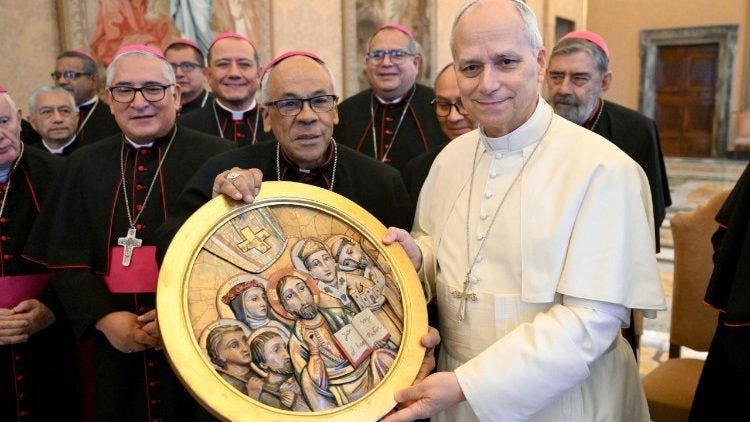
Yet if it had to be immensely simplified, one could argue that Leo looks for men who can practice his style of unity and do not rock the boat. Like many things, this has positives and negatives. After the twelve years of tumult under Pope Francis the Church is in desperate need of calm. She has been weakened from within and become a laughing stock from without.
Leo seems to be aware of this and has picked men who seem to be – in his eyes – least likely to cause immense controversy and further fan those flames. Yet there is a definite sense with many episcopal appointments that Leo is applying a bandage over a bleeding wound, while a permanent healing solution is yet to arrive.
This article was originally published by the author at Pelican+, where this author serves as Vatican correspondent. It is reprinted here with permission of Pelican+’s editor. For those wishing to engage in the wider discussion at Pelican+, you can do so here.
Indeed the Church is also called to be the Rock of Scandal, unashamedly teaching the Faith, and for this She needs bishops who are not just content to avoiding rocking the boat, but to steer the ship through turbulent waters where necessary. On that front, it seems Leo is not so keen to choose men who will be as vocal as, for instance, Bishop Athanasius Schneider – and that aspect is a loss for a Church which so desperately needs manly leadership from Her prelates.
But in trying to understand what kind of bishop Leo is looking for, one must understand how the candidates are narrowed down – for in reality the selection process can be skewed or decided long before the Pope is involved. This process is outlined carefully in Canon Law.
Every three years, diocesan bishops are supposed to compile a list of candidates suitable for the episcopate and send it to the Vatican. When the time comes to assign a new bishop for the diocese, this list is a chief resource, along with details of the needs of the diocese which the outgoing bishop is asked to itemize.
The Apostolic Nuncio is also naturally involved. He is tasked with presenting the Holy See with his personal opinions on a proffered candidate, along with the thoughts and advice of the relevant local Archbishop and bishops of the province, the suggestions of the president of the bishops’ conference, the senior diocesan clergy and the cathedral chapter. If necessary, the Nuncio is even to seek opinions of laity “outstanding in wisdom.”
The Nuncio thus draws up his own list of three candidates and sends it to the Congregation for Bishops. In turn the Congregation examines the three men, and if it decides to move forward then it presents a leading candidate to the Pope for approval. Should the Pope, or the candidate, refuse the selection then the whole process resumes from the beginning.
Hence, at every stage there is a series of checks and balances: but this is a system that can also be used against certain candidates according to the ideological bent of the episcopate already predominate in a country. A largely liberal diocese and national bishops’ conference is unlikely to recommend a conservative candidate, and vice versa, and so even the information the Pope receives can be heavily biased in varied directions and the pool of candidates already very limited.
All that is to say that while any episcopal choices made in Leo’s name can reveal something about his style, they can also reveal just how lacking the possible candidate-pool is.
A critic might make the same point about Pope Francis, but to this I would reply that Leo so far seems to keep to the appointment procedures, whereas (though it is little known) Francis often disregarded them, appointing ill-suited men chosen by him or his confidants against the advice or wishes of the Nuncio or the Dicastery for Bishops.
A critic might also argue that Leo could select the sole conservative priest in a liberal diocese and thus effect a positive change. But as Pope he has to consider the likely diocesan-wide clergy revolt with such a selection – he will not wish for dioceses to increasingly become rogue states – and thus Leo is forced to choose a compromise candidate who may be far less than perfect.
So far Leo appears to have favored diocesan continuity rather than radical rupture: he chooses candidates either already serving as auxiliaries in the diocese or from neighboring sees. In principle, this seems very much a positive reaction aimed at bringing some normality after Francis’ often wildly erratic method. But this also means that Leo is limited to the candidates locally available – or, perhaps more crucially, the candidates recommended or just tolerated by the local clergy and episcopate.
In practice this has different results across the board.
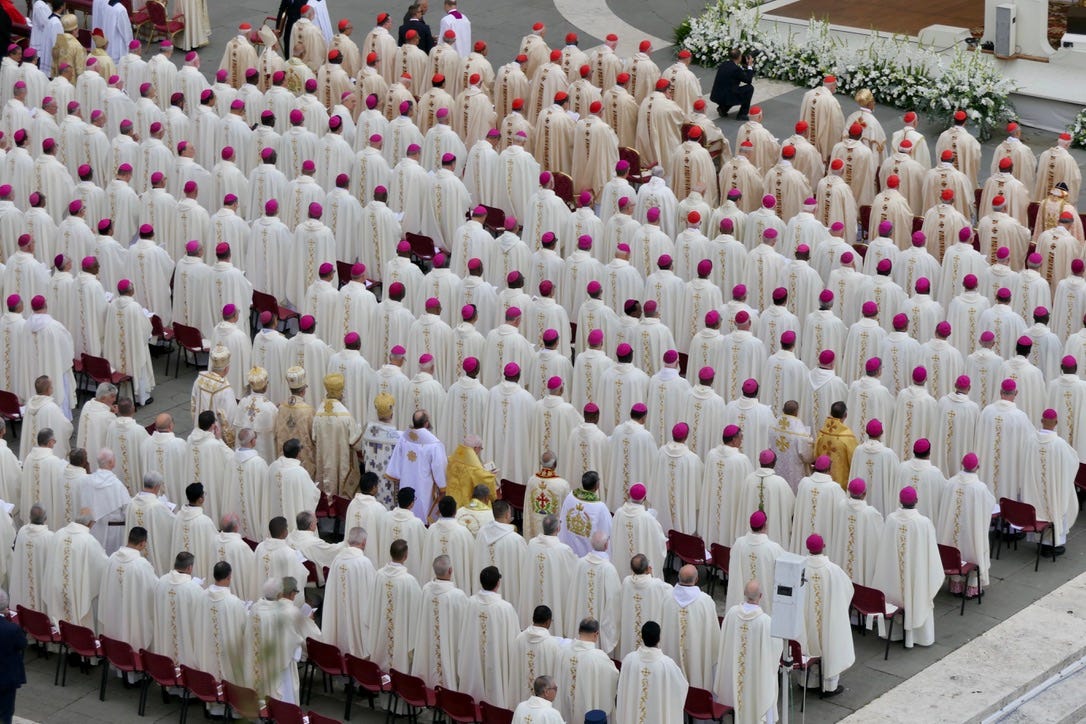
The naming of Archbishop Ronald Hicks to New York and Archbishop Richard Moth to Westminster – both traditional cardinal sees – points to Leo’s desire for men who will continue a steady approach of the status quo: not making headlines for anything good or bad. In a Church boiling with internal division it is quite easy to imagine Leo is looking for men who will not do anything to increase such tensions.
This approach may well lessen tensions, but it does carry the risk that any courageous and necessary defense of the faith may well also be eschewed by such men, in the aim of not rocking the boat.
Farther afield, chiefly outside the Anglosphere, appointments have been notably concerning due to doctrinal concerns with the bishops involved. At the Vatican, this has also happened, when in his first few weeks Leo went with the “continuity” option and appointed the right-hand man of the outgoing president of the Pontifical Academy for Life as the new lead – a man who also carries considerable moral concerns.
One thing Leo does seem notably concerned with is addressing criminal illegality among bishops, as demonstrated by the recent swift removal of the scandal-plagued Chaldean bishop in the U.S. This could be part of a move to ensure the Church cannot be attacked from the outside, while granting him a breathing space to then deal with the crisis within.
In essence, Leo appears to favor at least “decent” curial governance and a lack of polemics. Given the national pooling of candidates this means that the Anglosphere is somewhat more likely to see bishops who are decent administrators and uninspiring Church-men, whilst elsewhere it is a case of choosing the least dangerous of a bad bunch.
But while such an approach might work on a limited scale and time-period, its limitations are readily clear for the global Church at a time when doctrinal confusion is rife and the episcopate swamped with numerous bad actors.