
The Decline of the Petrine Ministry?
I believe that recent popes have lost authority and spiritual capital. Their personalities take center stage.

Editor’s note: The following is a guest commentary from Bishop Marian Eleganti, the former auxiliary bishop of the Diocese of Chur and former Abbot of St. Otmarsberg Abbey. It is published on Per Mariam at the direct request of Bp. Eleganti.
VATICAN CITY (PerMariam) — On July 31, 2026, Pope Leo XIV met with American rock musician, poet, and artist Patti Smith — the so-called “Godmother of Punk” — in a 40-minute private audience at the Apostolic Palace in the Vatican. Both are from Chicago. The meeting was attended by Father Antonio Spadaro. There are several official photos and a video of the encounter.
This harmless encounter — I imagine that it mainly involved an exchange of pleasantries, with hardly anything of great significance for the Church — raises questions for me.
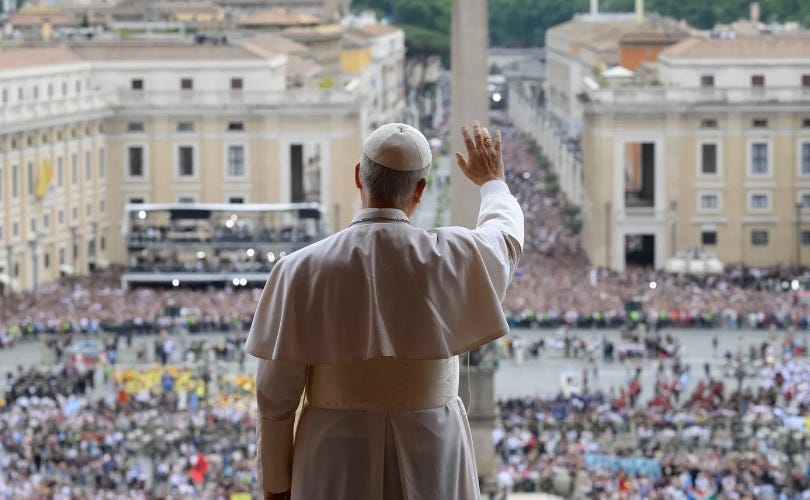
For a long time now, I’ve been personally troubled by the fact that, since John Paul II, popes have increasingly been speaking in a purely informal manner on all sorts of occasions (e.g., on an airplane or by the roadside, as Pope Leo XIV recently did in Castel Gandolfo). They give spontaneous interviews and express personal opinions. They are accessible to all sorts of people who want to have their picture taken with them. Given a pope’s workload and responsibilities, does he really have nothing more important to do than grant such private audiences (which are especially popular when the petitioners come from show business or have some kind of cultural or elite relevance)? Such appearances reinforce the impression among the secular public that the pope is, at heart, simply another member of the international establishment. The humble fisherman from Galilee certainly knew nothing of such “glamour.” Nor did Paul seek the spotlight; rather, he entered the Areopagus in Athens to proclaim the Gospel. I will refrain here from discussing protocol obligations and significant state visits.
Among those pampered with a private audience may also be people like Emma Bonino, who spent her entire life at odds with Church teaching. Pope Francis even paid her a private visit at her apartment on November 5, 2024. However, the Pope’s task is not individual pastoral care. Nor should he teach through images, but through clear words.

Not to be forgotten are this Pope’s repeated and lengthy conversations and phone calls with the atheist Eugenio Scalfari, founder of the left-wing newspaper La Repubblica. From these, Scalfari reconstructed ominous interviews from memory. On several occasions, the Vatican had to distance itself from alleged statements attributed to the Pope. For Pope Francis, this approach — of hinting at things while remaining reserved on doctrinal matters — had almost become a method. Above all, I would like to point out: When a pope receives such people in a private audience, he cannot, out of courtesy, publicly distance himself from them afterward. As a result, such a reception comes across to many as a trivialization of what these individuals stand for. In this way, the Pope himself obscures the Church’s position and — depending on the circumstances — even causes offense to the faithful.
These audiences take on all the more false significance the less the Pope simultaneously upholds the unabridged doctrine of the faith, publicly corrects the false views of these people, and puts a stop to abuses (cf. the exploitation of private audiences with the Pope for his own pro-LGBT agenda by the Jesuit James Martin).
I believe that as a result, recent popes have lost authority and spiritual capital. Their personalities (spin doctors need images) take center stage. Their private inclinations and details irrelevant to their office become messages to the mainstream and take center stage. We see Pope Benedict at the piano or Pope Francis visiting a record store in Rome in a Fiat that’s far too small for his corpulence, just to indulge a personal whim.
Popes certainly have more important things to do than pay for their hotel room out of their own wallet, as Francis did at the beginning of his pontificate. Do they even have enough time for that? Do they have enough time to reflect on matters in prayer, to linger long before God so as to be guided by Him? Do they have enough time to read, study documents, and prepare statements in which they truly teach—teach authoritatively and unambiguously—rather than offering speculations that are of no use to us?
But no, they must constantly appear at audiences, shake hands, and receive people indiscriminately. At papal Masses, they themselves take center stage as a sort of “church star,” pushing Christ — “the actual subject” — into the background. The papal throne towers over the altar. The Holy Mass in St. Peter’s Square should really serve as an encounter with the LORD, and not be a “happening” featuring His servant, the Pope—to put it somewhat polemically.
I cannot comprehend this. Collections of interviews, spontaneous remarks of varying quality, personal appearances at all sorts of events — such as the blessing of an ice block at a climate conference in Rome: All these things do more harm than good to the office. They serve only those who like to use the Pope to further their own agenda. And popes have recently been lending themselves to such things. They can be seen, for the media and to the delight of business leaders, test-driving the first electric Ferrari and more. Here, too, one should pay attention to the ambivalence of the images!
For me, there is a lack of distance — in the positive sense of the word. I’m not talking about aloofness, but about dignity. This is often underscored more by silence than by speech — by speaking at the right moment, and then in a warm and engaging manner, using few, unambiguous, and clear words. Pope Francis demonstrated this particularly toward traditionalists and Mafiosi, or in the context of migration. He was able to clearly condemn abortion while warmly welcoming its proponents and even elevating them to significant Vatican commissions. This, too, undermines the Church’s doctrinal position.
We need discernment in the sense of tradition (not in the sense of so-called “new synodality”). But the popes have almost no time for this. They spend far too much time on audiences, greetings, handshaking, and travel. I see the danger of activism. It masks the lack of a clear condemnation of heretical positions, which are also held by bishops (cf. the Synodal Path). These positions must be clearly identified, and their proponents must be admonished or removed from office.
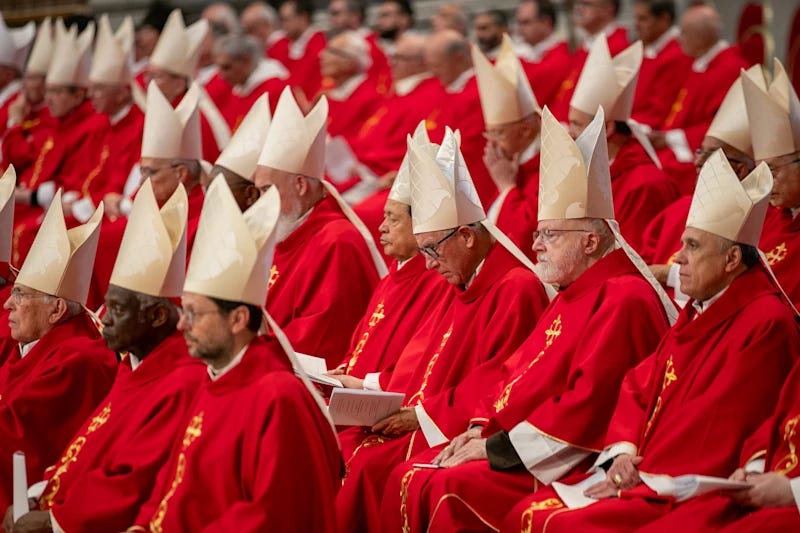
Burning issues such as the liturgical question are being put on the back burner. As advisors to the Pope, the cardinals do not really have a say.
St. Pope John Paul II — perhaps willy-nilly — gave his public appearances as Pope the character of a superstar, especially through World Youth Days. In 2003, John Paul II published “The Roman Triptych—Meditations,” a new cycle of poems. The Vatican documented its official presentation on March 6, 2003, as if it held significance comparable to the major magisterial documents from the same pen. Even as Prefect of the Congregation for the Doctrine of the Faith, Benedict published collections of interviews, a practice he continued as pope. With his valuable books on Jesus, he did not intend to teach authoritatively as pope, but rather to make an academic (?) contribution, as he had done in the past when he was a university professor.
All of this is unusual for popes, who are expected to teach authoritatively. Pope Francis produced several autobiographies at once — a format previously unthinkable for popes. Moreover, he did not write them himself, as one might assume. Through all these innovations, the media portrayal of his personality and style took on almost greater significance than what he taught or was supposed to teach. In the age of the media, there was a concerted effort to come across well. This was also evident with Pope Francis. Any cracks in his image were quickly patched up by the media (cf. his brusque reaction in St. Peter’s Square when a Chinese woman grabbed his hand and pulled him toward her on December 31, 2019, and the “mea culpa” that became necessary during the Angelus the following Sunday).

But for the LORD to shine through, other things — the irrelevant, the overly personal — must take a back seat. The media, however, take particular delight in turning precisely the latter into a main attraction: the swimming pool or tennis court at Castel Gandolfo, the black shoes beneath the white cassock, the worn leather briefcase from days gone by, Benedict’s cute cat, the piano, the Fiat, the Ferrari. The list just keeps getting longer. Who cares about that when popes are teachers of the truth? A revealed truth! I don’t think they need to constantly undertake elaborate and grueling trips for that (for the truth) — trips that physically exhaust them — when a single sentence from their lips can circle the globe in the blink of an eye without them even moving.
How much personal energy is lost this way — energy that is then lacking elsewhere (also due to their constant absence): in leading the Curia; in meeting with people who are truly relevant to the Pope’s decision-making; in staff meetings to prepare sound statements and coordinate the various dicasteries. Their presence is not required merely to observe processes initiated by others, to let them run their course without providing leadership, to act as students themselves, or even to be good listeners. Are they not the teachers of Christendom, whose words everyone awaits? Do they not sit on the Chair of St. Peter, and not on some other chair? Are they not needed above all in Rome?
The popes have become all too human in the exercise of their office. Their personality, not their office, takes center stage. This may seem appealing to some who are eager to get a photo with them, perhaps later exploiting it to promote their heretical views.
The mainstream wants to see them as approachable: as ordinary people just like the rest of us. Pope Francis, in particular, wanted the latter. For this reason, on March 25, 2017, in Milan — much to the annoyance of many believers — he spontaneously used a nearby portable chemical toilet, which his spin doctor, Antonio Spadaro, naturally put into the proper context afterward. Most recently, he had his caregiver push him in a wheelchair through the bustling St. Peter’s Basilica while dressed in everyday clothes, as if he were just some senior citizen from next door (with all due respect to his terminal illness!). For me, this was yet another historic low point for the papacy.
Popes, after all, are not people like us. They should have respect for their office and, as guardians of the Church’s doctrine, step down personally like John the Baptist, who wanted to be nothing more than a voice—albeit one that speaks the truth. In contrast, his own profile was of no consequence. Popes should remain aware of this: that it is not their personality that counts, but their office. That is a cross to bear. “He must increase, but I must decrease” (John 3:30). They are merely the friends and representatives of the Bridegroom, not the Bridegroom himself. Only the latter is of significance and interest!