
Editor’s note: The following is an analysis by veteran Vaticanist Luis Badilla regarding the publication of Pope Francis’ diary by Cardinal Fernández. {A review of the book by this correspondent can be found here}.
Badilla is perhaps less known in the English speaking world, but for many years he was recognised as a leading Vatican expert. His site was so widely respected that it became known as an unofficial Vatican news outlet and was regularly checked by the Secretariat of State. It was also described by fellow Vaticanists as “a reference point of the diplomatic, curial and journalistic world, consulted even internationally.”
Though now technically retired, Badilla continues to issue weekly analyses on the recent Vatican events to a small group of contacts. This essay is translated into English and published here with his permission.
VATICAN CITY (Per Mariam) — The book, presented on November 25 by the publisher (Libreria Editrice Vaticana - LEV) as “Pope Francis’s Personal Diary” — and which has been the subject of discussion for several weeks — is, in truth, something else entirely, very different from what has been advertised.
It is a book by Cardinal Víctor Manuel Fernández “that compiles notes by Jorge Mario Bergoglio from 1992 to 2024, kept in a planner.”
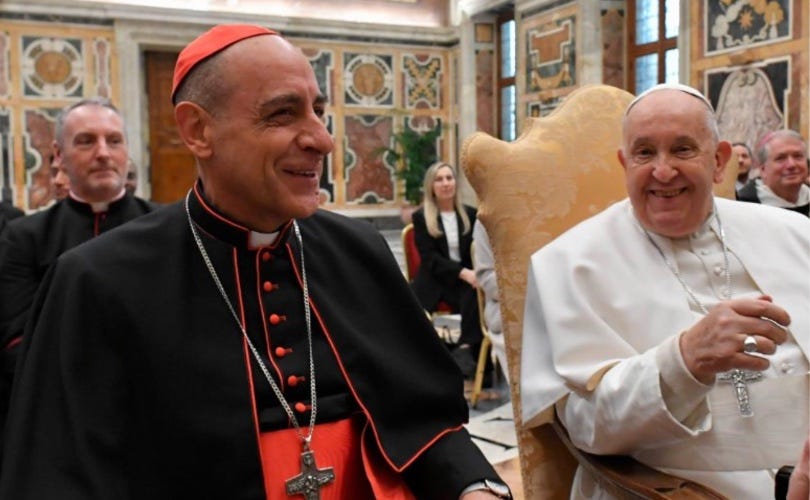
In reality, this unusual and clumsy publishing venture is a book by Argentine Cardinal Fernández – a close friend of Pope Bergoglio, the current Prefect of the Congregation for the Doctrine of the Faith, as well as a poet and writer – who presented his work in Vatican News on November 24 as follows: “A concise yet intense volume that compiles notes by Jorge Mario Bergoglio from 1992 to 2024, preserved in a diary. The private side of a Pope who jotted down fears, self-assessments, and feelings of inadequacy—and who, worn down by the threats of the devil he had ‘seen’ on several occasions, entrusted himself entirely to God’s mercy.”
This distinction between the Pope and the Cardinal Prefect is trivial and obvious, yet it must not be overlooked. It is an essential methodological issue for better and more detailed understanding of what is being discussed, especially since both the publisher (i.e., the Holy See) and the author state that the volume offers a portrait of the “most authentic Bergoglio” drawn “from his private papers.” Not only that: it is added that these papers are “indispensable material for obtaining a complete picture of his character.”
Thus, for poor Francis, this little volume is supposed to be decisive in situating him within the grand history of the world and the Church, but the initiative has failed; not only does it place Pope Bergoglio at the center, but it also drags Pope Prevost into the mix. Cardinal Fernández clarified a few days ago: “Pope Leo agreed with everything. He also believes that publishing only the texts could confuse readers who do not know Francis in depth, and therefore, he considered my comments — which explain the context — to be important.” (Vatican News)
A clumsy and inappropriate project
This consideration alone prompts a first and fundamental question: Did this publishing project have the express and documented authorization of Francis himself or of Pope Leo XIV?
Or who, and how, authorized LEV to officially publish and promote such a volume – one that was so lacking in credibility from the very start, devoid of indisputable foundations, and without answers to questions that those responsible for the editorial project could well have anticipated months ago, had they reflected on what they were about to do? Anyone at the highest levels of the Vatican who had read the drafts would have asked many questions and would certainly have advised investigating the matter further, entrusting it confidentially to experts. A so-called “personal diary” of a Bishop of Rome is a very serious – indeed, extremely serious – matter and therefore should not be made available to just anyone without proper authorization.
The project clearly reveals an entirely unnecessary attempt to sketch out a sort of mystical profile of Pope Bergoglio. The author of the diary-style text, Cardinal Fernández, from the first page to the last, paints a portrait of Pope Francis using his own bizarre narrative interspersed with ambiguous phrases and snippets of quotations – often brief remarks – drawn from the Pontiff’s so-called “Personal Diary.”
This “Diary” consists of thoughts, reminders, notes, and comments jotted down over 32 years of life without any organic structure, without any particular pretensions, and for entirely personal use. In a seriously inaccurate, but above all clumsy manner, the author attempts to convey Bergoglio’s spiritual intimacy by weaving these notes into a narrative of his own devising, without explaining or documenting the context or the reasons behind the quotations.
The result is that the Argentine Pope emerges as such a mediocre, insubstantial figure that it is offensive to his memory. Something similar had already happened when Francis’s entourage reported Pope Bergoglio’s last (alleged) words before his death. In this sense, this book is insensatus – that is, devoid of common sense, imprudent.
What about the original text of the pope’s notes?
At this point, as many have already done, there is only one question to ask: where is the complete original text? Without this document, nothing Cardinal Fernández writes is reliable, because the reader does not understand the true and ultimate context of the Pope’s words and, above all, is unable to grasp the meaning and rationale behind the quotations, as already emphasized.
Quoting – especially when referring to a Pope – is a very serious matter, and the author must earn the reader’s trust by demonstrating the rigor and soundness of his work. In this volume, unfortunately, there is a lack of third-party corroboration: in several sensitive passages, no witnesses, corroborating facts, or convincing evidence are cited. Under such circumstances, a more than legitimate suspicion of manipulation arises.

This sort of annotated anthology of Bergoglio’s personal notes is a work that fails to meet even the minimum standards of editorial rigor. The author, Cardinal Fernández, has done too many things all by himself: he was the only one to have access to the original and complete text, the only one to select the quotations and omissions, the only one to construct its thematic structure... In short: he was the discoverer of the text, the analyst, the interpreter, and the jack-of-all-trades for the entire editorial operation from the day the work-in-progress was announced.
“Francis’ widows”
In the final section, it would appear that the author availed himself of the support and advice of a segment of the Vatican media apparatus (Dicastery for Communication), which operated according to the usual, well-worn criteria of the “friendly publications and cooperative journalists” model: rewarded with advance access to extensive excerpts, these journalists had to be cautious in their criticism and avoid uncomfortable questions, refraining from any in-depth analysis. Above all, they were expected to praise the book without having had the slightest time to read its 160 pages, let alone conduct a detailed and rigorous analysis to verify facts and cross-check information.
We, particularly since Pope Francis’s trip to Chile (January 15–18, 2018), have been openly critical of numerous aspects of Jorge Mario Bergoglio’s pontificate. Among these criticisms, we have often highlighted the damage caused to him by the infamous “magic circle” of Santa Marta, composed largely of journalists now ironically dubbed “Francis’s widows.” Unfortunately, nearly twenty months after the Argentine pope’s passing, with this book and this media campaign, the “widows” have returned to the fray, using some of Jorge Mario Bergoglio’s private notes in a clumsy and inept manner, without considering the damage inflicted on his memory.
At this moment, we wish we had the talent necessary to effectively defend the privacy and memory of Pope Francis. While we remain hopeful that one day we will be able to read the original text of the notes from Bergoglio’s black notebook, we must make it clear that we have not the slightest doubt about every single word of this text. We are not at all convinced by the use of this important private text, nor by the way it has been handled.
Here’s how Father Spadaro brings it full circle
Father Antonio Spadaro brings it full circle in a conversation with Bruno Vespa on RAI1: “Pope Francis had experience of the spirit. He recognized the good spirit and the evil spirit. He recognized the evil spirit, its voice, its presence. All the actions of his pontificate were based on spiritual principles. His was a mystical pontificate. Here lies the root of his governance—not in ecclesiastical politics. And this diary explains it with great clarity.” (Source – video)
What can one say...At this point…
Today, after this book, Cardinal Fernández should recall the phrase with which he tried to defend himself when, some time ago, certain passages of his from a 1995 work were cited—on the basis of which he was harshly criticized and, above all, mocked. Fernández told the journalist: “Don’t you think it’s rather petty to take that little book—to extract isolated phrases from that brief text on youth ministry—and use them to judge me as a theologian?”
The Argentine cardinal was referring to the volume *Heal Me with Your Mouth: The Art of Kissing* (Sáname con tu boca. El arte de besar), published in 1995 when he was a young parish priest in Argentina. This response appears in his first interview (granted to Javier Arias on July 5, 2023, for Infovaticana) following his appointment as Prefect of the Congregation for the Doctrine of the Faith. Here is the original text in Spanish: “Don’t you think it’s in bad faith to take that little book, to use isolated phrases from that youth ministry pamphlet to judge me as a theologian?”.
This is exactly — albeit in a very different and more delicate context — what he did by taking words or phrases from Pope Bergoglio’s private notes and even attempting to construct a mystical profile.