

Marian theologians critique Vatican note on Co-redemptrix as furor grows
The International Marian Association Theological Commission described the Vatican's recent note as “an anti-development of doctrine.”

(PerMariam) — The fallout from the Vatican’s document Mater Populi Fidelis continues apace, with a critique from an international body of Marian theologians coming in addition to an international Filial Appeal seeking to restore the proper veneration due to Mary.
Since its publication on November 4, the Marian Note Mater Populi Fidelis has instigated increased debate and controversy regarding the cooperation of Mary in the redemption. Its author, Cardinal Victor Manuel Fernández, wrote that “given the necessity of explaining Mary’s subordinate role to Christ in the work of Redemption, it is always inappropriate to use the title ‘Co-redemptrix’ to define Mary’s cooperation.”
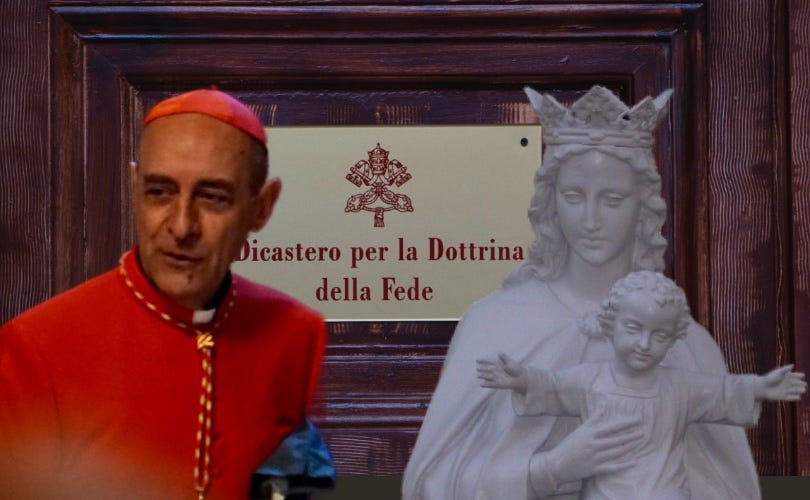
Fernández was well aware of the debate surrounding the issue, as he admitted on the day. Even during the launch event an Italian man protested vehemently against the document, which he labelled as an insult to God.
Marian theologians and experts have been swift also to critique the Note’s attack on the use of the titles of “Co-redemptrix” and “Mediatrix of graces,” outlining their longstanding use in the Church’s history, and the ready availability of the theological arguments and explanation for them.
It then transpired that Fernández had reportedly not consulted any Mariologists when writing the text, although he later told Vaticanista Diane Montagna that he had consulted such experts. During his interview with Montagna, Fernández expanded on his Note and somewhat reversed track – saying that the term may be used privately but just not in official documents:
“If you, together with your group of friends, believe you understand well the true meaning of this expression, have read the document, and see that its positive aspects are also affirmed there, and you wish to express precisely that within your prayer group or among friends, you may use the title—but it will not be used officially, that is, either in liturgical texts or in official documents.”
But the Church already has a long history of using these titles in official texts, even liturgical ones. There is indeed an indulgenced prayer which invokes Mary as Co-redemptrix.

With this in mind a Filial Appeal was recently launched, asking Pope Leo XIV to personally intervene to restore peace and proper honor to Mary. The appeal reads:
Holy Father, we desire to remain faithful to the patrimony of Catholic doctrine and to the perennial faith of the Church. For this reason, with filial trust, we beg Your Holiness to hear our sorrow and intervene in whatever manner You deem most fitting, so that the honor, truth, and special veneration owed to the Most Blessed Virgin Mary, Mother of God and Our Mother, may be restored.
It highlights the “clear opposition” between Mater Populi Fidelis and the pre-existing teaching of the Church, and asks if all the saints, popes and theologians who have used the titles before “were all mistaken.”
The Appeal also warns of subsequent effects on Marian devotion more generally, including “the Miraculous Medal, the Scapular of Our Lady of Mount Carmel, the innumerable ex-votos that adorn our Marian shrines, the Holy Rosary, and all the Marian devotions that presuppose—and embody—the true and maternal mediation of Mary?”
Now as of December 8, the Appeal has been bolstered by a strident critique of Mater Populi Fidelis by the International Marian Association Theological Commission (IMATC). The group – by no means a fringe group, due to boasting of a number renowned prelates and theologians – suggested the Note “appears to be an anti-development of doctrine.”
The IMATC systematically outlined a series of issues with the Vatican’s text, highlighting the theological and logical errors present.
“In truth,” they argued, “the title ‘Co-redemptrix’ is not difficult to understand once it is properly explained, which has been done successfully by the Church for over a half millennium.”
Belief in the Co-redemptrix and Mediatrix titles is not a fringe view, but rather that of the Church itself, the theologians argued:
It is precisely these teachings that constitute the perpetual doctrine of the Church—from their seed form in Scripture, to the Patristic model of Mary as the New Eve, up to modern and contemporary popes, who have repeatedly used these titles and articulated the doctrines that these titles represent in concise form.
Far from causing confusion, as Fernández himself opined, the title Co-redemptrix “communicates the truth of Mary’s unique but subordinate cooperation in the redemptive work of Christ,” IMATC wrote.
Any possible risks “appear more theoretical than real,” IMATC wrote. “It would be difficult to find within the Church a single reputable Catholic author in the last three centuries who taught that the Coredemptrix title denotes that Mary is divine or an equal redeemer parallel to Jesus.”
Co-redemption has been downplayed by some who argue it poses a risk to ecumenical endeavors. But the IMATC Mariologists opined that on the contrary it would be an aid:
For those outside the Church, the Co-redemptrix and Mediatrix of all graces titles become excellent opportunities for authentic Catholic evangelization, along with other key Catholic truths that require appropriate explanations, such as the Real Presence of Jesus in the Eucharist, the Papacy, and the intercession of the Saints.
As with the Filial Appeal, the Marian theologians warned of damaging consequences as a result of Mater Populi Fidelis, but noted how such results would also include trust in the papal magisterium.
If prior teachings and titles used by popes are now considered “inappropriate” or “inopportune,” why should the faithful have confidence in the papal Magisterium? Confusion and frustration in this domain are already being voiced by the People of God both in international Catholic and secular media.
It is perhaps unlikely that Pope Leo will wish to personally intervene, though perhaps the chaos and controversy may yet force his hand. He was a member of the Congregation for the Doctrine of the Faith during the period in which the Note was approved, although his direct, personal involvement with the text is not known.
He did approve its publication as Pope, but as with most of Cdl. Fernández’s texts, the published work has now come back with a vengeance to haunt a Pontiff. Such controversy may prove to be contrary to the bridge-building which Leo has been described as being so adept at.
Doubt that any atheist ‘theologians’ at the Vatican has anything but the lowest Mariology possible.
The IMATC critique is respectful but brutal. Excellent work by them; I’m really pleased that some more meaningful and tangible resistance is emerging on this.