
Here's what will happen at next week's Vatican Consistory
What is notable is the lack of time given to the free interventions, which used to comprise the largest part of a consistory prior to Pope Francis’ reign.

VATICAN CITY (PerMariam) — Details of the upcoming consistory reveal that just around two hours are outlined for the customary free discussion between cardinals and the Pope, whilst strict confidentiality and media silence is ordered on the participants.
In an exclusive published by reliably-sourced outlet Messa in Latino on Wednesday morning, more precise details about next week’s Extraordinary Consistory were provided. A letter sent to the cardinals was published, containing both the daily itinerary and formal instructions for the cardinals to adhere to.
Running chiefly on June 26 and 27, the consistory also includes the June 29 Mass marking the feast of Saints Peter and Paul.
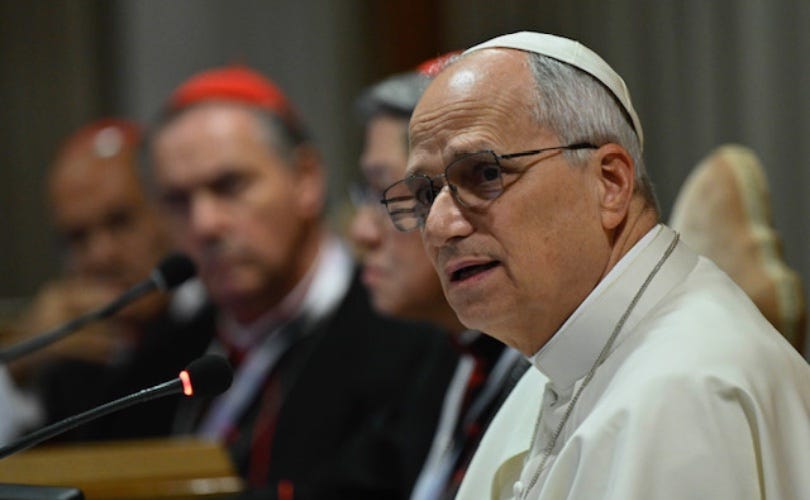
Beginning proceedings, the cardinals will join Leo XIV for a concelebrated Mass in the Vatican at 7:30 am on June 26, before heading to the Paul VI Audience Hall for the first of the four sessions over the two days of meetings. (The full schedule is found at the bottom of this article)
As previously reported on these pages, the College of Cardinals will examine four themes during the four sessions:
First session — “a shared meditation beginning with the international situation,” during which the cardinals will be asked to “share” the concerns and priorities which emerge from their respective areas of the globe.
Second session — “The Culture of Power and the Civilization of Love” drawing from passages of Leo’s encyclical Magnifica Humanitas.
Third session — “Building for the Common Good: The Construction Sites of Our Time,” again based on passages of Magnifica Humanitas.
Fourth session — The Path to Implementing the Synod, with updates on the Church’s preparations for the Synodal Assembly concluding at the Vatican in 2028.
The liturgy is notably left off the official schedule, and while individual cardinals may raise it during the free intervention period, it will not be formally addressed. This has led to speculation that perhaps Leo intends to tackle the liturgical question himself, away from the consistory, but so far nothing more concrete than speculation has emerged.
Also absent is any discussion of the Just War doctrine, which had been billed as part of the Consistory when the Vatican issued official details a few weeks ago.
Overall view
What is notable is the lack of time given to the free interventions, which used to comprise the largest part of a consistory prior to Pope Francis’ reign. The schedule issued to the cardinals grants just 2hrs 15 minutes for free interventions at the end of the consistory, but in that same timeframe they must also listen to a speech from Leo and sing the Te Deum.
Organizationally the consistory resembles that which was held in January, which itself was very much a copy of the Synod on Synodality. The small table discussion format severely limited the ability of cardinals to address the entire assembly, and the use of emails for cardinals to submit their reports negatively impacted the less tech-savvy of the College.
“I think this was an experiment promoted by those who organized it with more illogical ideas,” Cardinal Gerhard Müller told me after January’s consistory.
Interview: Cardinal Müller on Leo XIV’s first consistory

Grateful for the return of consistories as the proper forum for cardinals to engage with the Pope, but warning about issues remaining over synodality – Cardinal Gerhard Müller has shared his thoughts about the recent Extraordinary Consistory with this correspondent
While he noted that in the small groups cardinals could “speak openly,” he added that “at the end there no result for the others and therefore everybody would prefer the plenary discussion.”
Practical workings
Each of the four sessions will begin with a the introduction of the relevant theme, followed by a prayer or bible reading. Then a division into small table groups will take place, just as at January’s consistory.
Nine groups will be made up of cardinal-electors, while eleven groups will be made up of cardinal-electors serving in the Roman Curia and all those cardinals too old to vote. Thus each group will separately discuss the theme of the session, rather than having a full discussion between the entire room.
According to the letter sent to the College, each of these twenty groups will have a president and a secretary. Work is to be “carried out while maintaining a climate of mutual listening and respect,” and “tensions and disagreements should not be avoided, as long as they are addressed with respect and fraternal affection.”
Each member of the group speaks for 3-minutes about the questions the schedule prompts. The whole group just then ponder everything in silence. After this, another round of 2-minute speeches is held for all members of the group, summarizing the most interesting points of the first round.
It falls to the secretary of each group to compile a report which the group approves. No details were given on whether it must be a report approved by unanimous vote, though this was the situation in January – a stipulation which leaves little room for the airing of elements deemed controversial.
Only the nine groups of cardinal-electors will present the summary of their reports to the entire room; the other eleven groups must simply email them to the organizers.
While sparingly little time is afforded for free interventions – when the cardinals can raise any issue with the Pope – there is an email provided which will allow them direct access to contact him.
Previous consistories saw journalists receive detailed information about how the proceedings were run.
Yet January’s was very different, and June’s looks set to be the same. Cardinals have received a strict order “to maintain confidentiality of the proceedings and not to make statements to the press during the Consistory.”
A press conference will be held after the consistory, though if it is anything like January’s then it will raise more questions than answers.
Friday, June 26
7:30 a.m. Holy Mass in St. Peter’s Basilica presided over by the Holy Father Leo XIV
Following the Mass, in the atrium of the Paul VI Hall: welcome, distribution of badges and documentation – Coffee service will be provided
Introduction and First Session: 9:30 a.m. – 12:45 p.m. Paul VI Hall
9:30 a.m. Veni Creator Spiritus
Opening Address
Greeting by His Eminence Cardinal Giovanni Battista RE, Dean of the College of Cardinals
Introductory Remarks by the Holy Father
Presentation of the meeting and working procedures
FIRST SESSION: In what kind of world are we called to proclaim the Gospel?
10:00 a.m. Biblical meditation followed by a few moments of silence and personal prayer
10:30 a.m. Group discussion, based on the following questions:
What sufferings, tensions, and questions most strongly affect the peoples and ecclesial communities entrusted to your care today?
What signs of hope, fidelity to the Gospel, and possible reconciliation is it important to bring to our shared discussion?
12:00 p.m. Plenary Report
All groups will submit their contributions via email. The groups of Ordinaries and some of the other groups will present their reports in the hall.
12:45 Angelus
SECOND SESSION: “The Culture of Power and the Civilization of Love” from 4:00 p.m. – 7:30 p.m. Paul VI Hall
4:00 p.m. Prayer and resumption of proceedings. Introduction to the theme based on Chapter V of Magnifica humanitas (nos. 182–192)
4:20 p.m. Group Work, based on the following questions:6:00 p.m. Break
How do the tensions, divisions, and conflicts affecting the world today impact the lives of our Churches and our peoples?
What languages, attitudes, and practices can help foster reconciliation, coexistence, and peace?
6:30 p.m. Plenary Session
All groups will submit their contributions via email. The Ordinaries’ Group and some of the other groups will present their reports to the plenary.
Followed by: open discussion on the session’s theme
7:30 p.m. Closing prayer
Saturday, June 27
7:30 a.m. Holy Mass in St. Peter’s Basilica presided over by His Eminence Cardinal Giovanni Battista Re Followed by: coffee service in the atrium of the Paul VI Hall
THIRD SESSION: “Building for the Common Good: The Construction Sites of Our Time” 9:30 a.m. – 12:45 p.m. Paul VI Hall
9:30 a.m. Prayer and resumption of proceedings. Introduction to the theme based on the Introduction and Conclusion of the Encyclical Magnifica humanitas
9:50 a.m. Group Work, based on the following questions:Break – each group determines the most appropriate time for a break
What are the divisions today, in your contexts, that make it more difficult to build the common good?
What expectations and questions are emerging from the people and communities the Church is called to listen to—and whom we may not be listening to enough?
What forms of support, guidance, or initiatives from the local Churches and the universal Church could most effectively aid the commitment to building the common good?
11:30 Plenary Session
All groups submit their contributions via email. The groups of Ordinaries and some of the other groups present their reports in the plenary hall.
Followed by: open remarks on the session’s theme
12:45 Angelus
FOURTH SESSION: The Path to Implementing the Synod 4:00 PM – 7:30 PM New Synod Hall
4:00 pm Prayer and resumption of proceedings. Introduction to the theme based on the document Toward the Synodal Assemblies 2027–2028. Stages, criteria, and tools for preparation.
Questions for clarification will follow
5:00 p.m. Break
5:30 p.m. Dialogue with the Holy Father. Open remarks, limited to a maximum of 3 minutes each
Concluding remarks by the Holy Father
Te Deum
Dinner with the Holy Father at 7:45 p.m., in the Paul VI Hall