

VATICAN CITY (Per Mariam) — Pope Leo passed on his encouragement to the Priestly Fraternity of Saint Peter last month, during a meeting with one of the Fraternity superiors, as the Vatican remains officially silent on the SSPX or the Latin Mass restrictions.
On October 28, Father Benoît de Giacomoni – superior of the French district of the Latin Mass order, the Priestly Fraternity of Saint Peter (FSSP) – spoke with Leo XIV at the end of one of the weekly general audiences. Revealing details of the encounter, the FSSP described the meeting as “a warm exchange” in which Leo “blessed the Province of France”.
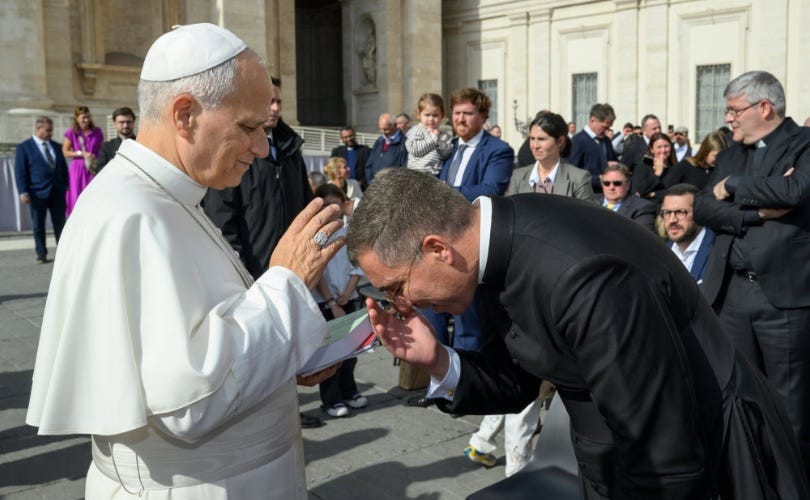
Their meeting took place just a few days after the annual Ad Petri Sedem pilgrimage to Rome, which this year was somewhat overshadowed by the Vatican’s prohibition on the pilgrimage processing into St. Peter’s Basilica or having Mass inside.

Much debate has ensued since then: many have argued that the Vatican’s decision was woeful and will only backfire as it will lead to greater numbers in the next pilgrimage. Others conversely attested that the publicity of the pilgrimage’s ban from the Basilica would turn Leo against the traditional cause, suggesting that the media coverage was creating an incident which Leo would be keen to avoid.
While both these assessments of the pilgrimage oppose each other in some regard, they point to the same presumed conclusion that the Pope wants to distance himself from traditional Mass Catholics.
Yet his meeting with FSSP superior Fr de Giacomoni suggests otherwise, particularly regarding the blessing he gave to the French district. It seems that Leo is not opposed to the traditional Mass in itself, but rather elements he – correctly or otherwise – perceives as attached to it.
The meeting also comes against the backdrop of three private papal audiences the FSSP superiors have had recently: with Pope Francis in 2022 and 2024, and then with Leo in 2026. During their meeting with Leo this year, the FSSP outlined its charisms and the nature of celebrating the traditional Mass as outlined in its constitutions.
“This audience also provided an opportunity to evoke any misunderstandings and obstacles that the Fraternity encounters in certain places and to answer questions from the Supreme Pontiff,” they added.
De Giacomoni’s meeting with the Pope thus points to the emerging trend which Leo seems to be taking regarding the traditional Mass. Traditionis Custodes remains very much in force although it does not directly impact the FSSP, as confirmed to them by Pope Francis in 2022. Added to this is the new situation regarding the SSPX and the Vatican’s call for Catholics to avoid Society liturgies following the July consecrations.

Leo has seemed uninterested in dealing with Traditionis Custodes, whilst being keen to move swiftly against the SSPX. It seems increasingly that he is happy – at least for now – to consign the issue of the Latin Mass to orders such as the FSSP, providing he is reassured that they meet his requirements for adherence to the magisterium and crucially Vatican II.
Proving what they are not
With this in mind, de Giacomoni’s meeting is even more noteworthy, since he gave the Pope a variety of gifts, including a copy of the June 2026 letter to FSSP friends and benefactors. The June edition of the regular newsletter contained the district superior’s response to the Society of Saint Pius X’s then-upcoming episcopal consecrations.
Recounting the FSSP’s founding in 1988, which occurred when priests and seminarians desired to leave the SSPX due to the 1988 episcopal consecrations, de Giacomoni likened the situation in 2026 to 1988.
“We could say that this does not concern us (or no longer concerns us), but the gravity of such an act for the unity of the Church and the history of our foundation cannot leave us indifferent,” he wrote.
Notably, the priest commented that “in many respects, a doctrinal, theological, and liturgical crisis certainly persists within the Church.” Yet he added that such a situation “does not prevent the Holy Spirit from continuing to act within Her. Thus, we have observed with joy in recent years that many people are discovering or rediscovering the Catholic faith.”
Continuing, he firmly defended the FSSP’s existence, making an indirect rebuttal to arguments posed against the Fraternity by some SSPX members. The Fraternity’s founders were aware that their decision “would not always be well understood,” de Giacomoni wrote.
“In establishing the FSSP with respect for and in proper dependence on ecclesiastical authorities, our founders were not unaware of the sometimes difficult consequences this might have for their community and for the faithful entrusted to it…But Christ, who knows all things, does not leave His children orphaned. Suffering united to Him carries within it the grace of trusting surrender, and the supernatural acceptance of the cross is never a surrender.”
He rejected the claim that the FSSP, by nature of its full recognition by the Holy See, is thus forced to “silence in the face of the errors of men of the Church or the scandals visible within it.” Rather, de Giacomoni described the FSSP as living “fully in communion with the Catholic Church – not as if seeking to save it, but as working within it to proclaim the joy of the Gospel.”
Once more pushing back against arguments expressed by SSPX members, de Giacomoni presented the FSSP as an alternative to the Society. He outlined the FSSP’s acceptance of certain points which the Society has raised concerns about.
The FSSP accepts Lumen Gentium section 25, concerning the exercise of the magisterium and the hierarchy, de Giacomoni wrote, just as the Fraternity accepts the legitimacy of the Novus Ordo and 1983 Canon Law. He also noted that the FSSP was committed to “maintaining a positive attitude of study and dialogue with the Apostolic See, avoiding all polemics” regarding any points in Vatican II, the new Code of Canon Law, or the liturgical reforms which “seem to us difficult to reconcile with Tradition.”
De Giacomoni’s word are clarifying when it comes to the Fraternity’s stance on current issues in the Church. They take on much greater weight now by virtue of the fact that he has given his thesis to the Pope, following the July 1 episcopal consecrations.
If Leo needed reassurance that the FSSP were ‘on board’ with Vatican II in a way that the SSPX are not, then he now has it. De Giacomoni’s meeting with the Pope will have served to demonstrate to the Pope that the FSSP is ‘safe’.
The Holy See’s response to the SSPX’s consecrations has been firm, with the CDF moving against the Society in a speed rarely seen in recent years. As is widely known, the Congregation for the Doctrine of the Faith followed through on its warning and issued a decree on July 2 announcing the automatically incurred excommunication of the six bishops involved.
Since then, the Society began the initial process of a canonical appeal against the Decree and so far it is continuing through the appropriate stages. The expectation of the CDF ruling in favour of the SSPX is low, given that the CDF will be looking for the Society to demonstrate remorse for the consecrations. No update has been given by the Holy See, and requests for such information by this correspondent to the CDF have so far gone unanswered.
With no immediate change on the horizon regarding restrictions on the traditional Mass, it seems that Leo’s current policy is to simply allow the inherited status quo to continue, whilst allowing traditional Mass orders – such as the FSSP – to proliferate and grow.
As for reading the tea leaves about the future of the Latin Mass, it is an issue which Leo cannot ignore indefinitely. Indeed, his inaction on that front was cited by the SSPX as a defence for the July consecrations.
Former Ecclesia Dei orders, like the FSSP, appear to be the vessel of his pastoral response to the desire for the Latin Mass – a response enacted by simply allowing them to continue in accord with their canonically protected constitutions. Yet the longer Leo preaches “unity,” whilst leaving the restrictions of Traditionis Custodes in place, then he will increasingly undermine the meaning of his own words and deepen the divide which he inherited.
Please help me understand why the vatican wants to do away with the TLM in diocesan parishes and at the same time promote fssp tlm v sspx tlm but on the other hand promote the idea that tradition is passe and move speedily towards ecumenist ideology?
The FSSP leadership’s acceptance of made up categories such as that of full or partial communion tells us anything we need to know about them.