


(PerMariam) — Editor’s note: To mark the feast of Our Lady of Sorrows, the following is an excerpt from Father William Faber’s book “The foot of the Cross,” taken from a chapter entitled “How Our Lady could rejoice in her dolours.”
Having thus considered the characteristics of Our Lady’s dolours, we must now pass to a peculiarity of them, which it is necessary always to bear in mind, namely, their union with the intensest joy.
That her dolours were accompanied throughout with floods of heavenly joy, she herself revealed to St. Bridget. But indeed it could not be otherwise. Can we suppose it possible that a sinless rational creature can ever be otherwise than bathed in joy?
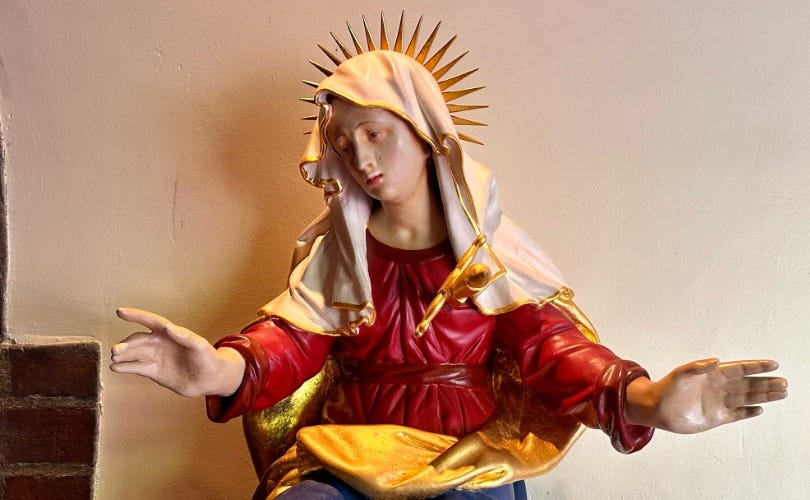
Beatitude is the life of God, and it is out of that life that torrents of gladness inundate His whole creation. It is sin only that brings sorrow, and if the sins of others can make the sinless grieve, they can never interfere with that abiding gladness deep down, which union with God must of necessity produce. Moreover there is no merit where there is no love.
If Our Lady’s dolours had not risen out of her love and been animated by it, they would not have been meritorious. But in truth love was the very cause of them. Out of the excess of love came the excess of sorrow. Now it is undeniable that love cannot exist without delectation. Love is of itself essentially a joy; and in proportion to the eminence of our Mother’s love must also be the eminence of her celestial joy. To sorrow and rejoice at once is possible even for us, whose inward life sin has distracted, and made irregular and uncompact.
We have all of us done so, even though our sensitive nature is a battle-field where the struggles are quickly over, and one or other of the contending passions is left master of the field. But it is in Jesus and Mary that this perfect union of the uttermost of joy and sorrow has taken place, and been an abiding, lifelong, normal state. It is one of the most remarkable phenomena of the Incarnation, and has seemed, in our Lord’s lower Nature, to be a sort of adumbration of His union of Two Natures in one Person.
It is also one of His characteristics in which He has given His Mother largely to participate. In His Passion He restrained His Divinity, and would not let it sensibly penetrate His Human Nature with its light and glory. Nay, He even laid His hand upon that Beatific Vision, which was due to His Sacred Humanity, and which was uncloudedly before His Soul from the first moment of His Incarnation, and would not allow it to include within its sphere of gladness His sensitive nature, lest it should blunt His suffering: and quench the fire of His great agony.
So, in her measure, our Blessed Lady in the depths of her soul was filled with gladness because of her intimate union with God, and yet the gladness had a sphere of its own, and was not allowed to break out with its vast world of light, so at least as to banish all sorrow from the heart. As was said before, her joy, so far from alleviating her sufferings, probably made her suffer more.
But once again we must remember it was not with her as with the martyrs. They sang among the fires and exulted among the panthers, because their soul was all whole and joyous, while their flesh was torn and their bones broken. But with her the soul was the chief sufferer ; and joy and sorrow divided it against itself. This was nearer to a mystery. Indeed it was a true participation in the characteristics of Jesus, a cleaving asunder of the soul without disturbing its simplicity, a division without sedition, a wound which was a new life, a battle while all was harmony and peace.
O Mother! we cannot tell how it was, only that so it wasl Thou wert all joy, and being so near God, how couldst thou help but be so? Thou wert all sorrow, and what else couldst thou be in those dark abysses of the Passion? And thy sorrow had no power over thy joy; but thy joy had power over thy sorrow, and gave it a brisker acid, a more volatile and pervasive bitterness ! Glad creature I sorrow crushed thee, and then a joy, like that of heaven, sat upon thy burden, and made it tenfold more hard to bear.
Yet we are hardly doing justice to her sorrows, when we say that they had no influence upon her joys. Doubtless they increased them, and were to her the fountains of new joys which she had never had before, or of new degrees of old accustomed joys. It is not as if her joy and sorrow were two oceans in her soul, which had no mutual inlets, and did not commingle with each other, or ebb and flow in sympathy.
So far from that, there is a sense in which we might say that her sorrow and her joy were almost identical; for her joys were sorrows, and her sorrows joys. They might be the one or the other, according to the double life that was in them. Truly in her sorrows were many reasons for joy, such as the grandest and happiest archangel of heaven has not in himself. If we look long at the darkness of Calvary, a beautiful light breaks out of its gloomiest centre.
What is it all but a magnificent reparation of the Divine Honour? Not Michael, when flushed with triumphant sanctity he drove usurping Lucifer out of heaven, so rejoiced in the honour of God, as Mary did. She, who had been allowed to fathom sin so deeply, and who in the spirit of Gethsernane had tasted somewhat of the Father’s anger, could exult in the satisfaction of His justice, as neither angel nor saint could do. She, who had lived thirty-three years with Jesus and had caught from Him His passionate yearning for His Father’s honour, could find depths of blissful congratulation in the restoring of that honour, which not all creatures together could discover. Sometimes there has been a minutest drop of that joy in our hearts, and we know what it was like, but could not tell even if we would. O for that land, where it will be an unchecked, eternal habit!
There was joy too through all the immense wisdom with which God had endowed her, because of the divine wisdom which was apparent to her in the whole scheme of our redemption. There was not a cavern of shame, but it was illuminated by several of the divine perfections, shedding over it a perfect blaze of beautiful splendour. There was not a physical horror in the Passion, from which an unloving faith shrinks back in vulgar fastidiousness, but was clothed with a strange loveliness out of the treasures of the divine mind and will.
The science of the Incarnation never came out, even to her, in such amazing, fascinating clearness as it did in her Compassion, with all its reasons, possibilities, adaptations, and conveniences. The sight she saw would have been enough to feed the worship of the nine choirs of angels for ever.