

Editor’s note: The following is a guest commentary by Bishop Marian Eleganti OSB, former auxiliary bishop of the Diocese of Chur, first published on his site and sent to Per Mariam for publication in English.
(Per Mariam) — A rite is neither conservative nor progressive. It is either Catholic or it is not. A rite is not to blame for the fact that its adherents may be more critical of reform than others. A rite is not responsible for the fact that its adherents criticize another rite. A rite is neither a wrongdoer nor a danger, as long as it conforms to the Church’s faith and expresses it. A rite should not be judged based on the mindset of its adherents. It must be assumed that it is not absolute, but objectively has strengths and weaknesses.
A rite has theological implications. These should first and foremost be seriously examined by the Church.
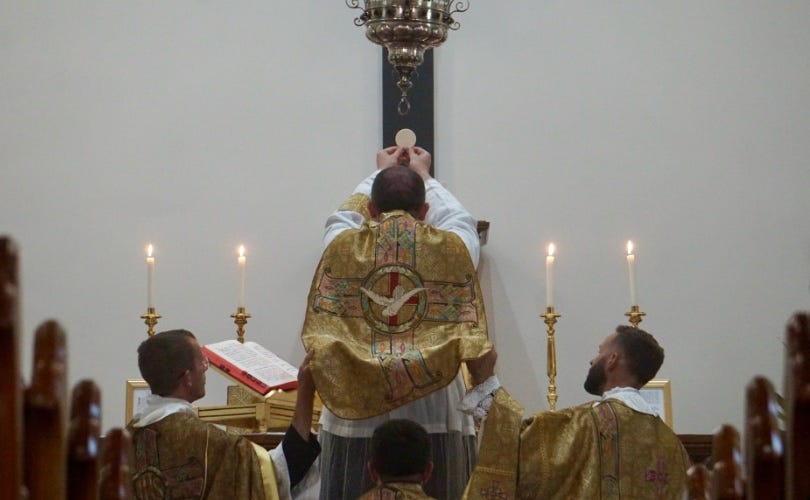
In the case of the Old Rite or Vetus Ordo (VO), this has long since been done. In other words: the tradition that approved it was not mistaken. A rite that for centuries—and in essential parts, for millennia—has been regarded as apostolic and Catholic in the best sense of the word cannot become obsolete or the subject of bitter rejection in the Church overnight. To do so would also mean rejecting its theological implications.
The Magisterium of the Church, however, cannot contradict itself. Therefore, any discussion on this matter is superfluous. It must be just as clear to every Catholic that the new rite (NO) corresponds to the faith of the Church and presents and communicates the mystery of the God-man without compromise.
It is, however, legitimate to consider why people find a Catholic rite more or less appealing. This may be due to the rite itself, but also to the mindset or history of those who favor a particular rite. Whether adherents of a rite are orthodox or heretical is another question. Whether a rite contains theological errors is likewise another matter. To be considered Catholic, it must have already passed this test. This applies to both the NO and the VO, so questioning it is unwarranted.
However, one rite may emphasize certain aspects more than another. The weight given to these aspects is, in turn, another question, but insofar as a rite is recognized as Catholic, it is a matter of preference, not of orthodoxy. As is well known, there are well over twenty rites in the Catholic Church, most of them time-honored. They have never been viewed as a threat to the unity of the Catholic Church, but rather as its richness. So where, then, is the problem?
All of my assertions so far seem reasonable to me. If they were heeded, we would move away from a toxic debate.
That would mean we could adhere to any rite approved by the Catholic Church without violating the unity of the Church or fearing that it is endangered. This assertion is irrefutable. Therefore, the question of rites within the Catholic Church does not constitute a matter of its internal unity! Incidentally: The greatest danger to the unity of the Church comes not from the rites, but from heresies. But today, people do not want to look closely at that. Instead, in Rome, they are sorting out rites rather than heresies.
Both the Vetus Ordo and the Novus Ordo are recognized by the Magisterium of the Church. They are Catholic. They do not need to be banned. Why should the Church prefer one rite over another when they are all Catholic—full forms of the sacrament? Catholic Chaldeans or Armenians, Byzantines or Maronites, Syro-Malabars or Syro-Malankars will continue to rejoice in this. They do not cause any disturbance, even though their manner of celebration is significantly different—but the sacrament itself is not! Can we affirm this and apply it to the Vetus Ordo as well? Of course! Further questions arise:
Is it permissible to engage in theological discussion about liturgical reform? Yes, it is! Is there a historical or cultural component in every rite? Yes, there is! Is every reform in the course of Church history ipso facto progress or an improvement? That will only become clear over time.
May a reform be examined in this regard from the perspective of tradition? Of course! Is this process ever fully complete at a specific point in time? Not in an absolute sense! For every era has its own one-sidedness and perspective. Is something all the more time-tested the longer it has withstood the test of time? Experience suggests yes! Can something be measured by its positive effects? Yes! It can! This alone would defuse many of the landmines in the debate.
So where, then, does the real problem lie?
In our context, opponents of the VO will answer: in the mindset of conservatives or those attached to tradition! I distinguish the latter from traditionalists just as I do not equate supporters of the NO with modernists!
Counterquestion: Is the mindset of the VO’s opponents – generally speaking – less problematic than that of those attached to tradition? Answer: No! Based on what has already been clarified, both questions must be answered independently of the rite. For I know many problematic people who adhere to the NO and who jeopardize the unity of the Church. But I have also condemned those who adhere to the VO and who destroy the unity of the Church (FSSPX). Let us be clear: Undoubtedly, there are people in both camps (VO and NO) with a problematic mindset and erroneous views, even regarding the faith!
There have always been theological discourses about Council documents. Commentaries fill volumes. One may wrestle with what is meant, with terms in the context of their time, whose meanings can change as, for example, in the case of freedom of conscience. What documents say – and what they do not say – requires study.
I come to another aspect:
A rite does not make a person devout. Otherwise, we would have only devout people in the NO, to put it another way. Worship, true faith, and devotion are rooted in the heart and express themselves from the inside out. The Pharisees and scribes were indeed considered devout people. Jesus, however, called them whitewashed tombs, even though they followed rites and rubrics and were extremely law-abiding. We should therefore stop judging the orthodoxy and piety of Catholics based on their preference for a particular rite. Ritualists—that is, in my opinion, people who treat a form as an absolute—exist in both camps, as do erroneous views.
I celebrate Mass in the Novus Ordo. At the same time, I love many of the priestly prayers of the Vetus Ordo. I have also celebrated in the Byzantine (Chrysostom) Liturgy, as well as in the Syro-Malabar and Syro-Malankara rites. In the meantime, I have relearned the VO, in which I served as an altar boy before the Council when I was a child. In none of the rites mentioned have I been found to be more devout or faithful than in the others. The sinner remains the same, no matter how he celebrates.
I ask readers to reassess and reconsider their own attitudes in light of what has been said so far. A good Catholic must acknowledge all rites recognized and practiced within the Catholic Church and be willing to encounter Christ, the Son of God, in them and to receive Him in an appropriate manner. Otherwise, for my part, I question the person’s mindset—not the rite they prefer—at this point.
The discussion regarding imbalances in one’s own (faith) views and in one’s own practice should not be tied to the rite and must be conducted on a different level. The sacrificial and Eucharistic character of the Holy Mass is present in all Catholic rites. Reductionist beliefs or prayers can be corrected.
The rest is a matter of preference. In all Catholic rites, we speak of the Holy Mass or the Divine Liturgy. Whether we ourselves are holy is another question. How narrow-minded we are is another as well. I encounter such people everywhere, so this is not a matter limited to specific rites. It is legitimate to discuss which form better expresses the appropriateness of an attitude or a sacramental truth.
I’ll conclude. Let us not treat rites as absolute, but rather let us focus on piety, orthodoxy, and catholicity. At the center of the liturgy is GOD or CHRIST, not man. In this regard, corrections are always possible—at every level!