


VATICAN CITY (PerMariam) — One of the most striking, even controversial, passages in Pope Leo XIV’s encyclical Magnifica Humanitas is his declaration that the Church’s teaching on just war is no longer suitable for the modern world.
Leo has made his regular appeals for peace in the world one of the most regular and recurring elements of his pontificate, starting from his first moments emerging onto the Vatican loggia in front of the world.
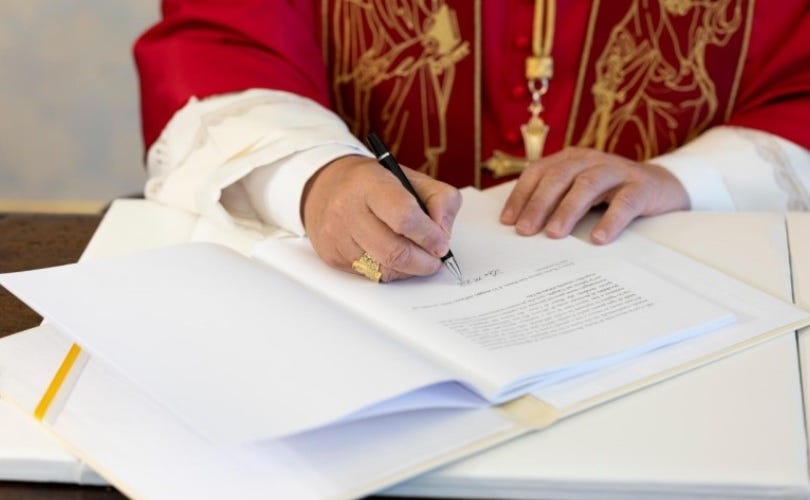
This was re-iterated in Magnifica Humanitas as Leo decried the “normalization of war” and the manner in which war is becoming a normal part of common parlance and international policy.
{For a full roster of different analyses on the encyclical by this correspondent, interested readers may find them on Pelican+, The Catholic Herald, Ad Vaticanum, The European Conservative.}
“We are witnessing a real paradigm shift in public discourse and in decisions regarding rearmament, with a troubling revival of war as an instrument of international politics, while the very ethical principles that had previously limited its use are being eroded,” he wrote.
But as part of this, Leo took aim at the Church’s teaching regarding a just war:
It is in this context that humanity is slipping into a violent culture of power, where peace no longer appears as a responsibility to be taken on, but as a fragile interval between conflicts.
Today, more than ever, without prejudice to the right to self-defense in the strictest sense, it is important to reaffirm that the “just war” theory, which has all too often been used to justify any kind of war, is now outdated. (182) Humanity possesses far more effective and capable tools for promoting human life and resolving conflicts, such as dialogue, diplomacy and forgiveness. The use of force, violence and weapons reflects a relational poverty that always has disastrous consequences for civilian populations.
Footnote 182 adds further information and a quotation from the catechism regarding just war:
“The Catechism of the Catholic Church speaks of the possibility of legitimate defense by means of military force, which involves demonstrating that certain ‘rigorous conditions of moral legitimacy’ have been met. Yet it is easy to fall into an overly broad interpretation of this potential right. In this way, some would also wrongly justify even ‘preventive’ attacks or acts of war that can hardly avoid entailing ‘evils and disorders graver than the evil to be eliminated.’”
This footnote appears to clearly be aimed more directly at President Trump’s administration and his joint preventative strikes with Israel against Iran. Leo passionately decried the instigation of fresh hostilities at the time, something which drew the repeated ire of Trump who accused the Pope of defending Iran.

So great was the public tension from the White House that the US bishops weighed in. Indeed it was only just over a month ago that the United States Conference of Catholic Bishops (USCCB) issued a number of clarifications over the Just War teaching under the headline “Just War Doctrine.” Bishop James Masa, chairman of the USCCB doctrine committee, noted in mid-Aril that “for over a thousand years, the Catholic Church has taught just war theory and it is that long tradition the Holy Father carefully references in his comments on war.”
The Catholic teaching on the just war is often referred to as a “theory” but the Church’s own texts note it as a “doctrine.”
“As long as the danger of war persists and there is no international authority with the necessary competence and power, governments cannot be denied the right of lawful self-defense, once all peace efforts have failed,” reads the catechism, before proceeding to outline the precise element which must be met in order to constitute a just war:
The strict conditions for legitimate defense by military force require rigorous consideration. the gravity of such a decision makes it subject to rigorous conditions of moral legitimacy. At one and the same time:
the damage inflicted by the aggressor on the nation or community of nations must be lasting, grave, and certain;
all other means of putting an end to it must have been shown to be impractical or ineffective;
there must be serious prospects of success;
the use of arms must not produce evils and disorders graver than the evil to be eliminated. The power of modern means of destruction weighs very heavily in evaluating this condition.
These are the traditional elements enumerated in what is called the ‘just war’ doctrine.
The evaluation of these conditions for moral legitimacy belongs to the prudential judgment of those who have responsibility for the common good. (CCC 2309)
The Church’s Just War Doctrine has, as the USCCB noted, been in force for centuries and owes a great part of its makeup to Saints Ambrose, Augustine and Thomas Aquinas (ST II-II, Q40).
Leo’s comments regarding the Just War are by no means a novel development in the Vatican. In doing so he was not breaking fresh ground by any means. Pope Francis argued similarly, as did Cardinal Ratzinger before he became pope.