

SSPX rejects Holy See's dialogue and will proceed with consecrations
The Society's response was issued to the Vatican on Wednesday, and outlines robust areas in which the two parties are misaligned.

(PerMariam) — The Society of Saint Pius X (SSPX) have rejected the Holy See’s proposed dialogue and request for the cancellation of episcopal consecrations, stating that there is a “shared recognition that we cannot find agreement on doctrine.”
The letter from SSPX Superior General Father Pagliarani, sent to Cardinal Victor Manuel Fernández on February 18, was published today along with a statement presenting various documents sent to the Holy See.
Pagliarani said he welcomed Fernández’s proposed “opening of a doctrinal discussion, as signalled today by the Holy See, for the simple reason that I myself proposed it exactly seven years ago, in a letter dated 17 January 2019.”
However, the terms of doing so – postponing the planned episcopal consecrations from their July 1 date – were unacceptable for the SSPX.
“I cannot accept the perspective and objectives in the name of which the Dicastery offers to resume dialogue in the present situation, nor indeed the postponement of the date of 1 July,” Pagliarani wrote.
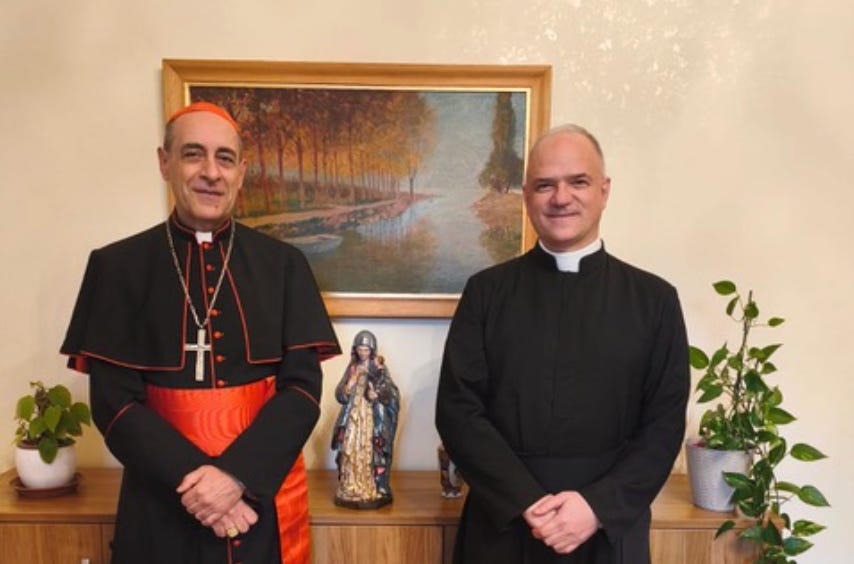
He presented five detailed reasons for doing so, outlining issues pertaining to the Second Vatican Council. “We both know in advance that we cannot agree doctrinally, particularly regarding the fundamental orientations adopted since the Second Vatican Council,” Pagliarani wrote. “This disagreement, for the Society’s part, does not stem from a mere difference of opinion, but from a genuine case of conscience, arising from what has proven to be a rupture with the Tradition of the Church.”
While Fernández had mentioned some dialogue regarding Vatican II, the SSPX wrote that the official interpretation of its documents had already been given – and such interpretation was troublesome: “The Second Vatican Council is not a set of texts open to free interpretation: It has been received, developed, and applied for sixty years by successive popes, according to precise doctrinal and pastoral orientations.”
As for what this interpretation is? The Society pointed to some of the most controversial documents issued by Pope Francis as the evidence, along with two texts by Pope John Paul II:
This official reading is expressed, for example, in major texts such as Redemptor hominis, Ut unum sint, Evangelii gaudium, or Amoris lætitia. It is also evident in the liturgical reform, understood in the light of the principles reaffirmed in Traditionis custodes. All these documents show that the doctrinal and pastoral framework within which the Holy See intends to situate any discussion has already been firmly established.
Pagliarani lamented how the Holy See had only acted to propose “dialogue” when the SSPX made a public plan for episcopal consecrations, opining that “the hand extended to open the dialogue is unfortunately accompanied by another hand already poised to impose sanctions.”
Accepting what Pagliarani described as an unchanging reality – “in the shared recognition that we cannot find agreement on doctrine, it seems to me that the only point on which we can agree is that of charity toward souls and toward the Church” – the priest made a request to Fernández for the SSPX’s future:
This same Society asks you only to be allowed to continue to do this same good for the souls to whom it administers the holy Sacraments. It asks nothing else of you—no privileges, nor even canonical regularisation, which, in the current state of affairs, is impracticable due to doctrinal divergences. The Society cannot abandon souls. The need for the sacraments is a concrete, short-term need for the survival of Tradition, in service to the Holy Catholic Church.
The Superior General made notable mention of his own efforts in recent years to engage in “dialogue” as far back as 2019, and sought also to make what was a thinly veiled argument warning, or urging, the Vatican not to invoke excommunications. “We can agree on one point: neither of us wishes to reopen wounds,” he wrote in a poignant phrase.
Closing his letter to Cdl. Fernández, Pagliarani demonstrated what has become trademark in his negotiating style – sincerity mixed with perhaps a lack of diplomatic awareness – when he invoked the title of Mediatrix of Graces: a title defended in Church teaching but recently attacked by Fernández himself: “It is a moment when we implore from Heaven a special grace and, from the Holy See, understanding. I pray for you in particular to the Holy Ghost and—do not take this as a provocation—His Most Holy Spouse, the Mediatrix of all Graces.”
In an accompanying article on the SSPX’s in-house news-site, the Society made a strong argument rejecting “any accusation of schism,” adding that “relying on all traditional theology and the Church’s constant teaching…an episcopal consecration not authorised by the Holy See does not constitute a rupture of communion—provided it is not accompanied by schismatic intent or the conferral of jurisdiction.”
Fernández met privately with Pope Leo XIV this morning after taking receipt of the SSPX’s letter, and so far no public response from the Holy See has been made, with confirmation of this coming from the Holy See Press Office on Thursday evening.
Shortly prior to the SSPX’s publication of their letter, the U.S. District Superior issued a prayer for their faithful to recite in the run-up to the episcopal consecrations. The prayer closes by invoking Mary as Co-Redemptrix, a title which the Society have been particularly defending after Mater Populi Fidelis, which itself seemed to be one of the final straws provoking their decision.
The Society’s announcement has naturally divided opinions in the Church, particularly among those devoted to tradition.
Their decision to turn down the Holy See’s dialogue proposal now means that a very long five months now lies before the planned consecrations.
But just 48 hours prior to the letter’s publishing, Bishop Athanasius Schneider urged the Pope to be more lenient when it came to responding to the issues raised by the Society. “I fear that this harsh behavior, this uncompromising and imprudent behavior of the Holy See towards the SSPX, may be made partly by those who are motivated by ideological reasons,” said Schneider, who was an official Apostolic Visitor to the Society on behalf of the Holy See in 2015.
“They don’t want the great number of faithful of the Society to be integrated in some way in the Church,” Schneider opined.
This story is developing. Further updates will be provided on Per Mariam and on X @MLJHaynes
Viva Cristo Rey! And Our Lady, Co-Redemptrix and Mediatrix of All Graces!
The SSPX consecrations may not be schismatic but these actions hardly work towards unity in the Church. In fact I suggest this is part of the US Doctrinal Warfare program founded in 1953 on the feast if St Peter and St Paul and indirectly targetting theCatholic Church. It was specifically designed to create schism and division in "Totalitarian thought patterns". Thr Coetus Patrum, all of whom had masonic epsicopal lineages did not block the liberal heresies being pushed at VII but allowed the documents to be written in such a way as to allow for a liberal AND a conservative interpretation leaving the post VII Church more divided. Then the Rockefellar Organisation funded Los Tecos who were a Mexican Catholic Right Wing secret organisation whose spiritual director Father Sáenz y Arriaga published the first Sedevacantist Thesis. From then Lefebvre dencounced the Council and Thuc after visiting Econe recast himself as a Traditionalist and began consecrating Bishops without jurisdiction. Lefebvre imitated this in 1988.
Neither Arriaga, Lefebvre nor Thuc acted in a Catholic manner which would have been to suffer meekly trustint in God' providence.
https://open.substack.com/pub/archbishoplefebvrewasafreemason/p/the-us-doctrinal-warefare-program