
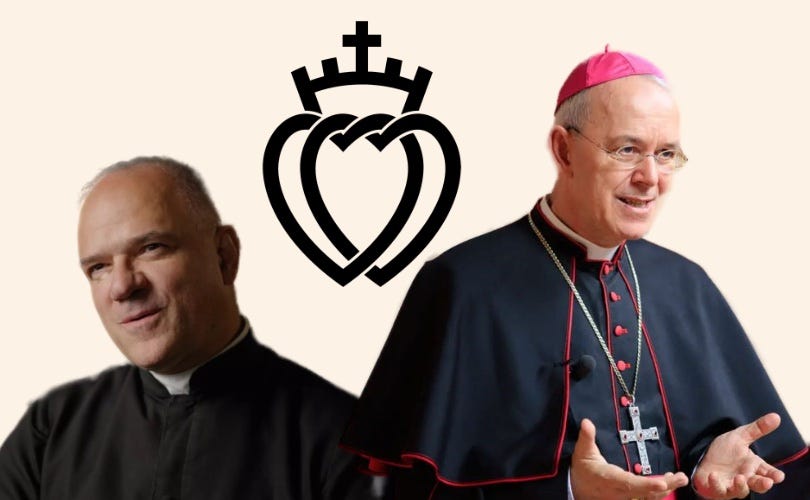
Bishop Schneider: SSPX ‘profess the Catholic faith’ & excommunication would be ‘unjust’
“When we read this declaration of faith, we must accept it if we are Catholics,” said Bishop Schneider of the SSPX's recent Declaration of Faith.

VATICAN CITY (PerMariam) — With the Society of Saint Pius X’s episcopal consecrations and the accompanying threatened excommunication now just over two weeks away, a prominent prelate has given advice on what position Catholics who attend the Society will be in.
“I think the faithful and the Society simply profess the faith of all times,” said Bishop Athanasius Schneider in a recent interview with journalist Matt Gaspers. “They profess it, accept the Pope, pray for him, and profess the Catholic faith. This is the minimum really required to be in communion.” (The full interview can be watched here)
Vatican warning and declaration of Catholicity
As it stands, the Holy See appears unlikely to change its stance regarding the SSPX and the planned episcopal consecrations. This means that, come the July 1 consecration date, the Holy See would deem that such consecrations without the papal mandate would incur “the excommunication established by the law of the Church.”
Cardinal Victor Manuel Fernández’s document from May 13 declares this, reading:
This act will constitute “a schismatic act” (John Paul II, Ecclesia Dei, n. 3) and “formal adherence to schism constitutes a grave offense against God and entails the excommunication established by the law of the Church” (ibid., 5c; cf. Pontifical Council for Legislative Texts, Explanatory Note, August 24, 1996).
The Society has expressed its intention to proceed with the consecrations, noting that “regrettably all the discussions entered into have remained without result, and none of the concerns expressed have received any truly satisfactory response.”
SSPX Superior General Fr. Pagliarani replied to Rome on behalf of the Society, publishing a Declaration of Faith in response to the Holy See’s threat of excommunication. The text, wrote Pagliarani, “seems to us to correspond to the minimum indispensable to be in communion with the Church, and to truly call ourselves Catholics and, consequently, your sons.”
This view is also held by Bp. Schneider, an authoritative voice on the matter given his experience as the Holy See’s official visitor to the Society under Pope Francis. “If this is not the minimum, then what shall the minimum be?,” he asked, referencing their recent Declaration of Faith and loyalty to the Pope.
“At the same time,” he observed, “the German synodal way and other bishops around the world openly proclaim heresies and permit blasphemies during liturgies, all unpunished and not corrected.”
The Society’s Declaration of Faith concludes by noting that “it is in this immutable Faith that we desire to live and die, in the hope that it may give way to the direct vision of the immutable eternal Truth.”
For Schneider, the SSPX’s Declaration is clearly Catholic: “When we read this declaration of faith, we must accept it if we are Catholics.” He added that “even all so-called traditional Ecclesia Dei communities and others who celebrate the traditional Latin Mass would, of course, accept this declaration, because it is Catholic. I cannot imagine that they would not accept it.”
What next for SSPX attendees?
Bishop Schneider has already opined to this correspondent that the Holy See’s excommunication would be invalid. “Therefore, I think that, if the excommunication would be applied, it would be in some way not valid because there is no intention to do a schismatic act on the side of the Society of Pius X, and you cannot be punished when you have not the intention to do it, according to the canon law,” he stated in March.
Bishop Schneider suggests Vatican excommunication of SSPX would not be valid

(Pelican+) — Bishop Athanasius Schneider, the Holy See’s former Apostolic Visitor to the Society of Saint Pius X, has opined that any excommunication which the Society may be handed following the upcoming episcopal consecrations would be invalid.
He reiterated this during the course of his interview with Gaspers. “To excommunicate those who profess this faith and repeatedly express that they recognize the Pope and want to serve the Roman Church would be unjust.”
In Schneider’s assessment, the SSPX consecrations are important in order to continue their activity and their very existence “because of a dilemma of conscience. Otherwise, if they do not carry out the consecrations, their work will come to an end, and this would be a damage to the entire Church.”
Such a comment touches on an issue which is often overlooked when the SSPX is debated. Far from being simply a question of access to the traditional Latin Mass, the Society’s concerns relate to widespread confusion emerging in doctrine and Church teaching – concerns which are broadly but more quietly shared across many members of the other Ecclesia Dei traditional communities in full communion with Rome.
These concerns relate to the Second Vatican Council, with Schneider viewing the SSPX as offering a key “theological contribution” in the necessary process of “clarifying, supplementing, and, if necessary, amending those statements in the texts of the Second Vatican Council that raise doctrinal doubts and difficulties.”
He highlighted how, due to the SSPX’s “uncompromising clarity in doctrine, liturgy, and priestly formation,” is thus “not welcomed by some authorities in Rome.” For Bp. Schneider, the issue boils down to the same thing: “the demand to accept Vatican II and the current path of the Church since the Second Vatican Council. This is the root of the problem, the core question.”
Earlier this year, Fr. Pagliarani attested that this the much cited state of necessity is worse than ever before – worse therefore than at the time of the 1988 episcopal consecrations – following Pope Francis’ pontificate.
Bp. Schneider appears to have agreed with Pagliarani, remarking previously about the Church’s internal crisis that “only divine intervention can help, such as through massive persecution of the Church and the person of the Pope himself by political, anti-Christian global elites.”
Bishop Schneider: ‘Only divine intervention can help’ Church crisis now

Referencing the “state of necessity” in the Church invoked by the Society of Saint Pius X, a prominent diocesan bishop has opined that “only divine intervention can help” in the face of the widespread internal ecclesial crisis.
The auxiliary bishop of Astana has been cautious not to directly or publicly advise the Society to perform the episcopal consecrations. However, he has defended their urgency in doing so, along with the rationale behind the move and the importance of such an action.
The SSPX exists “only as a work for the Church,” he noted, lamenting that “unfortunately, the authorities in Rome currently do not see or recognize this, probably because they desire a different style of Church, not the traditional one.”
Schneider suggested that this position of the Holy See was akin to the Avignon Exile, competing that “perhaps we are now in a sixty-year exile of clarity in doctrine and liturgy, and this will end.”
As things stand, neither the SSPX nor the Vatican appear any closer to resolving the doctrinal issues which led to the breakdown in negotiations. With the Holy See appearing deaf to Schneider’s repeated, public plea to approve the episcopal consecrations, it seems likely that a new and painful era in the Church will begin as of July 1.