


(PerMariam) — To mark the joyous feast of the Annunciation, Per Mariam is very happy to have a guest post from Father Thomas Crean O.P.
Father Thomas’ commentary on the Annunciation as recorded in St. Luke’s Gospel, is both succinct and rich in beauty. It is taken from his book “St Luke’s Gospel - A Commentary for Believers” published in 2021 by Arouca Press, and is reproduced here with kind permission of the author.
(Readers in the U.S. can purchase a copy here, while those in the U.K. can find it here)
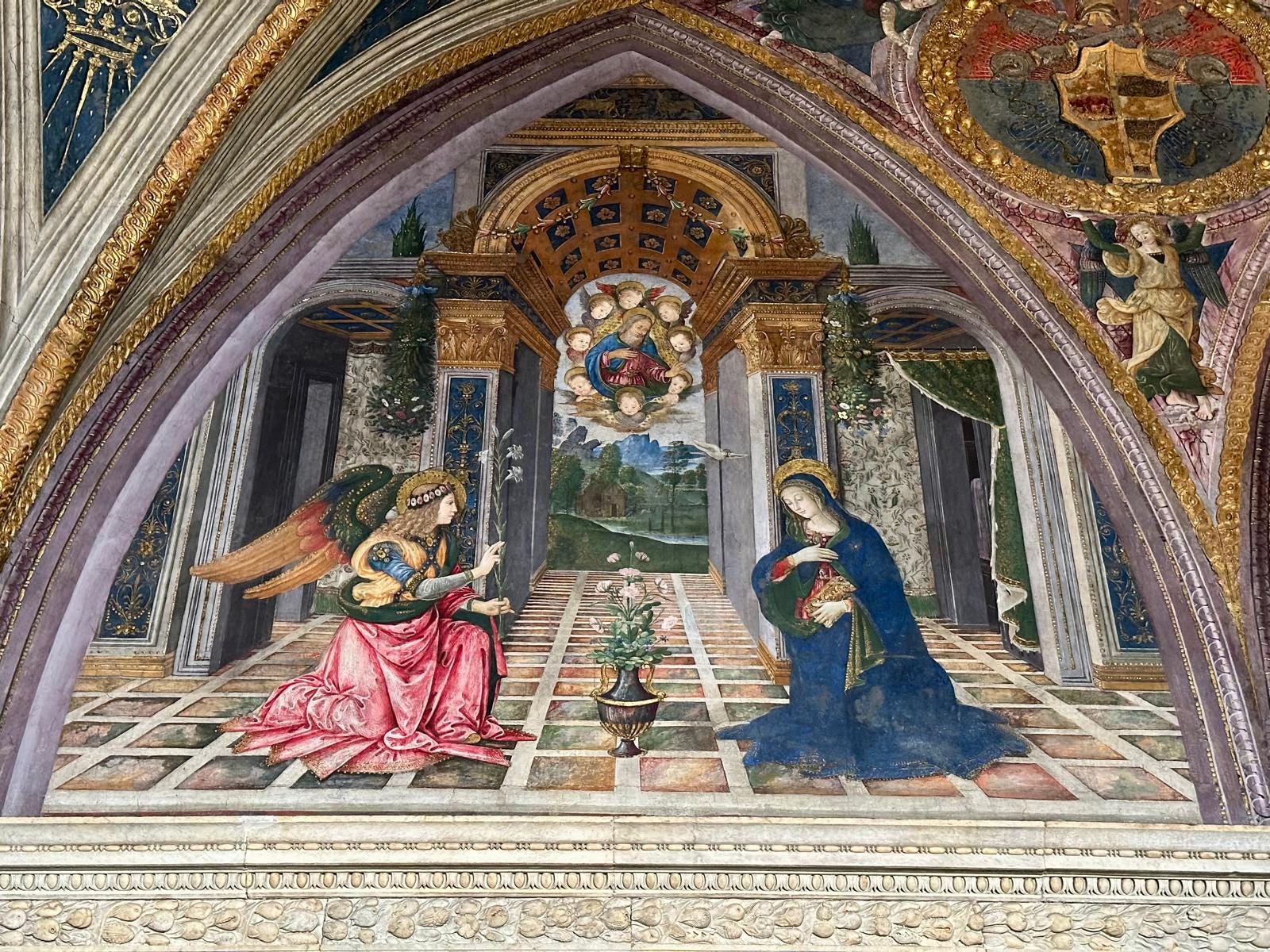
The relevant passages from St. Luke’s Gospel (1: 26-38) are presented first, before Fr. Thomas’ commentary afterwards:
And in the sixth month, the angel Gabriel was sent from God into a city of Galilee, called Nazareth, To a virgin espoused to a man whose name was Joseph, of the house of David; and the virgin’s name was Mary. And the angel being come in, said unto her: Hail, full of grace, the Lord is with thee: blessed art thou among women. Who having heard, was troubled at his saying, and thought with herself what manner of salutation this should be. And the angel said to her: Fear not, Mary, for thou hast found grace with God.
Behold thou shalt conceive in thy womb, and shalt bring forth a son; and thou shalt call his name Jesus. He shall be great, and shall be called the Son of the most High; and the Lord God shall give unto him the throne of David his father; and he shall reign in the house of Jacob for ever. And of his kingdom there shall be no end. And Mary said to the angel: How shall this be done, because I know not man? And the angel answering, said to her: The Holy Ghost shall come upon thee, and the power of the most High shall overshadow thee. And therefore also the Holy which shall be born of thee shall be called the Son of God.
And behold thy cousin Elizabeth, she also hath conceived a son in her old age; and this is the sixth month with her that is called barren: Because no word shall be impossible with God. And Mary said: Behold the handmaid of the Lord; be it done to me according to thy word. And the angel departed from her.
Extract from Fr. Thomas Crean’s “A Commentary for Believers”
The Blessed Virgin was already espoused, that is, married to St Joseph. If she is sometimes spoken of as simply ‘betrothed’ to him, this is to show the purity of their marriage. It is reasonable also to suppose that she was already living in the house of St Joseph, so that no imputations would be cast upon her once she had conceived her Child.
St Gabriel does not need to say to her, Fear not, as soon as he appears, as he had done to Zachary. Living in perfect union with the Creator, Mary is not frightened by the sight of one of His servants. He says, Fear not, only once he has greeted her with high praise. Since she lives habitually in the thought of her own nothingness before God, this praise was able to trouble her.
In speaking to St Joseph, the angel says that Jesus will save his people from their sins. Why does he not say this to our Lady? Perhaps because she had no sins, and thus he would have been saying something that was less pertinent to her. Instead, he tells her three times that her Son will be a king: He will have the throne of David, reign in the house of Jacob, and have dominion with no end. Implicit in this is the promise of her own queenship: in the Old Testament, which foreshadowed the New, it was always the mother of the king who was the queen.
Our Lady knew from the Scriptures that the Messias was to be born of a Virgin. Why then does she remind the angel of her vow of virginity, saying I know not man, as if this were a difficulty? Perhaps because the prophecy of Isaias had not said how the virgin would conceive and bear; perhaps too, so that the angel might ratify the word of the prophet. The Law taught that two witnesses were sufficient to establish any truth.
“The Holy which shall be born of thee”: we could also translate the angel’s words: “The one who shall be born of thee in a holy way”, and miraculously. In this way, the answer would correspond more closely to the question, as an assurance that not even in giving birth would she lose her virginity.
Mary did not doubt St Gabriel’s words, as Zachary had done. Therefore, he rewards her faith with a secondary proof: God’s power as manifested in Elizabeth’s conception. She does not need this proof, since her faith rests on the word of God alone: but it is a gracious gift to her.
In the Old Testament, the angel of the Lord departs from Gedeon and Manue with fire; from Mary he departs quietly, as befits a servant.

Great read 👍🏾✝️